Will Harrison: Rising Star of Broadway’s Punch & Tony Nominee 2026
Will Harrison: The Breakthrough Voice Turning Broadway’s Punch Into a Tony Nomination
From a mailman’s son in upstate New York to a Tony nomination alongside Nathan Lane, Daniel Radcliffe, and Mark Strong — the remarkable rise of one of American theatre’s most electric new performers.
Origins: A Mailman’s Son Who Found the Stage
There is nothing particularly theatrical about Will Harrison’s background — which is part of what makes his ascent to Broadway so compelling. Born in 1996 in Ithaca, New York, Harrison grew up in Hadley, Massachusetts, in a household that was, by his own description, far from the world of the arts. His father works as a mailman. His mother is a nursery school teacher. It is a modest, working-class upbringing, and the young Harrison was, by his own candid account, a restless, searching, somewhat reckless kid — not entirely unlike the character he would one day play to extraordinary critical acclaim on Broadway.
“I was a little aimless and getting in trouble from pushing the limits as far as I could push them,” Harrison told Broadway.com. “I was searching and bored and a bit of an adrenaline seeker.” It is a self-portrait that would strike any reader of his later press as deliciously ironic: the actor who became famous for portraying Jacob Dunne — a young man whose aimless aggression led to a fatal punch — found his way to the same destination through an entirely different route.
The route, in Harrison’s case, was the stage. His school had an unusually structured approach to arts education: two and a half hours each morning were dedicated to a specific subject, and at the end of every year, the class would mount a play based on that subject. Harrison got the bug immediately. “I just got obsessed with it,” he has said. “And it led me to doing summer Shakespeare.” His first significant role was in The Tempest. He went on to play the lead in Macbeth and, most formatively, to star in a high school production of Waiting for Godot — a play that would reset his entire understanding of what theatre could be.
“That was the best,” he said of Godot, “and it’s one of the first plays I read that I was like, ‘Oh, this is just ridiculous. This can be anything. If this is something that stood the test of time, then there are no rules.’ And that was really exciting.” It is the kind of formative theatrical encounter that marks a genuine artist rather than a casual enthusiast — the moment when the rules dissolve and the possibilities become infinite.
Carnegie Mellon: Sharpening the Instrument
Harrison’s path from high school Shakespeare to professional acting ran through one of the most rigorous conservatory programmes in the United States. He enrolled at the Carnegie Mellon School of Drama in Pittsburgh, graduating in 2019 with what he would describe as a deep, bone-level understanding of theatrical craft — the kind of foundational technical grounding that, as he would later note with some amusement, is what drew him back to the stage even after his screen career began to take off.
Carnegie Mellon’s drama programme is consistently ranked among the very best in the country. Its alumni include Ted Danson, Blair Underwood, Saoirse Ronan, and Josh Groban — performers who share Harrison’s combination of technical rigour and genuine emotional range. The conservatory model prioritises craft over personality: students are trained to understand the physical, vocal, and intellectual demands of performance rather than simply to project their own charisma. For a young actor with Harrison’s restless intelligence, it was the ideal environment.
“The theatre is how I got into acting,” Harrison told The Hollywood Reporter, reflecting on what the discipline meant to him even after his first screen success. “It’s how most young people do, and it really centres me and gives me an ownership of the work more than film or TV.” That sense of ownership — of a performer who knows exactly where his craft comes from and what it requires — would become one of the defining qualities of his eventual Broadway debut.
He graduated from Carnegie Mellon in 2019, just months before the pandemic shut down both Broadway and most of the American film and television industry. The timing was brutal for an entire generation of newly graduated drama school students, but Harrison found his way through the closure period and emerged, when the industry reopened, with a formidable screen career already beginning to take shape.
Screen Breakthrough: Daisy Jones, Manhunt, and Chasing Bob Dylan
Will Harrison’s screen career began with the kind of debut that most actors spend years trying to engineer. His first professional credit was as Graham Dunne — a member of the fictional rock band at the centre of the story — in Amazon Prime Video’s Daisy Jones & the Six (2023), the limited series adaptation of Taylor Jenkins Reid’s bestselling novel about the rise and implosion of a Fleetwood Mac-adjacent 1970s band. The series starred Riley Keough and Sam Claflin in the lead roles, and it became one of the most talked-about streaming events of its year, introducing Harrison to a substantial global audience.
The role required Harrison to inhabit the world of 1970s rock with total physical and musical conviction — a challenge that suited his combination of natural energy and trained discipline. The show was a critical success and a streaming phenomenon, and Harrison’s performance announced him as a face to watch.
He followed it with another high-profile limited series: Apple TV+’s Manhunt, in which he played David Herold, the young accomplice of John Wilkes Booth in the days following the assassination of Abraham Lincoln. Opposite Anthony Boyle and Tobias Menzies, Harrison brought a compelling mixture of youthful impulsiveness and creeping dread to a role that required him to navigate one of the most dramatic episodes in American history with precision and sensitivity.
Then came the project that, more than anything else, drew Harrison to the attention of the broader Hollywood and theatrical community: James Mangold’s Oscar-nominated biographical drama A Complete Unknown (2024), in which Timothée Chalamet stars as Bob Dylan. Harrison plays Bobby Neuwirth, the folk singer and Dylan confidant who served as one of the young Dylan’s most important early allies. The film received Academy Award nominations and widespread critical acclaim, and Harrison’s performance — opposite Chalamet, Edward Norton, and Elle Fanning — confirmed that he was operating at a level well beyond what might be expected of a relative newcomer.
Most recently, Harrison played Buster Murdaugh in Hulu’s true-crime limited series Murdaugh: Death in the Family, opposite Patricia Arquette as his mother and Jason Clarke as his father. The series, based on the South Carolina legal dynasty’s spectacular collapse, gave Harrison yet another opportunity to inhabit real people in real events — a recurring theme in his early career that would find its most profound expression on the Broadway stage.
I think I initially underestimated how good it would feel just to return to that thing that I know in my bones more than anything. And at a place like Lincoln Center. Going to work there every day is a total dream.
Will Harrison on returning to the stage, Broadway DirectOff-Broadway: The Coast Starlight at Lincoln Center
Before he arrived on Broadway, Harrison made his New York stage debut in a production that served as both a personal homecoming and a professional statement of intent. In 2023, he played the lead role of T.J. in Keith Bunin’s play The Coast Starlight at Lincoln Center Theater, directed by Tyne Rafaeli.
The Coast Starlight — named for the Amtrak route that runs the length of the Pacific coast — is a play about strangers thrown together on a long train journey, each carrying the weight of their own private losses and uncertainties. Harrison’s role demanded exactly the qualities that his screen work had demonstrated: the ability to be simultaneously guarded and transparent, to suggest an interior life that is constantly in tension with the exterior one being presented to the world.
The production was well received and gave Harrison his first taste of the particular demands of New York stage work: the nightly repetition, the live audience, the collaborative urgency of a theatrical ensemble. He has spoken warmly about the experience. “It always has been a huge goal,” he told Broadway Direct. “You do so much theater in high school and in college that the mystery of film and television is kind of calling you. But then when the opportunity came around to do that show, I think I initially underestimated how good it would feel just to return to that thing that I know in my bones more than anything. And at a place like Lincoln Center. Going to work there every day is a total dream.”
The Lincoln Center production was, in retrospect, a crucial stepping stone — the Off-Broadway production that caught the right eyes and confirmed that Harrison’s stage instincts were every bit as sharp as his screen work suggested. When the opportunity to audition for Punch arrived in his inbox the following year, he was ready.
Broadway Debut: James Graham’s Punch
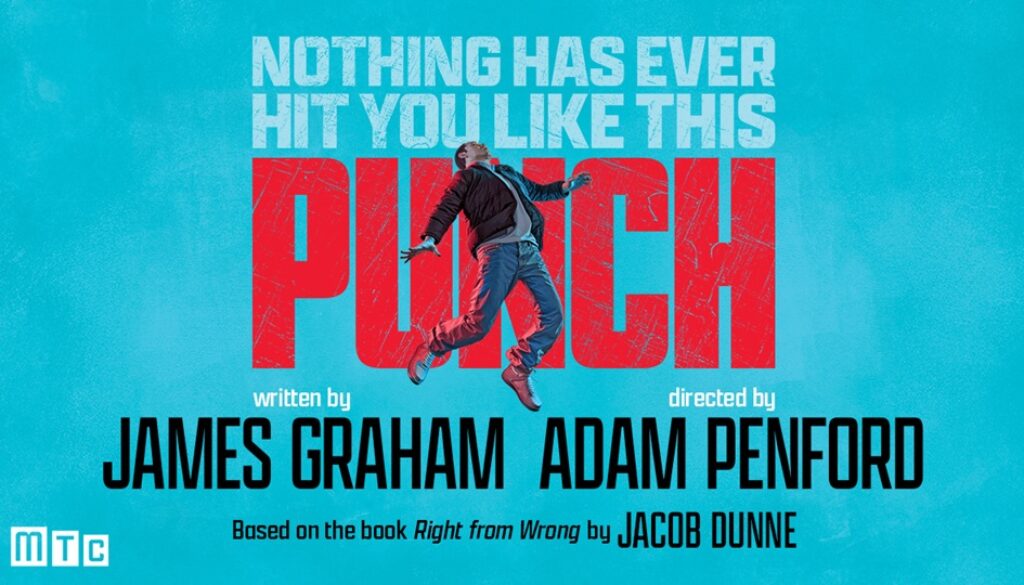
Punch is a play by the two-time Olivier Award-winning British playwright James Graham — best known in the United States for his Broadway production Ink (about Rupert Murdoch’s early tabloid career) and for Dear England, his acclaimed play about England football manager Gareth Southgate, which sold out the National Theatre in 2023. Punch was adapted from Jacob Dunne’s memoir Right from Wrong: My Story of Guilt and Redemption, and it tells the true story of what happened on a Nottingham street in 2011 and the extraordinary human journey that followed.
On that night, a nineteen-year-old named Jacob Dunne — drunk, drugged, and primed for trouble — landed a single punch on a man named James Hodgkinson outside a pub. Hodgkinson, a trainee paramedic who was out with his father to watch a cricket match, hit the ground hard. Nine days later, he was dead. Jacob Dunne was convicted of manslaughter and sent to prison.
The play does not end there — nor does Dunne’s story. What makes Punch remarkable is what came next: Dunne’s participation in a restorative justice programme that, improbably and painfully, brought him face to face with James Hodgkinson’s parents, Joan and David. The play’s dramatic and emotional peak is the encounter between these three people: an exchange so raw, so carefully earned, and so unlike anything conventionally available in the theatre of punishment and retribution, that critics reached for the word “extraordinary” across the board.
The American premiere of Punch was presented by Manhattan Theatre Club at the Samuel J. Friedman Theatre, opening on 29 September 2025, with the production running until 2 November 2025. It was directed by Adam Penford, Artistic Director of Nottingham Playhouse, the venue where the play had its world premiere in 2024. The cast featured Victoria Clark (two-time Tony winner) and Sam Robards as the victim’s parents Joan and David, with Camila Canó-Flaviá, Cody Kostro, Piter Marek, and Lucy Taylor in supporting roles.
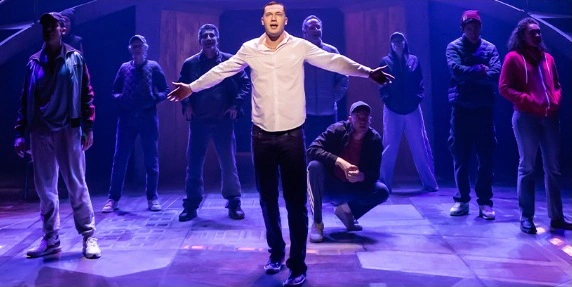
At the centre of it all was Harrison, in what is an extraordinary physical and emotional undertaking: a role that keeps its performer on stage for almost the entirety of the play’s two and a half hours, demanding he embody two distinct versions of the same man — the volatile, destructive nineteen-year-old and the chastened, searching adult he becomes — while simultaneously narrating the story to the audience and navigating scenes of intense dramatic confrontation.
Harrison prepared for the role with characteristic thoroughness. He was not able to see the original Nottingham Playhouse production in person, but watched an archival recording at the director’s suggestion. More significantly, he travelled to Nottingham to spend a day with Jacob Dunne himself — visiting the locations where the events took place and gaining an understanding of the real man that gave his performance its particular moral gravity. The real Jacob Dunne cannot travel to the United States due to his status as a convicted felon, meaning he was unable to attend the Broadway production.
I got to spend the day with Jacob, which was amazing, and getting that time with him gave me the freedom to really go for it onstage. It’s a traumatic event to relive over and over again. It’s such a sensitive thing, and to know that you have the blessing of the people who are closest to it is really important. It’s what gives you permission to go all out.
Will Harrison, The Hollywood ReporterWhat the Critics Said: Harrison’s Performance in Punch
The critical response to Harrison’s Broadway debut was, in a word, electric. Across a field of largely positive-to-mixed reviews for the production itself, Harrison’s performance was singled out — again and again, in publication after publication — as the undeniable centrepiece of the evening. Here is what the major outlets had to say.
Among the notable visitors to the production was Timothée Chalamet — Harrison’s co-star from A Complete Unknown — who came backstage after a performance, a moment documented in photographs that circulated widely in theatrical press coverage. Former First Lady Dr. Jill Biden also visited the cast backstage, a further indication of the cultural resonance the production achieved during its run.
Tony Nominated: Best Actor in a Leading Role in a Play
Will Harrison is nominated for his performance as Jacob Dunne in Manhattan Theatre Club’s Broadway production of Punch. He is the sole nominee from Punch, which received just one Tony nomination overall — making his recognition all the more striking given the company he keeps in the category.
Full category nominees:
- Will Harrison — Punch
- Nathan Lane — Arthur Miller’s Death of a Salesman
- John Lithgow — Giant
- Daniel Radcliffe — Every Brilliant Thing
- Mark Strong — Oedipus
The nomination landed on 5 May 2026, announced by Uzo Aduba and Darren Criss, and it immediately sparked discussion in theatrical circles. Punch had already closed — its run ended on 2 November 2025 — but the nominating committee, whose 55 members are appointed by the Tony Awards Administration Committee, had clearly been moved by what they witnessed at the Samuel J. Friedman Theatre.
As Variety observed, Harrison’s inclusion gives the category something rare and valuable: “His inclusion makes the race feel less like a celebrity coronation and more like a true performance category.” The point is well taken. Nathan Lane, John Lithgow, Daniel Radcliffe, and Mark Strong are four of the most recognisable and celebrated actors working in the English-speaking theatre today. Lane’s nomination for Death of a Salesman extends a remarkable chain of Tony-recognised portrayals of Willy Loman stretching back fifty years. Lithgow is a six-time Tony winner. Radcliffe won the Tony in 2024 for Merrily We Roll Along. Strong’s stage work at the National Theatre and on the West End has earned him a reputation as one of the finest actors of his generation.
And yet Harrison is there alongside all of them — at 29, in his Broadway debut, representing a production from Manhattan Theatre Club rather than a commercial blockbuster — because the Tony nominating committee, in its 55-member wisdom, decided that what he did in Punch demanded recognition on Broadway’s highest stage. It is a nomination that speaks, in the most eloquent possible terms, to the quality of what Harrison brought to the Samuel J. Friedman Theatre every night for thirty-eight performances.
The ceremony takes place on 7 June 2026 at Radio City Music Hall. It will be hosted by P!NK and broadcast live on CBS.
Career at a Glance: The Full Credits Timeline
Completes his BFA in Drama, equipped with the technical and conceptual grounding he will draw on throughout his career.
Professional debut as Graham Dunne, a member of the fictional 1970s rock band at the centre of this acclaimed limited series based on Taylor Jenkins Reid’s bestselling novel. The show becomes one of the most-watched streaming events of the year.
New York stage debut in the lead role of T.J. in Keith Bunin’s play, directed by Tyne Rafaeli. The production marks his return to theatre after his screen career begins to gather momentum, and confirms that the stage remains, for Harrison, the primary home of his craft.
Stars as David Herold, accomplice to John Wilkes Booth in the aftermath of Abraham Lincoln’s assassination. Opposite Anthony Boyle and Tobias Menzies in a critically praised limited series.
Plays Bobby Neuwirth, folk singer and Bob Dylan confidant, opposite Timothée Chalamet in James Mangold’s acclaimed Bob Dylan biopic. The film receives multiple Academy Award nominations. Harrison’s performance further raises his profile on both sides of the Atlantic.
Stars as Buster Murdaugh, eldest son of the disgraced South Carolina lawyer Alex Murdaugh, opposite Patricia Arquette and Jason Clarke in this true-crime drama.
Makes his Broadway debut as Jacob Dunne in James Graham’s Punch, directed by Adam Penford. The production runs 28 previews and 38 performances and closes 2 November 2025. Harrison’s performance is unanimously praised as one of the outstanding Broadway debuts of the decade.
Nominated for his performance in Punch. He is the sole nominee from the production, competing alongside Nathan Lane, John Lithgow, Daniel Radcliffe, and Mark Strong. The nomination is announced on 5 May 2026. The ceremony takes place on 7 June 2026 at Radio City Music Hall.
The Person Behind the Performance: What Makes Will Harrison Different
What emerges from every profile, interview, and critical notice about Will Harrison is a portrait of an actor who is, in the best possible sense, unafraid. Unafraid to take on roles that demand physical and emotional extremity. Unafraid to return to the stage even when a screen career is already gaining considerable momentum. Unafraid to inhabit real people — Jacob Dunne, Bobby Neuwirth, David Herold, Buster Murdaugh — with the kind of specificity and respect that their real lives demand. And unafraid, most importantly, to be wrong in public: to throw himself at the opening monologue of a Broadway audition tape by jumping on his couch, only to be told, gently, that perhaps a little less flouncing was in order.
That last anecdote — from his Hollywood Reporter interview about the audition process for Punch — reveals something important about Harrison’s temperament. He is a performer who goes all out and then listens; who brings maximum commitment to every attempt and then incorporates the feedback without ego or defensiveness. It is a quality that his co-stars on Punch clearly recognised and valued. “They have been so kind and helpful,” he said of two-time Tony winner Victoria Clark and the veteran Sam Robards, who flanked him in the production. “They’ve led by example and they really kind of elevate the whole company with their experience.”
One of the most telling details in Harrison’s background is his identification with the very character whose story he told on Broadway. Not in the criminal dimension — he is at pains to distinguish his own more sheltered upbringing from Dunne’s more dangerous one — but in the emotional register: the restlessness, the adrenaline-seeking, the sense of being a young person with enormous energy and insufficient direction. “There are so many similarities between us,” he has said. It is the kind of personal investment in a role — the kind of autobiographical resonance that an actor brings to a part without exploiting it — that lifts a performance from the merely excellent into the genuinely unforgettable.
Harrison’s work in Punch was also, in the truest sense, a form of public service. The play is dedicated to James Hodgkinson and to all victims of one-punch violence — a form of casual, impulsive brutality that kills or catastrophically injures hundreds of people every year in the UK and beyond. Harrison’s nightly embodiment of Jacob Dunne’s journey from perpetrator to seeker of redemption put a human face — a specific, particular, achingly real human face — on a phenomenon that statistics and newspaper reports can only partially illuminate. That the Tony nominating committee recognised and honoured that work is a testament not only to Harrison’s artistry but to the committee’s own understanding of what the theatre is capable of doing.
What Comes Next: The Future of a Tony-Nominated Star
Will Harrison is 29 years old, and he has already done more in his career than most actors manage in decades. He has appeared in an Oscar-nominated film, anchored two major streaming limited series, made his Off-Broadway debut at Lincoln Center, delivered one of the most celebrated Broadway debuts of recent years, and earned a Tony nomination in a category that includes some of the most respected actors on the English-speaking stage. By any measure, the trajectory is extraordinary.
What comes next is, genuinely, an open question — which is part of what makes Harrison so interesting to watch. He has demonstrated a range that defies easy categorisation: rock musician, historical villain, presidential assassin’s accomplice, Murdaugh son, and now the dual Jacob Dunne — the volatile teenager and the seeking adult. He has proven himself equally at home on screen and on stage. He has the training, the instincts, and, clearly, the personal depth to make the biggest challenges in acting look not effortless — because nothing great is effortless — but inevitable.
Whether or not he takes home the Tony on 7 June, Will Harrison has already won something more durable than an award: the recognition of the theatre community that his is a talent worth following, a voice worth listening to, and a presence worth seeking out — on whatever stage, screen, or page he chooses to inhabit next.
Whether running around the stage with kinetic, barely pent-up energy or cowering on the floor, seemingly terrified of having to find the right words to explain himself, Will Harrison makes one of the most impressive Broadway debuts in recent history.
Brian Scott Lipton, Cititour