Carrie Coon: Tony Nominated for Bug on Broadway 2026
Carrie Coon: The Motion-Capture Artist from Ohio Who Became Broadway’s Most Fearless Actress — and Why Bug Is the Performance of Her Career
From doing motion-capture work for video games to pay the bills, to four Emmy nominations and two Tony nominations — Carrie Coon’s decade-long slow burn is one of the great stories of American acting. And her return to Broadway in her husband Tracy Letts’ darkest, strangest play is the crown of it all.
Copley, Ohio: An Unlikely Beginning for a Theatrical Legend
Carrie Coon did not grow up in a theatre family. She was born on 24 January 1981 in Copley, Ohio — a small suburban community outside Akron, in the part of America that the coastal entertainment industry barely acknowledges exists. Her parents were not in the arts. There was no obvious pipeline from Copley to a Tony Award nomination. And yet, as Coon’s career demonstrates repeatedly, the pipeline was always there — it just required unusual levels of patience, determination, and willingness to do whatever work was available while waiting for the work that mattered.
Her first serious encounter with theatre came as a freshman at the University of Mount Union in Alliance, Ohio, where she was studying English and Spanish. She has described the experience in several interviews: she auditioned for the university’s theatre department production of A Midsummer Night’s Dream on a whim, found herself cast, and was entirely and permanently hooked. The discovery arrived not as a gradual dawning but as the kind of instantaneous recognition that defines a vocation: this was the thing she was supposed to be doing. She was seventeen years old.
She graduated from Mount Union with a BA in English and Spanish — the rigorous liberal arts foundation that would inform the particular quality of intellectual engagement she brings to every role she plays. Then came the step that separates serious practitioners from enthusiastic amateurs: she enrolled in the MFA Acting programme at the University of Wisconsin–Madison, one of the most respected graduate training programmes in the United States, from which she graduated in 2006.
The years between graduation and her eventual breakthrough are worth dwelling on, because they tell you everything you need to know about Coon’s character. She began her professional stage career at the Madison Repertory Theatre, close to her university, and performed motion-capture work for a local video game company to supplement her income. She commuted between Chicago and Wisconsin for several years, working at the Madison Repertory Theatre, the American Players Theatre (where she spent four seasons), and various Chicago venues including the Remy Bumppo Theatre Company. She did this for the better part of a decade — building craft, building range, building resilience — before her big break arrived.
Chicago and the Steppenwolf Years: Where the Career Was Built
Coon relocated to Chicago in 2008, and the city’s extraordinarily rich theatrical ecology became the environment in which her talent found its fullest expression before she was known anywhere beyond the Midwest. Chicago’s theatre scene — anchored by institutions like Steppenwolf, the Goodman, the Court Theatre, and Writers’ Theatre — is one of the few theatrical communities in the United States that genuinely rivals New York for the quality and ambition of its work. For an actress of Coon’s discipline and range, it was the ideal incubator.
Her Chicago credits from this period include Brontë at Remy Bumppo Theatre Company (2009), Magnolia at the Goodman Theatre (2010), and The Real Thing at Writers’ Theatre in Glencoe (2011) — Tom Stoppard’s demanding comedy of love and authenticity, in which she played the sensual, mercurial object of desire. Each of these productions added a new dimension to a performer rapidly becoming one of the most versatile in the city.
The decisive moment came in 2010, when she was cast as Honey in the Steppenwolf Theatre Company‘s production of Edward Albee’s Who’s Afraid of Virginia Woolf?, directed by Pam MacKinnon. Honey is the naive, drunk, childlike wife whose evening of dissolution alongside the volcanic George and Martha serves as both a mirror and a counterpoint to their spectacular self-destruction. It is a role that requires a particular kind of courage: the willingness to play weakness and desperation without sentiment, to commit to ugliness without vanity. Coon did all of this with an emotional rawness that stopped the Chicago theatrical community in its tracks.
The production subsequently toured to Washington, D.C., and then to New York — where Coon would make her Broadway debut. She has been a Steppenwolf ensemble member since 2019, one of only a small group of performers invited into the company’s inner circle, and the institution has been the theatrical home base she returns to between her increasingly distinguished screen commitments. The Steppenwolf production of Bug — which she originally performed in Chicago in 2020 and 2021, before bringing it to Broadway in 2026 — is the most recent and most consequential chapter of that long institutional partnership.
Broadway Debut and First Tony Nomination: Who’s Afraid of Virginia Woolf? (2012)
When the Steppenwolf production of Who’s Afraid of Virginia Woolf? transferred to Broadway’s Booth Theatre in October 2012, it brought with it an extraordinary ensemble: Tracy Letts — the Pulitzer Prize- and Tony Award-winning playwright who had written August: Osage County — as George; Amy Morton as the ferocious Martha; Madison Dirp as Nick; and Carrie Coon as Honey. The production was directed by Pam MacKinnon, and it ran from 13 October 2012 through 3 March 2013.
The critical reception was overwhelming. The production won the Tony Award for Best Revival of a Play, the Tony Award for Best Direction (MacKinnon), and the Tony Award for Best Actor in a Play (Letts). Coon herself received a Tony Award nomination for Best Featured Actress in a Play — her first Tony nomination, arriving in her Broadway debut — and won the Theatre World Award for the performance. It was a remarkable entrance: a debut that announced an actress at the very highest level of American stage performance.
The production also began the personal partnership that would define the next decade of her life. Letts and Coon, who had met through the Steppenwolf production, were by the time of the Broadway run in a committed relationship. They married in 2013 — a union that brought together two of the most gifted theatrical artists of their generation, whose creative and personal lives have since been intertwined in ways both public and profound. Their son Haskell Letts was born in 2018; a second child followed in 2021.
Off-Broadway and Beyond: Placebo, Mary Jane and the Theatrical Commitment
Even as Coon’s screen career began to build momentum after her Broadway debut and Tony nomination, she maintained a sustained commitment to the stage that distinguishes her from many screen actors who treat the theatre as an occasional prestige accessory. Her Off-Broadway credits from the period between her first and second Broadway appearances are a catalogue of serious, ambitious work at New York’s finest institutional venues.
In early 2015, she starred in the lead role of Placebo at Playwrights Horizons — a production that drew strong notices and confirmed that her 2012 Broadway debut had not been a lucky single performance but the expression of a consistent and serious theatrical identity. She also appeared at the New York Theatre Workshop in Mary Jane, Amy Herzog’s intimate and devastating play about a mother caring for a chronically ill child — a role that required everything she had learned about sustaining emotional truth over a full evening, and that critics agreed she delivered with extraordinary depth.
She participated in multiple readings and workshop productions during this period, including early engagement with Tracy Letts’s Mary Page Marlowe — a play in which six actresses portray the same woman at different stages of her life — which she eventually performed in the Steppenwolf production in Chicago from March to May 2016. Her commitment to the developmental work of new American playwriting, as well as to classic repertoire, reflects the depth of her identification with the theatre as an artistic home rather than a career adjunct.
The Screen Career: Gone Girl, The Leftovers, and the Emmy Nominations That Changed Everything
Coon’s screen career began modestly — a small role in the short-lived NBC series The Playboy Club in 2011, guest appearances on Law & Order: SVU, Ironside, and Intelligence. But 2014 was the year that everything changed, and it changed twice in the same twelve months.
The first change was her casting as Margo Dunne — the twin sister of Ben Affleck’s suspected wife-murderer — in David Fincher’s adaptation of Gillian Flynn’s Gone Girl. Released in October 2014, the film was a phenomenon, and Coon’s performance in a pivotal supporting role was immediately recognised as one of the film’s greatest assets: dry, funny, loyal, and finally horrified in a way that grounded the film’s elaborate thriller mechanics in human authenticity.
The second, more sustaining change was her casting as Nora Durst in HBO’s The Leftovers (2014–2017), Damon Lindelof’s adaptation of Tom Perrotta’s novel about a community grappling with the inexplicable disappearance of two percent of the world’s population. Nora Durst is one of the great television roles of the past decade: a woman whose entire family disappeared in the Sudden Departure, who is now doing the impossible work of continuing to live. Coon’s portrayal — combining grief, dark humour, ferocious intelligence, and an almost suicidal emotional directness — earned her a Critics’ Choice Television Award and is widely regarded as one of the finest sustained dramatic performances in American television history. Her final scene in the series’ third season remains one of the most discussed and debated scenes in prestige television.
This was followed by an Emmy nomination for Best Actress in a Limited Series for her role as the dogged sheriff Gloria Burgle in the third season of Fargo (FX, 2017) — one of the most purely satisfying performances of her career, blending deadpan comedy with genuine moral seriousness in the Coen Brothers register that the show inhabits. She then appeared as the supernaturally determined social climber Bertha Russell in HBO’s The Gilded Age (2022–present), a role that earned her a second Emmy nomination — this time for Best Actress in a Drama Series — as well as a Screen Actors Guild Award nomination.
Most recently, she delivered perhaps her most celebrated screen performance yet as Laurie Duffy in the third season of Mike White’s The White Lotus (HBO/Max, 2025) — a role that earned her a third consecutive Emmy nomination, this time for Best Supporting Actress. IMDB’s reviewer called her “an invigoratingly versatile actor and an arresting presence regardless of her character’s demeanour,” and noted that she is “one of the most sought-after actors for the kinds of roles reserved for performers who have that extra oomph factor.”
Her film credits in this period include Avengers: Infinity War (2018) as Proxima Midnight, Ghostbusters: Afterlife (2021) and its sequel Ghostbusters: Frozen Empire (2024) as Callie Spengler, and the acclaimed independent drama His Three Daughters — a film that brought her the kind of serious critical attention for screen work that her stage performances had generated for years.
I feel because Bug is so edgy and so dark and work has gotten so commercial, that this is a real f*** you in a way, and I think we need it. We’re in a pendulum swing where art needs to get gross and dark and ugly and irreverent.
Carrie Coon, The New York Times, 2026Bug on Broadway: Letts’ Cult Thriller Gets Its Long-Overdue Main Stem Debut
Bug is not a comfortable play. It is not the kind of work that offers an audience the pleasures of refined craft at a comfortable distance. It is — as its playwright, Coon’s husband Tracy Letts, has described it — a piece that is scary and funny and intimate and involving, a sorcery of theatrical engagement that can only happen in live performance. Its arrival on Broadway, thirty years after Letts first wrote it and twenty-two years after its first New York production, is one of the most anticipated theatrical premieres of the 2025-26 season.
The play was first staged in London in 1996 and received its American premiere Off-Broadway at the Rattlestick Playwrights Theater in New York in 2004 — where the New York Times critic Ben Brantley described it as “obscenely exciting.” It was subsequently adapted into a film by William Friedkin in 2006, starring Ashley Judd, Michael Shannon, and Harry Connick Jr. The Steppenwolf Theatre Company produced the definitive staging in Chicago in 2020, directed by Tony Award-winner David Cromer and starring Coon — before the COVID pandemic interrupted and then revived the run in late 2021. It is this Steppenwolf production, with the same cast, that transferred to Broadway.
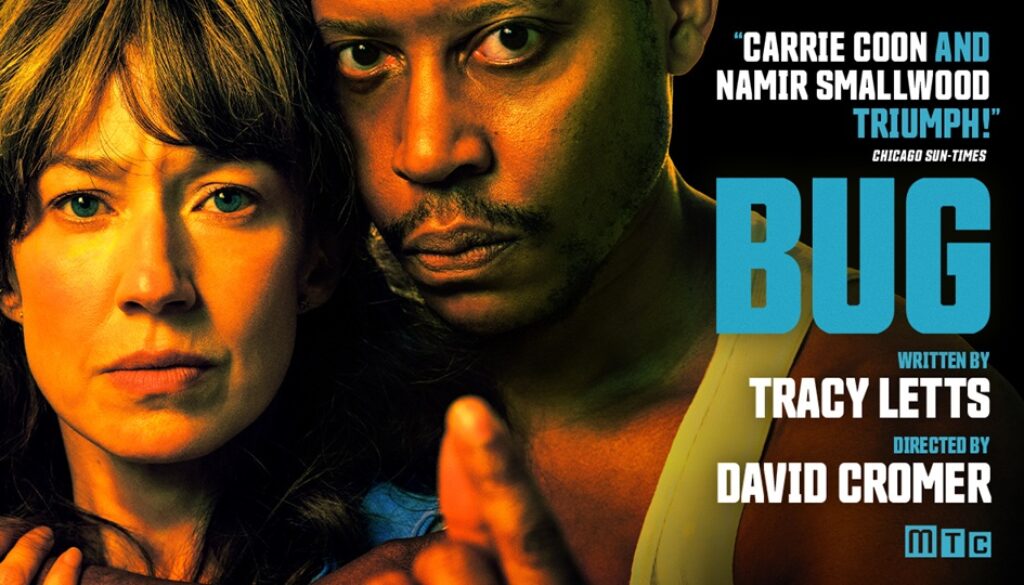
Bug is set in a seedy Oklahoma motel room. Agnes White (Coon) is a cocktail waitress living out of the room, isolated, haunted by the disappearance of her young son and the threat of her abusive ex-husband Jerry (Steve Key). Her friend R.C. (Jennifer Engstrom) brings by a quiet, polite drifter named Peter Evans (Namir Smallwood) — a Gulf War veteran who is, at first, exactly what the desperately lonely Agnes needs. They connect. They sleep together. Deeper feelings develop. And then Peter begins to confide his fears: that the military has implanted bug larvae in his body, that the government is conducting experiments on him, that the motel room is infested with microbugs that can be seen if you look hard enough.
What makes Bug so theatrically powerful — and so deeply unsettling — is the question it refuses to answer: is Peter delusional, or is he right? And what does it say about Agnes — about her loneliness, her desperation, her need to believe in something, anything — that she begins to see the bugs too? The play is a diagnosis of the contagious nature of conspiracy thinking, written in 1996, which now feels almost eerily prophetic in an era saturated with disinformation, viral paranoia, and the frightening ease with which isolated individuals can find communities of mutually reinforcing delusion.
The production is presented by Manhattan Theatre Club in association with Steppenwolf Theatre Company at the Samuel J. Friedman Theatre, 261 West 47th Street. It features scenic design by Takeshi Kata (Tony-nominated), lighting design by Heather Gilbert (Tony-nominated), and sound design by Josh Schmidt (Tony-nominated) — a creative team whose work collectively received three of the production’s four Tony Award nominations. The production is notable for its phone-free policy: all audience members must lock their phones in Yondr pouches for the duration of the performance, a decision that creates an unusually concentrated, communal theatrical experience entirely appropriate to the play’s themes of paranoia and surveillance.
Coon as Agnes: The Fearless Performance at the Heart of the Production
Playing Agnes White in Bug asks things of an actress that most roles do not. It asks for the complete abandonment of vanity — for a performance that is physically raw, emotionally unglamorous, and ultimately terrifying. It asks for the ability to chart a human being’s descent into delusion not as a sudden break with reality but as a gradual, almost logical progression, in which each step makes psychological sense even as the destination becomes more and more horrifying. It asks for the specific courage of an actress willing to be seen at her worst, her most desperate, her most completely stripped of the social performances that constitute ordinary human self-presentation.
That Carrie Coon is uniquely qualified for all of these demands is, by this point in her career, not exactly a surprise. The actress who played Nora Durst’s grief without sentimentality, who found the black comedy in Gloria Burgle’s Midwestern doggedness, who makes Bertha Russell’s social ambition feel simultaneously ridiculous and genuinely poignant — this is an actress who has never, in any role, retreated behind the comfort of likability. Agnes White is not likable. She is lonely and frightened and damaged. And in Coon’s hands, she is fully, recognisably, devastatingly human.
The Wall Street Journal’s Charles Isherwood noted simply that Coon “is unleashed from her corsets — and every other stitch of clothing” — a reference to the production’s nudity that also captures something essential about the quality of exposure Coon brings to the role. The New York Theatre Guide described her as delivering “a compellingly raw performance marked by emotional and physical boldness.” The New York Post’s Johnny Oleksinski called her simply “terrifying.” The New York Times noted that the play is “obscenely exciting” — the same language Brantley used for the original production two decades ago, now applied to a performance that has given the material a new and urgent contemporary resonance.
In her statement on receiving the Tony nomination, Coon was characteristically direct and generous: “I am grateful to be counted among such luminaries as my friend Kelli O’Hara, the truly gifted Rose Byrne, an astonishing Susannah Flood, and the legendary Lesley Manville. I’m also thrilled for my BUG design team, who made a difficult job look deceptively simple.”
At the Tonys nominees luncheon on 14 May 2026, she was equally candid when asked whether she felt she was experiencing a career high point. She declined to frame the moment as triumphant, offering instead what Variety described as the luncheon’s most honest answer. The specifics of what she said were reported in measured terms by the trade, but the consistent thread was her characteristic unwillingness to perform gratitude in the expected register — a quality that, paradoxically, makes her entirely credible when she expresses it.
What the Critics Said: Review Roundup
The critical reception to Bug and to Coon’s performance was strongly positive, with the play itself and its design team receiving particular commendation alongside the central performances.
Tony Nominated: Best Actress in a Leading Role in a Play
Carrie Coon’s second Tony nomination — thirteen years after her first for Who’s Afraid of Virginia Woolf? — arrives for the most demanding, least conventionally glamorous performance of her career. She is one of five nominees in a category of exceptional depth and range.
Full category nominees:
- Rose Byrne — Fallen Angels
- Carrie Coon — Bug
- Susannah Flood — Liberation
- Lesley Manville — Oedipus
- Kelli O’Hara — Fallen Angels
The Full Awards Record
| Year | Award | Category | Production | Result |
|---|---|---|---|---|
| 2013 | Tony Award | Best Featured Actress in a Play | Who’s Afraid of Virginia Woolf? | Nominated |
| 2013 | Theatre World Award | Outstanding Debut Performance | Who’s Afraid of Virginia Woolf? | WON ★ |
| 2015 | Critics’ Choice TV Award | Best Actress in a Drama Series | The Leftovers | WON ★ |
| 2018 | Emmy Award | Best Actress in a Limited Series | Fargo (Season 3) | Nominated |
| 2022 | Emmy Award | Best Actress in a Drama Series | The Gilded Age | Nominated |
| 2022 | SAG Award | Outstanding Actress in a Drama Series | The Gilded Age | Nominated |
| 2025 | Emmy Award | Best Supporting Actress in a Drama Series | The White Lotus (Season 3) | Nominated |
| 2026 | Tony Award | Best Actress in a Leading Role in a Play | Bug | Nominated |
A Career in Full: Selected Stage and Screen Credits
First theatrical performance, in the university production that reveals her vocation. The beginning of everything.
Graduates from the University of Wisconsin–Madison with an MFA in Acting. Begins professional stage career at Madison Repertory Theatre, performing motion-capture work for a video game company to supplement her income. Spends four seasons with the American Players Theatre.
Relocates to Chicago. Major productions include Brontë (Remy Bumppo), Magnolia (Goodman Theatre), and The Real Thing (Writers’ Theatre, Glencoe). Chicago theatre community recognises a major talent.
Cast as Honey in Steppenwolf’s production directed by Pam MacKinnon. The performance that changes her career trajectory and leads directly to Broadway. Also meets Tracy Letts during this production.
Broadway debut as Honey alongside Tracy Letts, Amy Morton, and Madison Dirp. Wins the Theatre World Award. Earns her first Tony Award nomination for Best Featured Actress in a Play. The production wins Best Revival, Best Direction, and Best Actor.
Double screen breakthrough: Margo Dunne in David Fincher’s Gone Girl opposite Ben Affleck, and Nora Durst in HBO’s The Leftovers. The latter earns her the Critics’ Choice Television Award and launches her as a major television presence.
Stars in Off-Broadway production at one of New York’s most distinguished developmental theatres, maintaining her stage presence during the height of her television career.
Stars as Sheriff Gloria Burgle in the third season of Noah Hawley’s Fargo. Emmy nomination for Best Actress in a Limited Series.
Stars in Amy Herzog’s intimate drama about a mother caring for a chronically ill child. Deeply praised by critics for her emotional depth and restraint.
Performs Agnes White in Steppenwolf’s production of Tracy Letts’ Bug, directed by David Cromer. The production is interrupted by COVID and revived in 2021. The performances that lead directly to the Broadway transfer.
Inducted into the Steppenwolf Theatre Company ensemble — one of the most significant honours in American regional theatre, and a recognition of her long artistic partnership with the institution.
Stars as Bertha Russell in Julian Fellowes’s period drama. Emmy nomination, SAG nomination. Returns for Season 4 immediately after completing the Bug Broadway run.
Stars as Laurie Duffy in Mike White’s third season. Emmy nomination for Best Supporting Actress in a Drama Series. One of the most praised performances of the season.
Stars as Agnes White in the Broadway premiere of Tracy Letts’ psychological thriller. Earns her second Tony Award nomination for Best Actress in a Leading Role in a Play. Immediately moves into production on Season 4 of The Gilded Age.
The Artist at the Peak of Her Powers
Carrie Coon has never done the expected thing. She did not move to New York or Los Angeles after drama school. She did not pursue the most commercially obvious roles. She spent years doing motion-capture work for video games while building a stage career in Wisconsin and Chicago that most of the entertainment industry was not watching. She made her Broadway debut in her early thirties and earned a Tony nomination for it. She then spent a decade building one of the most distinguished television résumés of any actress of her generation, while continuing to appear Off-Broadway and at Steppenwolf — never abandoning the stage even as the screen beckoned.
And now she has returned to Broadway in her husband’s darkest, most uncompromising play — not for the Tony consideration or the marquee billing, but because the play is, as she told the New York Times, a “f*** you” to commercial complacency, a piece of work that is “gross and dark and ugly and irreverent” at a moment when art needs exactly those qualities. That is a statement of artistic values as clear and as uncommon as any performer has made on Broadway in recent memory.
The Tony Award ceremony on 7 June 2026 will be a remarkable occasion for the Best Actress in a Play category — five extraordinary performances, from five very different plays, each making a compelling case. Whether or not Coon takes home the award, her nomination for Bug is a recognition of one of the bravest, most committed, most genuinely necessary performances in this Broadway season. In a career full of fearlessness, it stands out as the moment she was most herself.
It is so satisfying to come back to Broadway. In some ways, I’m glad it’s been a rare privilege for me, because I value it that much more.
Carrie Coon, Gold Derby interview, 2026