Rose Byrne: Tony Nominated for Fallen Angels on Broadway 2026
Rose Byrne: The Australian Actress Who Won a Golden Globe, Earned an Oscar Nomination — and Is Now Broadway’s Finest Comic Discovery of 2026
Golden Globe winner. Oscar nominee. First-time Tony nominee. In a single extraordinary twelve-month period, Rose Byrne has staked her claim as one of the most complete and versatile actresses in the world — and her weapon of choice on Broadway is Noël Coward and a bottomless bottle of champagne.
Balmain, Sydney: A Bohemian Childhood and Eight-Year-Old Ambition
Rose Byrne’s story begins in Balmain — a harbourside suburb of Sydney that has long had a reputation for its creative, slightly bohemian character, the kind of neighbourhood where artists, writers, and academics share streets with working families and waterfront pubs. She was born there on 24 July 1979 to Robin Byrne, a semi-retired statistician and market researcher, and Jane Byrne, a primary school administrator. She was the youngest of four children, raised in a household where, as she has described it, her parents instilled from an early age both an appreciation of the arts and a spirit of curiosity about the world beyond Australia’s shores.
What is extraordinary about Byrne’s early life is how early her vocation announced itself. At just eight years old, she enrolled in acting classes at the Australian Theatre for Young People (ATYP) — one of Australia’s most prestigious youth theatre institutions, which has served over its long history as a launching pad for many of the country’s most distinguished performers. This was not parental pressure but her own sustained desire; she knew, with a certainty unusual in any child, that performing was what she was for.
At twelve, the family moved to north Sydney, and Byrne enrolled at Bradfield College, which she chose specifically for its highly regarded drama programme. Her theatrical education was thus dual-tracked from early adolescence: the formal discipline of the school programme and the professional exposure of the ATYP running in parallel. When she was just thirteen, a casting agent visited the ATYP to scout talent for the Australian feature film Dallas Doll (1994), starring American comedian Sandra Bernhard. Byrne auditioned and was cast — her first professional role at the age of thirteen, before she had finished secondary school.
Her academic ambitions ran alongside her performing ones. She enrolled in English Literature at the University of Sydney — but her professional career was already gathering enough momentum that she eventually left without completing the degree. In 1999, she made a decision that would define the next chapter of her life: she moved to New York City to study at the Atlantic Acting School, the prestigious drama school co-founded by playwright David Mamet and actor William H. Macy. The discipline and emotional rigour of the Atlantic school’s approach would provide the technical foundation for everything Byrne subsequently built as a dramatic and comic actress.
The Australian Years: Venice, Heath Ledger and the First Big Break
Between her first professional role in 1994 and her move to New York in 1999, Byrne built a solid foundation of Australian screen experience — the unglamorous but essential accumulation of credits that teaches a young actor the basics of sustained professional work. She appeared in Australian television including the soap opera Echo Point (1995), and the series Wildside, Heartbreak High, and Big Sky. These were not star-making roles, but they were the apprenticeship that made the star-making roles possible.
The first genuinely significant milestone came in 1999, when she was cast opposite Heath Ledger in the independent crime film Two Hands, playing the small-town girl with whom Ledger’s would-be gangster falls in love. The film was a commercial and critical success in Australia, and Ledger’s star was already clearly in the ascendant. For Byrne, the association was valuable — but it was her next film that delivered the breakthrough that changed everything.
In 2000, she starred in the lead role of Clara Law’s The Goddess of 1967 — playing a seventeen-year-old girl who embarks on a car journey across Australia with a stranger. The film is subtle, visually distinctive, and emotionally complex, and Byrne’s performance is at its centre: a portrait of youth, longing, and displacement that drew upon reserves of emotional depth unusual in a performer so young. The international critical response was emphatic. At the Venice International Film Festival in 2000, Byrne was awarded the prestigious Volpi Cup for Best Actress — one of the most coveted prizes in international cinema. She was twenty-one years old.
The Venice prize announced her to the world beyond Australia and opened doors to Hollywood. She appeared on the Sydney Theatre Company stage in a production of La Dispute just before making her Hollywood debut as Dormé, one of Padmé Amidala’s handmaidens, in Star Wars: Episode II — Attack of the Clones (2002). It was a small role in one of the biggest franchises in cinema history — an introduction to a scale of production entirely different from anything she had experienced in Australian independent film. What it demonstrated was that even in a supporting role in a global blockbuster, Byrne could hold her own with total professional composure.
Conquering Hollywood: Damages, Bridesmaids, and the Range That Defines Her
The decade that followed Byrne’s Hollywood arrival was one of methodical, deliberate range-building — a conscious effort to demonstrate to the industry (and perhaps to herself) that she was not a single-register performer but an actress capable of inhabiting any genre, any emotional register, with equal conviction.
Her American career gathered momentum with roles in City of Ghosts (2002), Troy (2004) — as Briseis opposite Brad Pitt and Eric Bana — and Wicker Park (2004). In 2005 came XXX: State of the Union and Danny Boyle’s extraordinary science-fiction film Sunshine (2007). She was establishing herself as a reliable screen presence in major productions, without yet having found the role that would crystallise her particular gift.
That role came with the FX legal drama series Damages (2007–2012), in which she starred opposite Glenn Close as the young lawyer Patty Hewes’s protégée and adversary, Ellen Parsons. The show was a critical sensation — a tightly wound, morally complex thriller that demanded of both its leads a sustained, escalating performance across five seasons. Byrne earned two Primetime Emmy Award nominations for her work, and the show brought her to the sustained attention of the American television audience in a way that individual film roles had not yet achieved. Her ability to hold her own opposite Close — one of the most formidable actresses in the history of American screen performance — was the definitive proof of her dramatic calibre.
Then came the comic breakthrough. Bridesmaids (2011), Paul Feig’s landmark comedy, cast Byrne as Helen — the perfectly coiffed, passive-aggressively devastating antagonist to Kristen Wiig’s chaotic protagonist. The film was a phenomenon: a box-office smash, a cultural touchstone, and a demonstration that women could anchor R-rated comedy blockbusters. Byrne’s Helen is a masterpiece of comic precision — every brittle smile, every beautifully timed passive-aggressive gesture — and the film’s success gave her access to a comedic register that she has expanded and refined ever since.
She followed Bridesmaids with a string of comedies that confirmed comic timing as one of her defining gifts: Neighbours (2014) and Neighbours 2: Sorority Rising (2016) opposite Seth Rogen, Spy (2015) with Melissa McCarthy, and Instant Family (2018) opposite Mark Wahlberg. She played the iconic feminist activist Gloria Steinem in the limited series Mrs. America (2020), demonstrating the range between comedy and historical drama that few actresses can navigate with equal ease. She starred in the Apple TV+ comedy series Physical (2021–2023) and Platonic (2023–), both of which she also executive-produced.
Her most recent screen work brought her a career peak. In If I Had Legs I’d Kick You (2025), directed by Mary Bronstein, Byrne plays a mother whose daughter is seriously ill and whose ceiling has caved in while her husband is away — a portrait of slow-motion psychological unravelling that critics described as the finest dramatic work of her career. The film premiered at the Berlinale, where Byrne won the prestigious Silver Bear for Best Leading Performance. She subsequently won the Golden Globe for Best Actress in a Drama Film in January 2026, and received her first Academy Award nomination for Best Actress in February — one of only five women nominated in one of the most competitive Best Actress fields in recent Oscar history.
To have these creative opportunities, like If I Had Legs, I’d Kick You, and something like Fallen Angels, it’s all I can ask for. It’s been exceptional. It’s been so truly, truly extraordinary. And of course, recognition is always an amazing thing too.
Rose Byrne, The Hollywood Reporter, May 2026Broadway Debut: You Can’t Take It With You (2014)
Rose Byrne made her Broadway debut in 2014 in the Roundabout Theatre Company revival of Moss Hart and George S. Kaufman’s beloved 1936 comedy You Can’t Take It With You, directed by Scott Ellis at Studio 54. She played Alice Sycamore, the sensible young woman from an eccentric family who falls in love with a young man from a conventional upper-class household — the straight-woman role in a comedy constructed around outrageous ensemble absurdity. The production starred James Earl Jones as the lovable patriarch Grandpa Vanderhof and also featured Mark Evan Jackson, Kristine Nielsen, and Will Brill.
The production received positive notices and gave Byrne her first sustained experience of the particular demands of Broadway: the repetition, the live audience, the ensemble collaboration, and the subtle but significant differences in technique that the stage requires compared to the camera. She was at the time already an established film and television actress — Bridesmaids had made her famous, Damages had established her dramatic credentials — but on stage she was a newcomer, and she has spoken about the humility that required. Importantly, the director of that 2014 production was Scott Ellis — the same director who would reunite with her twelve years later for Fallen Angels.
Fallen Angels on Broadway: Noël Coward’s Scandalous Comedy Returns
Fallen Angels is one of Noël Coward’s most rarely produced comedies — a 1925 play written when Coward was just twenty-four years old, radical in its time for its casual, cheerful depictions of female desire and pre-marital sexuality. When it premiered in London, the Lord Chamberlain’s office — the British theatrical censor — described it as “vulgar, disgusting, shocking and degenerate.” Coward, typically, was delighted. The play was first produced on Broadway in 1927, and again in 1956, making the 2026 Roundabout production its third Broadway outing in a century — and its first in seventy years.
The original London production had been a vehicle for the legendary Tallulah Bankhead. The 1974 television adaptation starred Joan Collins and Susannah York. The 2026 Broadway revival offers the partnership of Rose Byrne and Kelli O’Hara — a pairing that critics have described as the most compelling aspect of a production that is, as several reviewers noted with affection, not exactly Coward at his deepest but Coward at his most deliciously daft.
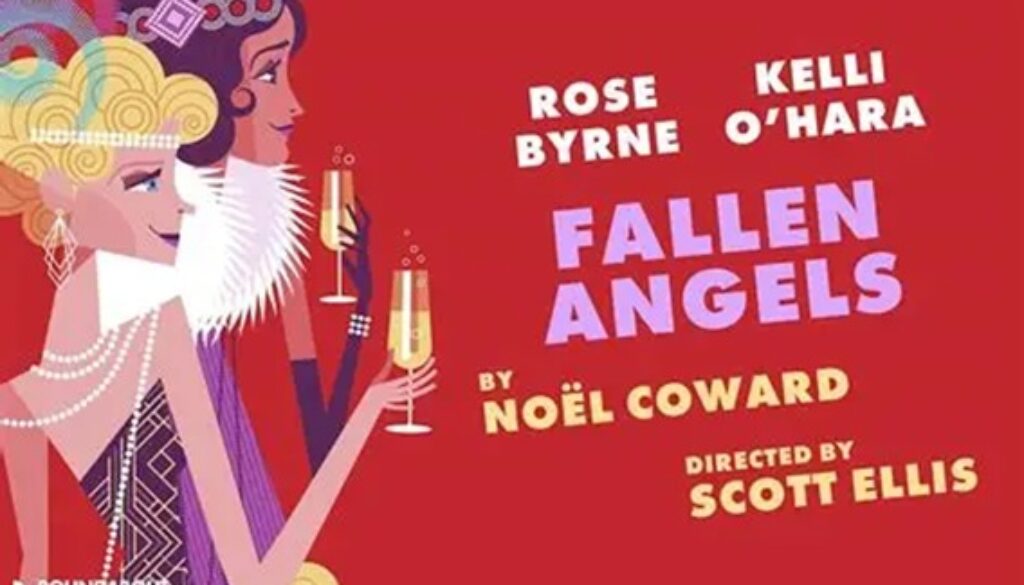
The play follows two best friends and neighbouring wives — Julia Sterroll (Kelli O’Hara) and Jane Banbury (Rose Byrne) — whose husbands have departed for a golfing weekend, leaving the two women to their own devices. The device in question is the arrival of a letter from Maurice Duclos (Mark Consuelos), a charming Frenchman who was the pre-marital lover of both women — unbeknownst, until now, to either. As the afternoon progresses and the champagne bottles multiply, the two friends move from nervous hilarity through mutual jealousy to outright, magnificently sozzled warfare, with the maid Saunders (Tracee Chimo) as hapless witness. The play’s climax — when Maurice finally arrives in the flesh — provides the farcical resolution that the preceding ninety intermissionless minutes have been building toward.
The production is presented by the Roundabout Theatre Company at the Todd Haimes Theatre (formerly the American Airlines Theatre), 227 West 42nd Street, directed by Scott Ellis — the company’s Interim Artistic Director — and features set design by David Rockwell, costume design by Jeff Mahshie, lighting design by Kenneth Posner, and sound design by John Gromada. The production began previews 27 March 2026, officially opened 19 April 2026, and runs through 7 June 2026. Ahead of the Tony Awards ceremony on 7 June, streaming service BroadwayHD is airing a live performance capture on 5 June 2026.
The production received five Tony Award nominations: Best Revival of a Play, Best Actress in a Leading Role (Byrne), Best Actress in a Leading Role (O’Hara), Best Featured Actor in a Play (Christopher Fitzgerald), and Best Direction of a Play (Scott Ellis). The double nomination of both leading actresses in the same category from the same production is, as several media outlets noted, an extremely rare distinction.
Byrne as Jane: The Comedy of Bad Manners Done Brilliantly
The particular quality that Rose Byrne brings to Jane Banbury is one she has been developing across decades of screen work: the capacity to be simultaneously elegant and completely unhinged. Jane is, on the surface, the more composed and supposedly sensible of the two wives — though the play quickly establishes that this is a relative distinction. As the champagne flows and Maurice’s arrival becomes more imminent, Byrne charts Jane’s dissolution from buttoned-up social propriety to howling, jealous, physically anarchic comedy with what multiple critics described as the precision of a master watchmaker and the commitment of someone who has absolutely no concern for looking dignified.
The New York Times characterised her performance as containing “a violence that can take you by surprise” — an observation that gets at the quality Byrne has brought to her best comedy work since Bridesmaids: the sudden, shocking intensity beneath the prettiness, the way an apparently decorative performance can suddenly reveal steel or menace or genuine rage. Deadline’s Greg Evans called her “an exemplary comedian.” The New York Stage Review described Byrne and O’Hara as “so wonderful — and so wonderfully matched.”
Physically, the performance is a sustained athletic feat. Byrne and O’Hara slide down stairs, fall over chairs, rearrange their costumes and wigs in states of increasing dishevelment, and navigate a stage set designed to amplify their pratfalls — all of it requiring the kind of physical discipline that makes chaos look effortless. Her skewed wig in the production’s drunken second half became something of a production signature, singled out by multiple critics as the visual emblem of a performance in full, magnificent free-fall.
In her interview with The Hollywood Reporter following the Tony nominations, Byrne was characteristically warm and generous about the experience: “To have these creative opportunities, like If I Had Legs, I’d Kick You, and something like Fallen Angels, it’s all I can ask for. It’s been exceptional. It’s been so truly, truly extraordinary.” She noted the particular pleasure of working with Scott Ellis again after You Can’t Take It With You twelve years earlier, and praised the ensemble — and especially Kelli O’Hara — as the production’s greatest asset.
What the Critics Said: Review Roundup
The critical reception to Fallen Angels was warm about the performances while somewhat divided about the play itself — with near-universal praise for Byrne and O’Hara as an ensemble, qualified by several critics who found Coward’s early work unequal to their talents. Here is what the major outlets had to say.
Audience response on Broadway.com has been highly positive, with verified ticket-buyers consistently praising the chemistry between Byrne and O’Hara, the quality of the physical comedy, and the production’s unpretentious, genuinely funny entertainment value. Multiple audience members have described it as among the most enjoyable evenings they have spent in a Broadway house in years — the rarest and most valuable kind of theatrical recommendation.
Tony Nominated: Best Actress in a Leading Role in a Play
Rose Byrne’s first-ever Tony nomination, for her performance as Jane Banbury in Fallen Angels, arrives in the same calendar year as her Golden Globe win and Oscar nomination — making her the 22nd performer in history to receive both an Oscar and Tony nomination in the same year. She competes against her own co-star Kelli O’Hara in the same category.
Full category nominees:
- Rose Byrne — Fallen Angels
- Carrie Coon — Bug
- Susannah Flood — Liberation
- Lesley Manville — Oedipus
- Kelli O’Hara — Fallen Angels
A Historic Achievement: Oscar and Tony in the Same Year
One of the most remarkable aspects of Rose Byrne’s 2026 award season is the rarity of what she has achieved. To receive both an Academy Award nomination and a Tony Award nomination in the same calendar year places her in historically distinguished company. As NBC New York reported, she became the 22nd performer in history to achieve this dual nomination — though different outlets have given slightly varying counts, with Gold Derby placing her as potentially the 17th actress to do so. The distinction, whatever the precise number, is extraordinary and underlines the scale of what she has accomplished in this single awards season.
The Oscar nomination was for If I Had Legs I’d Kick You, Mary Bronstein’s psychological drama in which Byrne plays a mother whose daughter is chronically ill, whose ceiling has collapsed, and whose husband is absent — a portrait of domestic unravelling that she described in her PBS NewsHour interview as one of the most demanding roles she had ever undertaken. “She’s been acting professionally for more than 30 years,” noted the NewsHour, “and now she’s up for her first Oscar.” The Golden Globe win that preceded the Oscar nomination — awarded in January 2026 at the 83rd Golden Globe ceremony — brought her to the Academy’s attention and launched the most decorated awards run of her career.
That she was simultaneously rehearsing and performing on Broadway throughout the height of the Hollywood awards campaign season is a detail that several profiles have noted. While many Oscar nominees focus primarily on the screenings and glad-handing of Hollywood’s awards season, Byrne was in New York at the Todd Haimes Theatre, doing eight shows a week of Noël Coward with Kelli O’Hara. It is a commitment that speaks volumes about her artistic priorities and her relationship with the stage — and it produced a Broadway performance that earned her a Tony nomination to sit alongside the Oscar one.
A Career in Full: Selected Stage and Screen Credits
Begins formal acting training at Sydney’s most prestigious youth theatre company. The decision is entirely her own — a child who already knows what she wants to do with her life.
First professional screen role, cast by an agent who visited ATYP scouting talent. Appears alongside Sandra Bernhard in the Australian feature film. Her professional career begins before she has finished secondary school.
Leaves Australia to study at David Mamet and William H. Macy’s Atlantic Acting School in New York City. Formal training that provides the technical foundation for all subsequent work.
Plays Heath Ledger’s love interest in the Australian crime film. The film’s success in Australia raises her profile considerably.
Wins the Volpi Cup for Best Actress at the Venice International Film Festival at age 21. The prize announces her internationally and opens Hollywood doors. The same year she appears on the Sydney Theatre Company stage in La Dispute.
Hollywood debut as Dormé, one of Padmé Amidala’s handmaidens, in George Lucas’s global blockbuster. Introduction to the scale of major franchise production.
Plays Briseis opposite Brad Pitt and Eric Bana in Wolfgang Petersen’s epic. Establishes her in the Hollywood mainstream alongside major stars.
Stars as Ellen Parsons opposite Glenn Close’s Patty Hewes in the critically acclaimed legal thriller. Five seasons. Two Primetime Emmy Award nominations. The performance that established her as one of the finest dramatic actresses of her generation on American television.
Plays Helen — the perfectly coiffed, passive-aggressively devastating antagonist — in Paul Feig’s landmark comedy blockbuster. Her comic breakthrough. The film becomes a cultural phenomenon and one of the highest-grossing R-rated comedies ever made.
Makes her Broadway debut as Alice Sycamore in the Roundabout Theatre Company revival of Hart and Kaufman’s comedy, directed by Scott Ellis. Stars alongside James Earl Jones. Her first experience of Broadway’s particular demands.
Plays feminist activist Gloria Steinem in the Emmy-winning limited series about the battle to ratify the Equal Rights Amendment in the 1970s. Critically acclaimed performance demonstrating her range between comedy and serious historical drama.
Stars as and executive produces the Apple TV+ dark comedy series about a woman in 1980s San Diego who finds salvation through aerobics. An Emmy-nominated turn in a show she helped shepherd from development through three seasons.
Wins the Silver Bear for Best Leading Performance at the Berlin International Film Festival. Wins the Golden Globe for Best Actress in a Drama Film (January 2026). Receives an Academy Award nomination for Best Actress (February 2026).
Returns to Broadway as Jane Banbury in Roundabout Theatre Company’s revival of Noël Coward’s 1925 comedy, directed by Scott Ellis. Receives her first Tony Award nomination for Best Actress in a Leading Role in a Play. Becomes the 22nd performer in history to receive Oscar and Tony nominations in the same year.
The Year That Defined Her Career — and What Comes Next
It would be easy, surveying the arc of Rose Byrne’s 2026, to reach for superlatives — and the superlatives would be justified. A Golden Globe win. An Oscar nomination. A Tony nomination. All in one calendar year. All for performances at opposite poles of the dramatic spectrum: the disintegrating, desperately serious mother of If I Had Legs I’d Kick You, and the champagne-soaked, magnificently ridiculous Jane Banbury of Fallen Angels. The range required to be equally excellent at both is the range that defines a great actress — and Rose Byrne has demonstrated that range beyond any reasonable argument.
What is perhaps most instructive about this moment in her career is that it has been thirty-two years in the making. She began taking acting classes at eight years old. She was cast in her first professional film at thirteen. She spent her teenage years training at ATYP and Bradfield College, moved to New York at twenty to study at the Atlantic Acting School, won the Volpi Cup at Venice at twenty-one. She spent five years on Damages learning how to sustain complex dramatic work opposite one of the most demanding actresses alive. She learned slapstick and physical comedy in Bridesmaids and refined it through six more comedies.
None of the 2026 recognition is accidental. It is the harvest of three decades of deliberate, wide-ranging, technically disciplined work — the kind of career that looks effortless only because the effort has been so thoroughgoing and so sustained. The Tony ceremony on 7 June 2026 will not be the end of this chapter. Whatever the result, Rose Byrne is at the peak of her powers, and the stage — as Fallen Angels has reminded New York — is as natural a home for those powers as any screen she has ever worked before.
Rose Byrne and Kelli O’Hara are so wonderful — and so wonderfully matched. They prove themselves brilliant physical comedians, whether sliding down stairs, falling over chairs, or guzzling champagne.
New York Stage Review & 1 Minute Critic — composite praise