Mark Strong: Tony Nominated for Oedipus on Broadway 2026
Mark Strong: The Man Born Marco Salussolia Who Became Hollywood’s Greatest Villain — and Broadway’s Most Compelling Tragic Hero
Two Tony nominations. Two Olivier nominations. One Olivier win. A career spanning the RSC, the National Theatre, the Donmar Warehouse, Hollywood’s biggest franchises, and now the most-nominated stage performance of the 2025-26 Broadway season — meet the actor the industry simply calls Strong by name and character.
Born Marco Salussolia: Islington, Single-Parent London and the Road to the Stage
The story of Mark Strong begins with a name he does not use. He was born Marco Giuseppe Salussolia on 5 August 1963 in Islington, north London, the son of an Austrian mother and an Italian father. His father left the family shortly after his birth, and Marco was raised by his mother alone while she worked as an au pair to support them. The family moved frequently through various London neighbourhoods — Walthamstow, Clapton, Stoke Newington, Edmonton — a peripatetic early childhood that the actor has spoken about with characteristic directness in later interviews.
His mother, determined to help her son assimilate fully into British society, legally changed the family surname to Strong during his childhood — a decision that was made entirely for practical reasons of social belonging but which acquired an almost poetic aptness given the qualities that would come to define his professional persona. Marco Salussolia became Mark Strong, and in doing so became one of the most powerfully named actors in the history of the British stage.
He attended Reedham Orphanage School in Surrey and Wymondham College in Norfolk — a boarding school where he sang in two punk rock bands called the Electric Hoax and Private Party. It was not yet an artistic vocation; at this stage, Strong’s ambitions were oriented toward the law, and he spent a year at university in Munich studying legal studies before concluding that it was not for him. He returned to London, where he enrolled in English and Drama at Royal Holloway, University of London — a course of study that eventually led him to theatre in earnest, though still, by his own account, without a clear sense that acting was the thing he would do with his life.
The transformation came, as it so often does, in performance. Strong has described watching French actor Alain Delon as an early formative influence — the particular quality of presence that Delon commanded on screen, the sense of a fully inhabited inner life projected outward with total control. It was an instinct more than a plan: the recognition that this was the kind of artist he wanted to be, whatever the path to getting there looked like.
That path ran through the Bristol Old Vic Theatre School, one of Britain’s most rigorous and respected drama training programmes, from which he graduated in 1989. In a training environment that prized classical discipline, vocal technique, and physical command, Strong found the foundation for a stage career of exceptional range and ambition.
Eight Years on the British Stage: RSC, National Theatre, Donmar and the Craft
Mark Strong spent his first eight professional years almost entirely on the British stage — a sustained, serious, classical apprenticeship at the institutions that define theatrical excellence in the United Kingdom. He has described this period, in interviews, as foundational in the deepest sense: not merely as the place where he learned his craft, but as the artistic home that gave him the standards against which he has measured all subsequent work.
His stage résumé from these years is remarkable. He appeared at the Royal Shakespeare Company in productions including The Plantagenets, The Man Who Came to Dinner, and Hess Is Dead. He worked at the Royal National Theatre in a series of productions that included Murmuring Judges, Fuente Ovejuna, Napoli Milionaria, King Lear, and Richard III — the last two offering him the opportunity to play alongside some of the most distinguished classical actors of the age, including Ian McKellen (in Richard III, with Strong in a supporting role) and Brian Cox (in King Lear). As he told BroadwayWorld in 2016, his National Theatre debut was as a company member alternating between supporting McKellen and Cox: “We did that for about a year and a half and then I stayed with the National for a few years.”
At the Donmar Warehouse — the intimate, highly regarded venue in Covent Garden that has launched some of the most celebrated productions in modern British theatre — Strong appeared in productions of Twelfth Night and Uncle Vanya, the latter earning him a nomination for the Laurence Olivier Award for Best Performance in a Supporting Role in 2003. This first Olivier nomination announced to the industry that Strong was not merely a capable journeyman performer but an actor capable of the highest level of distinction.
He also worked at the Almeida Theatre in a production of Eugene O’Neill’s The Iceman Cometh with Kevin Spacey, and at the New Ambassadors Theatre in David Mamet’s Speed the Plow in the West End. At the Royal Court Theatre, he appeared in The Thickness of Skin and The Treatment. He played Biff Loman in a National Theatre production of Arthur Miller’s Death of a Salesman — a fact that resonates interestingly given his later work in Icke’s Oedipus alongside the son of another American icon, and given his 2016 observations about Miller’s particular relevance to British theatrical culture.
After a decade of this extraordinary stage career, Strong made a decision that many theatre-trained actors make when the pull of the screen becomes strong enough: he transitioned primarily into television and film, spending the next twelve years almost entirely away from the live stage. “I pretty much felt that after ten years that I had done as much as I could in theatre,” he told BroadwayWorld. “I was repeating myself and so I got more interested in the movies.”
When I left drama school I did theatre for ten years before I went into movies. I went to Bristol Old Vic Theatre School and we did nine plays in nine months. Then I went to the Theatre of Manchester for three months, then the Royal Shakespeare Company for a year.
Mark Strong, BroadwayWorld interview, 2016Hollywood’s Most Reliable Villain: The Screen Career
If Mark Strong is known to the majority of global audiences, it is as a particular type of screen presence: the formidably intelligent, effortlessly menacing antagonist who is, paradoxically, often the most compelling figure in any given film. He has played this type — and played it magnificently, with range and wit and an absolute refusal to allow his characters to become mere genre furniture — in a string of major franchise productions that have made him one of the most recognisable British actors of his generation.
His television breakthrough came with the BBC drama series Our Friends in the North (1996), a landmark nine-part dramatisation of northern English political and social life across four decades, in which Strong played Tosker Cox alongside Daniel Craig, Gina McKee, and Christopher Eccleston. The series was a critical sensation and became one of the defining British television productions of the 1990s, establishing all four leads as significant talents. It was followed by Strong’s BAFTA-nominated performance in The Long Firm (2004), a BBC Two drama about organised crime in 1960s London.
His film career found its defining register with a series of high-profile villain roles that perfectly suited his combination of physical authority, verbal precision, and the quality — which he has spoken about with evident relish in interviews — of making evil feel genuinely, frighteningly comprehensible. He played Lord Blackwood in Guy Ritchie’s Sherlock Holmes (2009) opposite Robert Downey Jr.; the mob boss Frank D’Amico in Kick-Ass (2010); Sinestro in Green Lantern (2011); Sir Godfrey in Ridley Scott’s Robin Hood (2010); the mysterious intelligence figure in Matthew Vaughn’s Kingsman: The Secret Service (2014) and its sequel, Kingsman: The Golden Circle (2017); and Dr. Thaddeus Sivana, the principal villain, in the DC films Shazam! (2019) and Shazam! Fury of the Gods (2023).
More serious screen work includes Tinker Tailor Soldier Spy (2011) alongside Gary Oldman, Zero Dark Thirty (2012) for Kathryn Bigelow, The Imitation Game (2014) with Benedict Cumberbatch, 1917 (2019) for Sam Mendes — the acclaimed World War One film — and Tár (2022) with Cate Blanchett for Todd Field. More recently he has appeared in The Penguin (HBO, with Colin Farrell), Dune: Prophecy, and The Critic with Ian McKellen and Gemma Arterton.
Across this body of work, what is consistently remarkable is not merely that Strong is effective in franchise antagonist roles but that he is effective in almost everything, regardless of scale. He brings to every performance — from the smallest supporting role to the most elaborate supervillain — the same quality of absolute investment and technical precision that his years on the British stage instilled.
The Return to the Stage: A View from the Bridge and the First Tony Nomination
After approximately twelve years away from the live stage, Mark Strong returned to theatre in 2014 in what he has described as a modest experiment — an eight-week revival at London’s intimate Young Vic Theatre. The play was Arthur Miller’s A View from the Bridge, directed by Belgian theatre director Ivo van Hove in a strikingly abstract, minimalist staging. Strong played Eddie Carbone, the Brooklyn longshoreman whose obsessive, unacknowledged desire for his niece consumes and destroys him.
What happened next was, by Strong’s own description, entirely beyond his expectations. “It’s beyond my wildest dreams,” he told Playbill. “I had no idea when I first decided to do the job at the Young Vic two years ago that it would go to the West End, let alone Broadway and win me a nomination. It’s been an incredible journey to get to this point.”
The production transferred from the Young Vic to the West End’s Wyndham’s Theatre, where it became one of the theatrical events of the London season, playing to sold-out houses and generating the kind of critical enthusiasm that signals something genuinely exceptional. Strong won the Laurence Olivier Award for Best Actor for the performance — his first major acting prize — and the production subsequently transferred to Broadway’s Lyceum Theatre, where it played from 21 October 2015 through 21 February 2016.
The Hollywood Reporter described his performance as “a study in coiled menace and blistering rage,” noting the way the ensemble “superbly captures that complexity of people isolated by their own anxieties while being pulled into a calamity that will scar them all.” The Broadway production earned Strong a Tony Award nomination for Best Actor in a Leading Role in a Play — his first — confirming that the response to his work was not simply London enthusiasm but a genuine, transatlantic recognition of an actor at the very peak of his powers. He also earned a Drama Desk Award nomination for the same performance.
Strong was equally passionate about the specifically New York experience of playing the role: “The fact that it’s a New York play — to bring that play to New York was such an amazing experience. In the U.K., all of the American references like Nostrand Avenue and Times Square were just words. But in New York they were right down the road. It made me realize that the Broadway audience was receiving the play in a completely different way.”
Oedipus on Broadway: The Play, the Vision, and the Production
Robert Icke is one of the most acclaimed and controversial theatre-makers working in the English-speaking world — the youngest Olivier Award-winning director in history, known for transforming canonical dramatic texts into propulsive, visually inventive contemporary experiences. His adaptations of Aeschylus’s Oresteia, Shakespeare’s Hamlet, Ibsen’s Mary Stuart, and Chekhov’s Uncle Vanya have all generated significant critical discussion, admiration, and occasional controversy. His Oedipus is no exception.
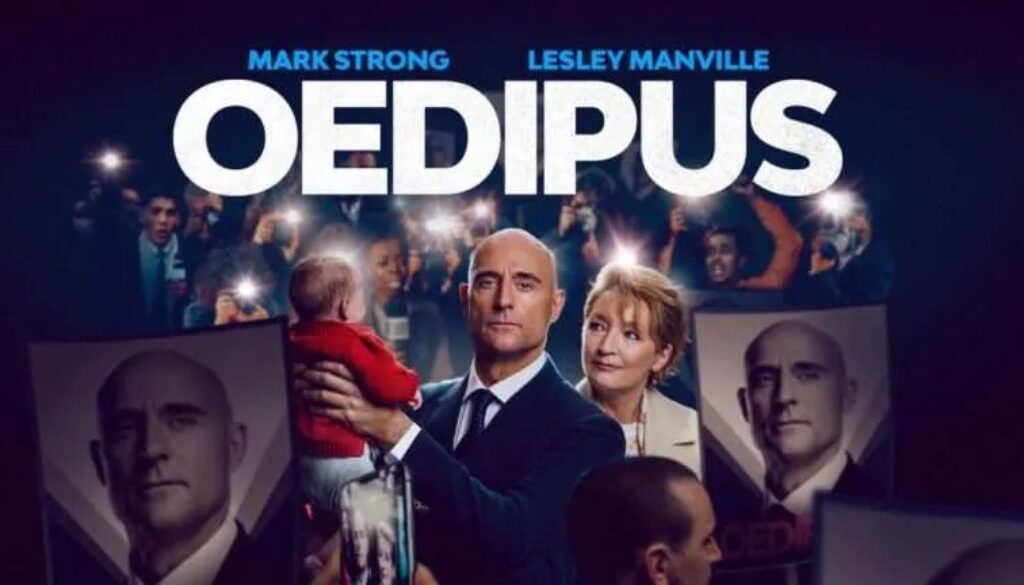
Written “long after Sophocles” — as the script itself wryly notes — Icke’s adaptation transplants the Greek tragedy into a world recognisably our own: a modern political campaign headquarters on election night, where a charismatic politician named Oedipus awaits the results of what should be a triumphant victory. The production’s Oedipus carries echoes of multiple real political figures — the inspirational immigrant family-man quality of Barack Obama, the populist outsider energy of Donald Trump, the marital dynamics of Emmanuel Macron — without identifying precisely with any of them. A countdown clock on stage ticks remorselessly toward the moment of revelation, creating a relentless dramatic tension that replaces the more leisurely unwinding of the ancient source.
The production premiered at London’s Wyndham’s Theatre in the West End in 2024, where it sold out and won the Laurence Olivier Award for Best Revival of a Play (and Lesley Manville won Best Actress). Strong received an Olivier nomination for Best Actor. It transferred to Broadway’s Studio 54, opening 13 November 2025 and running through 8 February 2026 — 14 previews and 100 regular performances. The production broke the all-time Studio 54 weekly box office record in its final week.
The cast featured Mark Strong as Oedipus, Lesley Manville as Jocasta (making her Broadway debut in the role), John Carroll Lynch, Anne Reid, Olivia Reis, Jordan Scowen, James Wilbraham, Samuel Brewer as the prophet Teiresias, and Teagle F. Bougere. The production design — by Hildegard Bechtler, Tony-nominated for its Broadway work — featured a sleek, glass-panelled campaign office, immaculate and modern, the stage a visual metaphor for the pristine surface behind which catastrophic secrets are buried.
The production earned seven Tony Award nominations: Best Revival of a Play, Best Leading Actor (Strong), Best Leading Actress (Manville), Best Direction of a Play (Icke), Best Scenic Design (Bechtler), Best Lighting Design (Natasha Chivers), and Best Sound Design (Tom Gibbons). It is the joint-second most nominated production of the 2025-26 Broadway season.
Strong as Oedipus: Playing the Man Who Destroys Himself with His Own Honesty
The particular challenge of Robert Icke’s Oedipus — the version of the role that Mark Strong plays — is that this Oedipus is not a figure of ancient tragic grandeur but a recognisable contemporary man: a politician, a husband, a father, a populist who has built his entire public identity on a promise of radical transparency. “I would like to be the first politician to have no secrets,” this Oedipus declares. It is, of course, the most devastating dramatic irony: a man who cannot survive the truth he insists on telling.
Strong has spoken about his approach to the role with characteristic thoughtfulness. In his interview with Gold Derby ahead of the Broadway opening, he noted: “I’d not done any Greek tragedy before Oedipus” — an acknowledgement that despite his vast classical stage experience, this particular mode was new territory. The challenge was to make the ancient material feel not merely contemporary in its setting but genuinely urgent — to find in a man who has been dead for 2,500 years something that speaks to the specific anxieties and moral failures of the present moment.
In his reaction to the Tony nominations, speaking to New York Theatre Guide from his car driving back to London, Strong captured both the honour and its personal significance: “Our two London runs were thrilling, but here on Broadway our audiences are absolutely stunned.” He praised the work ethic of the stage cast and crew, returning to the theme he has consistently articulated about what the theatre offers that film cannot: “I love being able to get into a rehearsal room with people. You’re able to actually work on something with people and then the reliance on everybody. They know their moves, they know their lines, that you’re going to create this thing together every night. It’s exactly what I wanted from being an actor when I very first started out and saw the first theater productions that made me want to go down this path.”
His personal connection to Broadway extends beyond the professional. Speaking to TheaterMania on the morning of the nominations, Strong revealed that his relationship with the theatrical form is rooted in the most personal of foundations: “I have loved theatre since I was a child, and my grandmother first took me to see Sandy Duncan and Peter Pan on Broadway when I was about three years old. And I will never stop loving it.”
The Gold Derby analysis of his Tony prospects offered what may be the most precise description of what distinguishes his work: “I’m not sure I’ve seen anybody better at conveying the inner turmoil and moral quandaries of his characters onstage than Strong, from Eddie Carbone in A View from the Bridge to Oedipus. The moment in which he learns the truth of his parentage — expertly choreographed to the rundown of the clock that had been counting down the seconds until the election polls close — is one of those indelible moments from the Broadway season that I’ll remember for a long time.”
What the Critics Said: Review Roundup
The critical reception to Oedipus and to Mark Strong’s performance was largely warm, though not without qualification — with near-universal praise for Strong and Lesley Manville as an acting partnership of extraordinary power, alongside some critical debate about Icke’s modernising choices and their dramatic effectiveness.
Among the notable visitors to the production during its Broadway run was Robert DeNiro, who visited backstage in December 2025 — a recognition that even among the acting fraternity, this was a performance generating serious attention. The production’s final week broke the all-time box office record at Studio 54.
Tony Nominated: Best Actor in a Leading Role in a Play
Mark Strong’s second Tony nomination — a decade after his first for A View from the Bridge — arrives for his performance as Oedipus in Robert Icke’s landmark production at Studio 54. The show itself earned seven nominations, the second-joint highest total for a play this season.
Full category nominees:
- Will Harrison — Punch
- Nathan Lane — Arthur Miller’s Death of a Salesman
- John Lithgow — Giant
- Daniel Radcliffe — Every Brilliant Thing
- Mark Strong — Oedipus
A Career on Stage: Selected Credits
Eight consecutive years on the British stage after graduating from Bristol Old Vic. Major productions include The Plantagenets, The Man Who Came to Dinner, and Hess is Dead (RSC); Murmuring Judges, Fuente Ovejuna, King Lear, and Richard III (National Theatre — supporting Ian McKellen and Brian Cox); Twelfth Night and Uncle Vanya (Donmar Warehouse — Olivier nomination for Supporting Actor); Speed the Plow (West End); and The Iceman Cometh (Almeida, with Kevin Spacey). Also played Biff Loman in Death of a Salesman at the National Theatre under director David Thacker — an early encounter with Arthur Miller who personally attended UK productions of his work.
Twelve years focused primarily on an increasingly distinguished film and television career. Key productions include Our Friends in the North (BBC, 1996), The Long Firm (BBC, 2004 — BAFTA nomination), Sherlock Holmes (2009), Kick-Ass (2010), Tinker Tailor Soldier Spy (2011), and Kingsman: The Secret Service (2014).
Returns to the live stage after twelve years with Ivo van Hove’s celebrated revival of Arthur Miller’s play, playing Eddie Carbone. Sells out the Young Vic before transferring to the Wyndham’s Theatre in the West End, where it again sells out. Wins the Laurence Olivier Award for Best Actor. The production also features Nicola Walker, Phoebe Fox, and Russell Tovey in the West End cast.
Broadway debut as Eddie Carbone in the American transfer of van Hove’s production. Plays 21 October 2015 through 21 February 2016 to critical acclaim and sold-out houses. Earns his first Tony Award nomination for Best Actor in a Leading Role in a Play and a Drama Desk Award nomination. Describes the experience of playing a quintessentially New York character on a New York stage as one of the great privileges of his career.
Returns to the National Theatre in David Hare’s The Red Barn, based on a Georges Simenon novel, a dark rural thriller directed by Robert Icke — Icke and Strong’s first collaboration, which would eventually lead to Oedipus.
Stars as Oedipus in Robert Icke’s modern adaptation of Sophocles alongside Lesley Manville at the Wyndham’s Theatre. The production sells out its limited run, wins the Olivier Award for Best Revival of a Play, and earns Strong an Olivier nomination for Best Actor (won by Manville for Best Actress).
The Wyndham’s production transfers to Broadway at Studio 54, opening 13 November 2025 and closing 8 February 2026 after 100 performances — breaking the all-time Studio 54 weekly box office record in its final week. Earns Strong his second Tony Award nomination for Best Actor in a Leading Role in a Play. The production receives seven Tony nominations in total.
The Awards Record: Tony Nominations and Stage Honours
| Year | Award | Category | Production | Result |
|---|---|---|---|---|
| 2003 | Olivier Award | Best Supporting Actor in a Play | Twelfth Night (Donmar) | Nominated |
| 2015 | Olivier Award | Best Actor in a Play | A View from the Bridge | WON ★ |
| 2016 | Tony Award | Best Actor in a Leading Role in a Play | A View from the Bridge | Nominated |
| 2016 | Drama Desk Award | Outstanding Actor in a Play | A View from the Bridge | Nominated |
| 2024 | Olivier Award | Best Actor in a Play | Oedipus (Wyndham’s) | Nominated |
| 2026 | Tony Award | Best Actor in a Leading Role in a Play | Oedipus | Nominated ★ (Pending) |
The Villain Who Plays the Hero: What Mark Strong’s Career Teaches Us
There is a rich irony at the heart of Mark Strong’s Broadway career. The man that most cinema audiences know as the scheming antagonist — as Lord Blackwood, as Frank D’Amico, as Sinestro, as Dr. Sivana — is, on the stage, one of the finest interpreters of tragic heroism that the contemporary theatre possesses. The qualities that make him so effective as a screen villain — the coiled physical presence, the sense of enormous inner life in rigid control, the way intelligence reads as threat — are precisely the qualities that make his stage protagonists so compelling. Eddie Carbone’s obsessive self-destruction. Oedipus’s catastrophic commitment to truth.
What both roles share, beneath their surface differences, is a man who cannot stop himself — who is driven by internal forces more powerful than his conscious will. This is a quality that Mark Strong understands from the inside. His twelve-year absence from the stage was not idleness; it was a period of artistic exploration in a different medium. His return was not nostalgia; it was a considered decision that the stage had more to offer him than he had yet taken from it. His second return, in Oedipus, confirmed what A View from the Bridge had suggested: that the stage is not merely one option in his career but its truest home.
Born Marco Giuseppe Salussolia in Islington to a single Austrian mother who changed his name so he would fit in — and who took her three-year-old son to see Peter Pan on Broadway and gave him a love of theatre that has never left him — Mark Strong has built one of the most complete and admirable careers in contemporary British acting. He is not done yet.
I’m blushing. It feels amazing. I’m in the car driving back to London to have a glass of champagne that my family put on ice for me. I’m trying to keep to the speed limit while being extremely excited.
Mark Strong, reacting to his 2026 Tony nomination, TheaterMania