Susannah Flood: Tony Nominated for Liberation on Broadway 2026
Susannah Flood: The Off-Broadway Insider Who Became Broadway’s Most Acclaimed Actress of the Season in a Pulitzer Prize-Winning Play
For over a decade, the New York theatre community has known exactly who Susannah Flood is. Now, thanks to a Tony nomination for playing double duty as both mother and daughter in the Pulitzer Prize-winning Liberation, the rest of the world is finding out too.
Born Into the Craft: New York City, a Theatre Family, and the Long Road to UC Berkeley
There is something almost inevitably theatrical about Susannah Flood’s origins. She was born on 30 June 1982 in New York City, and though she grew up between Manhattan and Los Angeles, the world of performance was never far from her earliest experience. Her father is Peter Gosnell Flood — an acting teacher and lifetime member of the Actors Studio, the legendary training institution founded in 1947 that counts Marlon Brando, Paul Newman, Al Pacino, and Dustin Hoffman among its most celebrated alumni. The Actors Studio approach — rigorous, psychologically grounded, deeply invested in emotional truth — was the water Flood swam in from childhood.
Notably, her father’s first marriage was to Betty Buckley, the Tony Award-winning musical theatre actress and singer best known for her performances in Cats, Sunset Boulevard, and Triumph of Love. While Buckley was not her mother, the presence of that theatrical legacy in her family history is a further index of the theatrical environment that shaped her early understanding of what the performing arts could be.
Flood spent her formative years in both New York and Los Angeles, eventually receiving her high school education in Santa Monica. Then came a decisive intellectual and geographic move: she enrolled at the University of California, Berkeley — one of the great public research universities in the world — where she studied English Literature, graduating summa cum laude. She was also, during her time at Berkeley, a member of the Women’s Lightweight Crew — a detail that speaks to the same combination of discipline, team commitment, and physical stamina that characterises her approach to the stage.
The academic achievement was exceptional — summa cum laude at Berkeley is not a casual distinction — but it was always in service of a theatrical vocation rather than an alternative to it. Following graduation, Flood pursued her MFA in Acting at the prestigious Brown University/Trinity Repertory Company programme in Providence, Rhode Island — one of the most respected graduate acting programmes in the United States, known for its combination of classical rigour and avant-garde theatrical sensibility. It was in the Brown/Trinity MFA that Flood encountered the kind of radical physical theatre training that would shape her whole approach to performance. In her TheaterMania interview, she described a formative exercise in physical theatre that drove a classmate to “complete hysterical vulnerability,” and how the teacher’s passionate response — “If this is not what you are doing, I do not want to pay money” — crystallised for her what the deepest theatrical commitment required.
Building a Career the Right Way: Clubbed Thumb, NYTW, and the New York Indie Scene
After completing her MFA, Flood did what the most serious stage artists do: she immersed herself entirely in the New York theatrical ecosystem, working her way through the city’s extraordinary network of Off-Broadway and fringe institutions with consistent dedication and rising distinction. Her career in this period is not a series of big breaks and dramatic pivots but a patient, sustained accumulation of serious work at serious institutions — the kind of theatrical apprenticeship that builds an artist from the inside out.
She became an affiliated artist with Clubbed Thumb — a vital downtown company known for developing adventurous new American plays — and appeared in two of their productions that have become touchstones of the contemporary Off-Broadway canon. Plano, Will Arbery’s dark and dreamlike play, was first performed at the Wild Project and then at the Connelly Theater, and earned considerable critical attention for its strange, unsettling theatricality. Baby Scream Miracle was a further Clubbed Thumb production that confirmed her as a central figure in the company’s artistic life. Clubbed Thumb’s commitment to formally adventurous, psychologically complex new work was an ideal environment for an actress of Flood’s particular gifts — her appetite for the strange, the demanding, and the formally unusual has been a consistent thread in her career from the beginning.
Beyond Clubbed Thumb, her Off-Broadway résumé from this period is a comprehensive tour of New York’s finest theatrical institutions. At the New York Theatre Workshop she appeared in Scenes from a Marriage and Love & Information — Caryl Churchill’s formally innovative exploration of disconnected episodes of human communication. At Playwrights Horizons, she appeared in Mr. Burns, a Post-Electric Play — Anne Washburn’s wildly original theatrical piece about the persistence of cultural memory after apocalypse. At the Barrow Street Theatre, she appeared in both The Effect (Lucy Prebble’s play about love, antidepressants, and the chemistry of consciousness) and Tribes (Nina Raine’s exploration of deaf culture and family). At The Public Theater and New York Shakespeare Festival, she played in As You Like It.
More recently, her Off-Broadway work has included The Comeuppance at Signature Theatre Company (2023), Staff Meal at Playwrights Horizons (2024), and The Counter at Second Stage’s Laura Pels Theatre — in which she starred alongside Anthony Edwards and Amy Warren. Each of these productions added a further chapter to what Broadway Direct described as her “extensive work on and Off-Broadway and in regional theater” that made her one of the most widely and warmly respected actresses in the New York theatrical community, even as she remained largely below the radar of mainstream cultural attention.
Liberation is a complete high-water mark in my career and life because it does braid all of these pure artistic values with the audacity of a commercial run. It’s a new play by a writer I respect, that challenges people.
Susannah Flood, TheaterMania interview, October 2025The Broadway Record: From Dunyasha to Lizzie
Despite her extensive New York stage career, Flood’s Broadway appearances have been relatively few — partly by temperament (she has spoken about valuing the intimacy and artistic freedom of smaller-scale work), partly by the economics of an industry that requires specific timing and opportunity. But each of her Broadway credits has been in work of genuine distinction.
Her Broadway debut came in 2016 with the Roundabout Theatre Company revival of Anton Chekhov’s The Cherry Orchard, in which she played Dunyasha — the flirtatious, romantically troubled housemaid whose subplot provides a crucial counterpoint to the main family’s aristocratic dissolution. The production was a high-profile one: it starred Diane Lane as Madame Ranevskaya, Joel Grey as Gaev, and Harold Perrineau, and played at the American Airlines Theatre (now the Todd Haimes Theatre). For Flood, it was a significant entrance into the Broadway world — a debut production at a major institutional theatre, in a celebrated repertoire work, alongside established stars.
She returned to Broadway in 2022 in Birthday Candles by Noah Haidle — a new play that traces a single woman’s life from her eighteenth to her hundredth birthday, played continuously by Debra Messing, with various members of the supporting cast playing multiple roles across the decades. Flood was among those ensemble members who inhabited multiple roles within the production’s ambitious timeline structure. The production was directed by Vivienne Benesch at the American Airlines Theatre.
Then came Liberation — which began as an Off-Broadway production in February 2025 and transferred to Broadway in October of that year, making Flood’s third Broadway credit also her most significant and most celebrated. The progression from Off-Broadway to Broadway, with the same cast and director reprising the same production, is in many ways the ideal theatrical journey: a production that found its form in the smaller venue, proved itself to audiences and critics, and arrived on the Main Stem at full confidence and maturity.
Liberation on Broadway: The Pulitzer Prize-Winning Memory Play That Won the Season
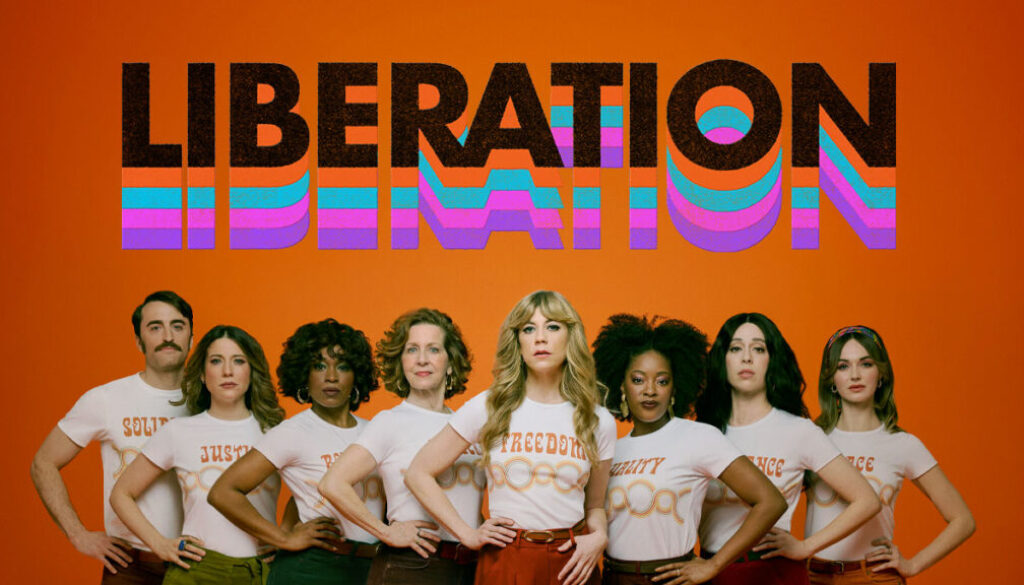
Liberation is a new play by Bess Wohl — the American playwright best known for Grand Horizons on Broadway (2020) and Small Mouth Sounds Off-Broadway. It is her most ambitious and most personal work: a memory play rooted in the real experience of her mother, who participated in a women’s consciousness-raising group in Ohio in the early 1970s. The play’s title carries its full weight: it is about women seeking liberation from the social structures that constrained them, and about the complicated, sometimes painful, always incomplete process of historical and personal reckoning that follows.
The play was commissioned and developed by the Roundabout Theatre Company and made its world Off-Broadway premiere at Roundabout’s Laura Pels Theatre on 20 February 2025, where it ran through 6 April 2025. Directed by Whitney White — nominated as one of two women in their respective directing categories at the 2026 Tonys, making the Liberation team the only all-female playwright-director pair nominated this season — the production transferred to Broadway’s James Earl Jones Theatre, beginning previews on 8 October 2025 and opening officially on 28 October 2025. The limited engagement ran through 1 February 2026 — extended by three weeks from its original closing date.
The Pulitzer Prize jury described the play as “a striking blend of comedy and sincerity that explores the legacy of the consciousness-raising feminist groups of the 1970s, using the story of the playwright’s mother to demonstrate how the movement grew out of conversation, and that anyone experiencing the play has joined the discussion.” The Pulitzer was announced on 4 May 2026 — one day before the Tony nominations. Wohl herself previously received a Pulitzer nomination for Grand Horizons.
The play follows two narrative threads in close parallel. In 1970, in a rec-centre basement in Ohio, Lizzie — a University of Chicago-educated journalist frustrated by being assigned to the obituary and wedding sections at her newspaper — gathers a weekly women’s consciousness-raising group. The group includes Margie (Betsy Aidem), an older housewife feeling the bars of a cage now that her children have grown; Celeste (Kristolyn Lloyd), a Black Harvard-educated editor who has returned to Ohio to care for her ailing mother; Isidora (Irene Sofia Lucio), an Italian immigrant who married for a green card; Dora (Audrey Corsa), an ambitious young woman hitting the ceiling at her job; Susan (Adina Verson); and Joanne (Kayla Davion). Fifty years later, Lizzie’s daughter — also named Lizzie — is trying to understand who her late mother really was and what she gave up when she chose marriage and family over the radical aspirations of her youth.
Both Lizzies are played by Susannah Flood — the production’s central technical and emotional challenge, and the source of its most profound dramatic resonance. Like the play itself, Flood must inhabit two time periods simultaneously: the daughter’s present-day reckoning and the mother’s 1970s urgency, often within the same scene, switching registers with what critics described as uncanny fluency.
The production also features a phone-free policy — audiences lock devices in pouches for the second act, a decision driven partly by the production’s privacy concerns and partly by the immersive quality of the experience, which benefits from an audience fully present and undistracted.
Flood as Lizzie: The Performance at the Heart of a Pulitzer Winner
The role of Lizzie in Liberation is, structurally, one of the most demanding on Broadway in recent years. Flood must simultaneously narrate the story as the daughter in the present day, inhabit the body and psychology of the mother in the 1970s sequences, break the fourth wall to address the audience directly, and step out of the narrative altogether to interrogate other characters when the material hits too close to home. All of this while remaining the emotional anchor of a two-and-a-half-hour production that depends on her being credible, specific, and warm in both of its time periods and in the meta-theatrical frame that surrounds them.
Stage and Cinema described her as guiding the audience “with nimble intelligence and sly charm,” calling her character “a reluctant leader” — a phrase that captures the particular quality Flood brings to the role. Her Lizzie is not a heroic protagonist in a conventional sense. She is a daughter trying to do right by a mother she never fully understood, a playwright’s stand-in for an audience of dejected liberals, and a woman embodying her own mother’s radical past with a mixture of love and bewilderment. That Flood makes all of these functions coexist in a single performance — with grace, with humour, and with genuine emotional depth — is the achievement at the centre of the production.
The New York Theatre Guide described Flood’s Lizzie as “serving dual purposes: she is herself, her mother, the playwright, and a stand-in for a 2025 audience of dejected liberals all at once.” The review noted that Flood’s character “is the story” — that the sophisticated device of the self-insert playwright character works precisely because Flood gives it so much specific, particular humanity. TheaterMania’s Rachel Graham called the production “funny, emotional, enraging, and inspiring” — and Flood is the axis on which all of those registers turn.
In her own words, from the TheaterMania interview conducted just before the Broadway opening, Flood described the production as “a complete high-water mark in my career and life.” She invoked Glenda Jackson’s return to Broadway in 2018 — at the age of 82, winning a Tony for Three Tall Women — as the model for the kind of career she aspires to: “All of this intelligence and all of this life came on stage with her. That is the career that I want. I want a big life with a great variety of experience.”
It is a statement that reveals something essential about how Flood understands the theatrical life: not as a sprint toward celebrity but as a long game of sustained artistic investment. The career she has built — the Off-Broadway credits, the institutional relationships, the willingness to do adventurous work in small venues for its own sake — is entirely consonant with that vision. Liberation is not the beginning of her story. It is a flower that has been growing for a very long time.
What the Critics Said: Review Roundup
The critical reception to Liberation and to Flood’s performance was warm to very warm, with the production hailed in several quarters as the best new play of the Broadway season. Deadline called it the best play of the entire 2025 calendar year. Here is what the major outlets had to say.
Tony Nominated: Best Actress in a Leading Role in a Play
Susannah Flood’s first-ever Tony nomination arrives for a performance that required her to play two characters simultaneously across two time periods in one of the season’s most formally demanding roles. The nomination comes one day after the Pulitzer Prize was awarded to the play she leads.
Full category nominees:
- Rose Byrne — Fallen Angels
- Carrie Coon — Bug
- Susannah Flood — Liberation
- Lesley Manville — Oedipus
- Kelli O’Hara — Fallen Angels
Screen Credits: For the People, Life & Beth, and a Radio Drama Podcast
While the stage has always been Flood’s primary artistic home, her screen career has included a number of notable credits that have brought her to wider public attention. Her television debut came in 2015 with a guest appearance as Sarah Keller on Law & Order: Special Victims Unit, followed by a recurring role as Athena across three episodes of Chicago Fire in the same year.
Her most significant television role came when she was cast as Kate Littlejohn — a young, ambitious, legally gifted prosecutor — on Shonda Rhimes’s legal drama For the People (ABC, 2018–2019). The show, set in the Southern District of New York federal court, was produced by Shondaland and gave Flood her first sustained national television exposure. As a regular cast member in a Shondaland production, she was introduced to a substantial audience beyond the New York theatrical community that had long known her work.
More recently, she appeared as Ann, the sister of Amy Schumer’s character, in the Hulu comedy series Life & Beth — a warm, semi-autobiographical show that gave Flood the opportunity to demonstrate the comic ease that her stage work has always displayed. She is also cast in Mary Laws’ upcoming series Daylight Daycare for Annapurna/Hulu, a production that has not yet aired but suggests her screen career continues to develop alongside her theatrical one.
Perhaps the most distinctive of her non-stage credits is her role as the voice of Laeticia Saltier on Julian Koster’s surreal fictional radio drama podcast The Orbiting Human Circus (of the Air) — a production of NightVale Presents and WNYC that has developed a devoted following. It is the kind of project that is entirely consonant with Flood’s theatrical identity: formally unusual, devoted to the possibilities of performance in unconventional spaces, and not obviously serving any conventional career-building purpose. She does it because it is interesting and because it is good work. That, in miniature, is the whole of her artistic philosophy.
A Career in Full: Selected Stage and Screen Credits
Graduates summa cum laude from UC Berkeley with a BA in English, having been a member of the Women’s Lightweight Crew. Completes MFA in Acting at the Brown University/Trinity Repertory Company programme in Providence, Rhode Island. Begins building her Off-Broadway career in New York.
Becomes an affiliated artist with Clubbed Thumb, one of New York’s most adventurous developmental companies. Appears in two productions that establish her as a key figure in the downtown theatrical scene and signal her appetite for formally unusual, theatrically challenging new work.
Builds her Off-Broadway résumé at two of New York’s most distinguished institutional theatres. Mr. Burns, a Post-Electric Play (Anne Washburn) at Playwrights Horizons demonstrates her range with formally ambitious, post-apocalyptic material. Love & Information and Scenes from a Marriage at NYTW extend her classical and contemporary range.
Two significant Barrow Street Theatre productions — Lucy Prebble’s The Effect (about love and antidepressants) and Nina Raine’s Tribes (about deaf culture and belonging) — confirm her as one of the most versatile Off-Broadway actresses of her generation.
Makes her first television appearances: a guest role as Sarah Keller on Law & Order: SVU and a recurring role as Athena across three episodes of Chicago Fire.
Broadway debut as Dunyasha alongside Diane Lane, Joel Grey, and Harold Perrineau in the Roundabout Theatre Company revival of Chekhov. Her entrance into the Broadway world at a major institutional theatre in a distinguished revival production.
Stars as prosecutor Kate Littlejohn in Shonda Rhimes’s legal drama set in New York federal court. First major national television exposure. The show brings her to the attention of audiences beyond the New York theatre community.
Returns to Broadway in Noah Haidle’s new play tracing one woman’s life from eighteen to a hundred, directed by Vivienne Benesch, with Debra Messing in the lead role. Plays multiple roles across the production’s expansive temporal structure.
A sustained run of Off-Broadway work at three of New York’s most distinguished institutions in consecutive seasons. The Counter at Second Stage’s Laura Pels Theatre, alongside Anthony Edwards and Amy Warren, is the most high-profile of the three. Each production adds a further layer to her already formidable Off-Broadway reputation.
World premiere of Bess Wohl’s Liberation, directed by Whitney White, at Roundabout’s Off-Broadway venue. The production earns the New York Drama Critics’ Circle Award for Best Ensemble. Flood receives a Lucille Lortel Award nomination for Outstanding Lead Performer in a Play.
Broadway transfer of the Off-Broadway production, with the full original cast. Opens 28 October 2025 and runs through 1 February 2026 — extended three weeks from original closing. The play wins the 2026 Pulitzer Prize for Drama (announced 4 May 2026). Flood earns her first Tony Award nomination for Best Actress in a Leading Role in a Play. The production receives five Tony nominations in total.
The Long Game: What Susannah Flood’s Nomination Means for American Theatre
There is a particular satisfaction in the arc of Susannah Flood’s story that goes beyond individual career success. In a Broadway season dominated by headline-generating celebrity debuts and star-powered revivals, the nomination of an actress who has spent fifteen years doing serious work at serious institutions — at Clubbed Thumb, at NYTW, at Playwrights Horizons, at Barrow Street — without ever seeking the spotlight for its own sake, feels like a statement about what matters in American theatre.
Flood herself has been explicit about this. In her TheaterMania interview, she pointed to Glenda Jackson’s 2018 Tony win at 82 as the model she aspires to: not a career built on a single famous role, but a career built on decades of accumulated intelligence and experience, arriving on stage with the full weight of a life lived with full commitment to the art. The career that earns a standing ovation not for the name on the marquee but for the body of work that precedes it.
Her father’s Actors Studio lineage, her UC Berkeley summa cum laude, her Brown/Trinity MFA, her fifteen years of Off-Broadway work, her affiliated artist status at Clubbed Thumb, her two New York Drama Critics’ Circle Awards with the Liberation ensemble — all of these coalesce, in this Tony nomination, into a recognition that the long game she has been playing is the right game. Liberation is her high-water mark, as she has said herself. It is also, at 43, just the beginning of a second act that looks very bright indeed.
I do think it’s a long game. That is the career that I want. I want a big life with a great variety of experience.
Susannah Flood, TheaterMania, October 2025, citing Glenda Jackson as her career model