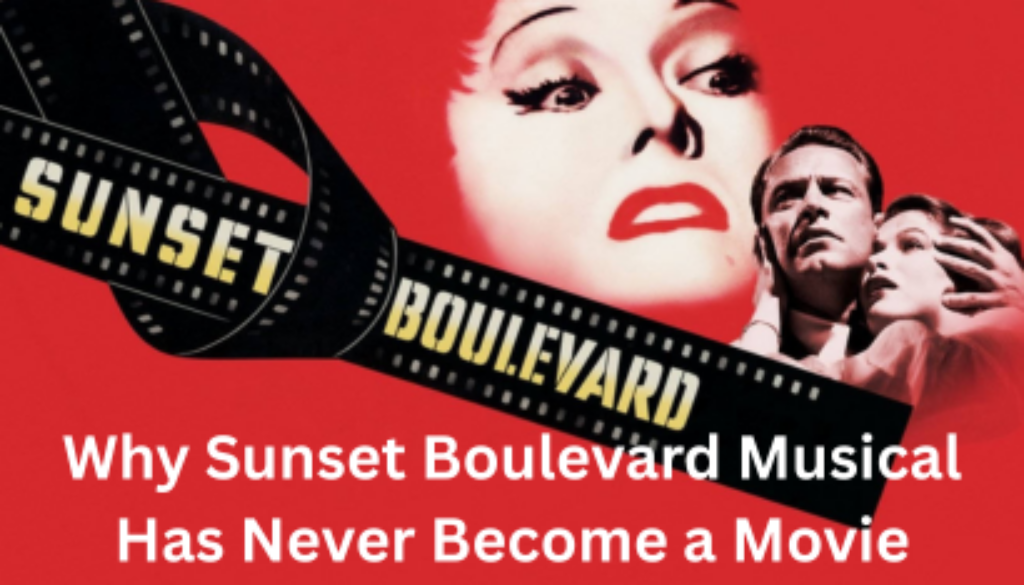
Why Sunset Boulevard Musical Has Never Become a Movie
Ready for Her Close-Up —
But Hollywood Won’t Call
Why the Sunset Boulevard Musical Has Never Become a Movie
From Billy Wilder’s 1950 masterpiece to Andrew Lloyd Webber’s Tony-winning stage phenomenon — the full, fascinating story of why a film version has been stuck in development hell for decades.
“I am big. It’s the pictures that got small.” Norma Desmond’s most famous line has become one of cinema’s greatest quotes. Yet the most famous stage retelling of her story — Andrew Lloyd Webber’s Sunset Boulevard, the Tony Award-winning musical that has obsessed audiences for over thirty years — has never itself been made into a film. Given that the original 1950 movie is considered one of the greatest ever made, and that the musical has produced some of the most celebrated performances in Broadway and West End history, the question is reasonable: why not? The answer, it turns out, is as dramatic, complicated, and riddled with Hollywood politics as anything that has ever happened on the Sunset Strip.
The Original Film: A Dark Masterpiece Born From Hollywood’s Own Shadows
To understand why the musical matters so much — and why a film version is so elusive — you have to go back to the beginning. Sunset Boulevard is a 1950 American black comedy film noir directed by Billy Wilder and co-written by Wilder, Charles Brackett, and D. M. Marshman Jr. The film stars William Holden as Joe Gillis, a struggling screenwriter, and Gloria Swanson as Norma Desmond, a former silent film star who draws him into her deranged fantasy world, where she dreams of making a triumphant return to the screen. Erich von Stroheim plays Max von Mayerling, her devoted butler.
What made the film so extraordinary — and so dangerous — was its savage willingness to bite the hand that fed it. Director Cecil B. DeMille and gossip columnist Hedda Hopper play themselves, and the film includes cameo appearances by silent film stars Buster Keaton, H. B. Warner, and Anna Q. Nilsson. By populating his film with real Hollywood legends playing versions of themselves or roles that mirrored their actual lives, Wilder created something unprecedented: a Hollywood movie about Hollywood’s cruelty, made with Hollywood’s own money, featuring Hollywood’s own stars as evidence. One cannot ignore the film’s autobiographical aspects. Gloria Swanson plays Norma Desmond, the aging silent film star, and like Norma, Swanson’s career declined shortly after the advent of sound. Also, Max, Norma’s chauffeur, had been one of her greatest directors. Erich von Stroheim plays the role and, like Max, he had been one of the more talented directors of the 1920s whose career ended abruptly during the next decade.
Narrated in flashback by the corpse of luckless screenwriter Joe Gillis floating facedown in a Los Angeles swimming pool, Wilder’s audaciously dark examination of the Hollywood dream factory cruelly casts faded silent-movie star Gloria Swanson as has-been silent star Norma Desmond. The narrative device of a dead man telling his own story was radical for its time, and studio executives were horrified — famously, the original edit opened with a scene inside a morgue, with the assembled corpses discussing how they came to be there. The audience reacted with laughter and seemed unsure whether to view the rest of the film as drama or comedy. After several poor preview screenings, the morgue opening was replaced by the poolside opening we know today.
The Hollywood establishment’s initial reaction to the finished film was equally turbulent. In Hollywood, Paramount arranged a private screening for the various studio heads and specially invited guests. After viewing the film, Barbara Stanwyck knelt to kiss the hem of Gloria Swanson’s skirt. But not everyone was so reverential. The legendary Louis B. Mayer condemned Billy Wilder for “ruining the industry,” and Wilder reportedly replied with a vulgarity that became part of Hollywood lore.
Praised by many critics when first released, Sunset Boulevard was nominated for 11 Academy Awards, including nominations in all four acting categories, and won three — for Best Original Screenplay, Best Art Direction, and Best Original Score (Franz Waxman). Review aggregator Rotten Tomatoes reports that 98% of critics gave the film a positive review based on 112 reviews, with an average rating of 9.5/10. The critical consensus states: “Arguably the greatest movie about Hollywood, Billy Wilder’s masterpiece Sunset Boulevard is a tremendously entertaining combination of noir, black comedy, and character study.”
The 1950 Film — Key Facts
- Director: Billy Wilder | Stars: William Holden, Gloria Swanson, Erich von Stroheim, Nancy Olson
- Studio: Paramount Pictures | Premiere: Radio City Music Hall, August 10, 1950
- Oscar nominations: 11 (won 3: Screenplay, Art Direction, Score)
- Gloria Swanson, William Holden, and director Wilder were all Oscar-nominated
- Currently holds a 98% critics score on Rotten Tomatoes — 9.5/10 average
- Ranked on AFI’s 100 Greatest American Films list; Norma Desmond rated one of cinema’s greatest characters
Fifty Years of Failed Attempts: The Musical That Nobody Could Make
The potential of the 1950 film Sunset Boulevard for adaptation into a musical was obvious to those in the theater industry almost as soon as it was released. And the attempts began almost immediately — though for decades, they all ran into the same wall.
Gloria Swanson – musical version of Sunset Boulevard (1957)
From approximately 1952 to 1956, Gloria Swanson herself worked with actor Richard Stapley (aka Richard Wyler) and cabaret singer and pianist Dickson Hughes on a musical adaptation originally entitled Starring Norma Desmond, then Boulevard!. It ended on a happier note than the film, with Norma Desmond allowing Joe Gillis to leave and pursue a happy ending with Betty Schaefer. Swanson spent some $20,000 of her own money — the equivalent of around $200,000 today — recording demos and wooing producers, even performing a number on the Steve Allen Show in 1957. But Paramount reneged on whatever agreement they’d had with Swanson to develop the project. “It would be damaging for the property to be offered to the entertainment public in another form such as a stage musical,” their letter went.
Stephen Sondheim briefly considered turning Sunset Boulevard into a musical until meeting Billy Wilder at a cocktail party, who told him that the film would be better adapted as an opera rather than a musical. That conversation with Wilder cast a long shadow — the great director’s insistence that the material could only work as opera discouraged some of the greatest lyricists of the era from touching it. Hal Prince later approached Sondheim to adapt the film as a musical with Angela Lansbury playing Norma Desmond. John Kander and Fred Ebb were also approached by Hal Prince to write a musical of Sunset Boulevard.
All through the 1960s and 1970s, the project shuttled between creative teams. There is an undated piece of paper, likely from the same era, with only the words “Sunset / 1) Shevelove 2) Goldman 3) John Kander.” Even Betty Comden and Adolph Green — who had written some of the great Hollywood-themed musicals including Singin’ in the Rain — were approached. None of them succeeded in cracking it. After Prince finally let the rights lapse in 1982, Lloyd Webber quietly snapped them up. A chain of other successful shows (Cats, Phantom of the Opera, Starlight Express) kept Webber busy until the early 1990s.
Andrew Lloyd Webber’s Sunset Boulevard: How the Musical Was Made
When Andrew Lloyd Webber finally turned his full attention to Sunset Boulevard in the early 1990s, he was the biggest composer in the history of musical theatre. Cats, The Phantom of the Opera, Evita — his shows had not merely succeeded on Broadway and the West End; they had redefined what those stages were capable of commercially. The prospect of Webber tackling the darkest, most cinematic source material in American film history was electrifying.
The path to the finished show was characteristically turbulent. Webber decided to work with his collaborator from Aspects of Love and Starlight Express, Don Black, and playwright Christopher Hampton, who had written the play Tales From Hollywood which, like Sunset, also includes a death in a swimming pool. An earlier lyricist, Amy Powers, had also contributed: Powers would ultimately receive an “additional lyrics” credit on four key songs in Sunset Boulevard: “With One Look,” “The Greatest Star of All,” “Sunset Boulevard” and “As If We Never Said Goodbye.”
Lloyd Webber’s earliest workshop presentation at Sydmonton was only about 30 minutes long, with Ria Jones and Michael Ball in the central roles. Over two years of development, the show grew into a fully formed musical drama. In August 1992, Patti LuPone was in Los Angeles, starring in the fourth season of the dreary ABC drama Life when she was cast as Norma Desmond for the world premiere.
The musical’s world-premiere production was nominated for Best New Musical at the 1994 Laurence Olivier Awards. It opened at the Adelphi Theatre in London in July 1993 to a divided critical response — but audiences loved it, and Patti LuPone’s performance was widely celebrated as the performance of her career. Then came one of the most notorious events in Broadway history.
The LuPone Affair: “I Got Fired in Liz Smith’s Column”
Patti LuPone was contractually promised the role of Norma in the show’s Broadway run when she signed on for the West End premiere. After she was replaced by Glenn Close, LuPone sued Andrew Lloyd Webber and received a settlement of roughly $1 million. She used the money in part to add a pool to her Connecticut home, which she named the “Andrew Lloyd Webber Memorial Pool.”
LuPone was in her dressing room when she received a call from her agent in New York. Gossip columnist Liz Smith had taken the liberty of making the announcement in the New York Daily News: “It isn’t even a bet; it’s a fact. Although the Andrew Lloyd Webber company won’t confirm or deny, Glenn Close will begin rehearsals as Norma Desmond in New York on August 1.” “I got fired in Liz Smith’s column,” LuPone wrote.
The decision to replace LuPone with Glenn Close for the Broadway transfer was driven by the belief that American audiences and producers would respond better to a marquee Hollywood name in the role. The calculation proved commercially correct but artistically divisive. What makes this recording less appealing than the original is that Close, despite summoning a fascinating and intricate characterization apparent in the recitative and spoken moments, is not as comfortable with the vocals as LuPone. Nevertheless, the 1994 Broadway production triumphed at the 1995 Tony Awards, winning Best Musical, Best Original Score, Best Book of a Musical, and Best Performance By A Leading Actress in a Musical for Glenn Close.
The Score: What Andrew Lloyd Webber Created
At the heart of the show’s enduring power is one of Lloyd Webber’s most cinematic and emotionally sophisticated scores. Integrating spoken dialogue, songs and dance numbers, the musical seamlessly fuses grand orchestral anthems, haunting ballads, and jazz-influenced tunes — arguably one of Andrew Lloyd Webber’s most remarkable scores.
The dark opening theme recalls Franz Waxman — the composer of the original film score — while throughout the lush strings perfectly evoke old Hollywood, occasionally broken by wonderfully jazzy interludes. Webber constructed the score around a system of recurring themes or leitmotifs, each associated with a character or emotional state, in the tradition of operatic composition.
The Greatest Norma Desmonds: A Roll Call of Legends
One of the show’s remarkable qualities is the way it has drawn the greatest performers of multiple generations into the role of Norma Desmond. The part demands a combination of operatic vocal power, physical charisma, comedic timing, and emotional ferocity that very few performers possess — and yet, across thirty years of productions, the show has assembled an extraordinary roster.
| Performer | Production | Year | Award |
|---|---|---|---|
| Patti LuPone | World Premiere, Adelphi Theatre, London | 1993 | Olivier Nomination |
| Glenn Close | Original Broadway, Minskoff Theatre | 1994–97 | Tony Award Winner ★ |
| Betty Buckley | London (replacement) & Broadway (replacement) | 1994–96 | Olivier Nomination |
| Elaine Paige | London & US Tour | 1995–96 | Multiple nominations |
| Diahann Carroll | Toronto Production | 1995 | First Black Norma |
| Rita Moreno | US National Tour | 1997 | Broadway replacement run |
| Glenn Close | English National Opera / Palace Theatre, Broadway | 2016–17 | Broadway revival |
| Nicole Scherzinger | Savoy Theatre, London / St. James Theatre, Broadway | 2023–25 | Olivier + Tony Winner ★★ |
| Sarah Brightman | Princess Theatre Melbourne / Sydney Opera House | 2024–25 | Australia/Asia Tour |
The 2023 Revival: Jamie Lloyd Reinvents Everything
When director Jamie Lloyd unveiled his production of Sunset Boulevard at London’s Savoy Theatre in 2023, the theatrical world was not sure what to expect. Lloyd was known for radical minimalist reinventions of classic plays — stripping away scenery, forcing audiences to confront raw performance. What could that possibly mean for a show famous for its grand Hollywood sets and sweeping orchestrations?
The answer electrified audiences. Starring Nicole Scherzinger as Norma, the piece was reimagined in a modern and minimalist staging directed by Jamie Lloyd and produced by Lloyd Webber Harrison Musicals. Others in the cast were Tom Francis, David Thaxton, and Grace Hodgett Young (in her professional debut) as Joe, Max, and Betty, respectively. Where previous productions had built elaborate Hollywood mansions on stage, Lloyd stripped the set entirely bare, using live video projection and close-up cameras to bring Norma’s deluded inner world to life in real time.
The revival received eleven nominations at the 2024 Laurence Olivier Awards and won seven, the most for any production of the season, including Best Musical Revival, Best Actress and Actor in a Musical for Scherzinger and Francis, and Best Director for Lloyd.
The Broadway transfer was even more audacious. In a six-minute sequence at the start of the second act, Joe walked through the backstage area of the theater, exited onto West 44th Street, and began to sing “Sunset Boulevard”. As he sang, he strode down the street and through Shubert Alley, joined by the company before reentering the theater at the end of the song. A 25-foot LCD screen inside the theater followed the sequence live. Nicole Scherzinger earned her first Tony Award for reprising her celebrated leading performance as fading film icon Norma Desmond in her Broadway debut.
The Movie That Never Was: Development Hell on Sunset Boulevard
And this brings us to the central question: with a musical this celebrated, this regularly revived, this beloved — why has no one made it into a movie?
The answer begins with rights. The 1950 film was a Paramount Pictures production, and Paramount retains significant control over any adaptation of the material. Since the musical began, efforts to make a film version have collided repeatedly with Paramount’s reluctance, changing studio leadership, shifting market conditions, and the sheer difficulty of the creative challenge.
Timeline of the Movie That Never Got Made
- 2005: Paramount Pictures first announced that a film adaptation was in development. No director or cast was named, and the project stalled almost immediately.
- 2013: Lloyd Webber said: “Talks with Paramount have never led to anything. I think in many ways Sunset is the most complete musical I have written. I’m producing School of Rock on stage, and that’s a Paramount picture, so maybe if they like what I do with that they’ll let me do Sunset.”
- 2019: Rob Ashford signed on to direct the film, with Glenn Close starring, and Tom MacRae writing the script. The project seemed closer than ever. Production hoped to begin later that year.
- 2020: COVID-19 derails all production timelines across Hollywood. The Sunset Boulevard film joins dozens of delayed projects.
- 2021: Lloyd Webber stated: “Paramount has not wanted to go ahead with it. Glenn Close has been absolutely doggedly trying to get it made.”
- 2024: Close stated that the film is still moving forward, but Ashford is no longer directing. Close praised a revised script from a new writer on Watch What Happens Live, noting, “We’re looking for a director.”
- 2025: Nicole Scherzinger, speaking to The Hollywood Reporter, was asked about a film adaptation. “There has been some talk. That is my dream, so I’m manifesting that right now,” she responded.
The film adaptation has been in development hell for years, with Close and Andrew Lloyd Webber shopping it to several film studios. Close originally stated that the film would go into production with Paramount in the summer of 2021. However, Webber revealed that Paramount ended up passing on it. “She’s tried, I’ve tried, everyone’s tried. Ultimately, it’s going to be their decision,” Webber explained.
So Why Can’t It Get Made?
The reasons are layered and interconnected. First, there is the creative paradox at the heart of the project: Sunset Boulevard is a musical about a woman who cannot accept that her career in film is over. Making a film of a musical about the tragedy of silent film — using the very medium that destroyed Norma Desmond — carries a meta-textual irony that filmmakers and studios find difficult to navigate. Do you embrace the irony? Ignore it? The question has no clean answer.
Second, there is the casting problem. Every major actress of the last three decades has been linked to the role — Barbra Streisand, Meryl Streep, and many others have been discussed over the years. But the role of Norma Desmond is extraordinarily demanding: it requires a performer who can sing powerfully enough to justify the great Lloyd Webber songs, act at a world-class level, and carry the weight of the meta-theatrical resonance that the role demands. In the age of movie musicals, finding someone who genuinely ticks all three boxes — and who Paramount will greenlight for a major studio release — has proved elusive.
Third, there is the question of what form such a film would take. The Jamie Lloyd revival demonstrated brilliantly that the material can be reinvented in startlingly modern ways. But a film musical requires different decisions from a stage production, and the Jamie Lloyd aesthetic — built on raw performance, live cameras, and bare staging — does not automatically translate to cinema. Conversely, a conventional lavish Hollywood adaptation risks simply recreating the visual world of the 1950 original, which would raise the obvious question of why audiences should watch an imitation when the real thing exists and is available in 4K restoration.
“She’s tried, I’ve tried, everyone’s tried. Ultimately, it’s going to be their decision. I think in many ways Sunset is the most complete musical I have written.”
Fourth — and perhaps most fundamentally — there is Paramount itself. The studio has shown a persistent reluctance over twenty years to commit to this project, even as it has watched other studios make billions with film musical adaptations. The studio’s ownership of the original film means it controls the rights to the property, and its reluctance may reflect a concern about creating a version that somehow diminishes the original — one of the most acclaimed films in Paramount’s entire catalogue — or simply a calculation that the commercial risk does not justify the potential reward.
The Irony of It All: A Show About Not Being a Film, Not Being Made Into a Film
There is something almost too perfect about the situation. Sunset Boulevard — a story about a woman driven mad by her inability to accept that the world of film has moved on without her — exists in a state of permanent longing for a film version that Hollywood keeps dangling and then withdrawing. Norma Desmond spends the entire show waiting for the cameras to call her back. The musical adaptation spends the entire twenty-first century waiting for the cameras to call it back.
In 2025, Nicole Scherzinger said: “There has been some talk” that she might play Norma in the film. And that is exactly where things stand — a whisper, a hope, a manifestation, and a dream deferred. For now, the greatest story ever told about Hollywood’s capacity to discard and destroy is still waiting, like Norma herself, for her close-up.
The Full Timeline: From Billy Wilder to Broadway and Beyond
After more than thirty years on stage and over twenty years of failed film development, Sunset Boulevard remains exactly what it has always been: the greatest story about Hollywood ever told, and the one story Hollywood itself seems unable — or unwilling — to tell again. Whether the cameras ever do call is, for now, one of the great unanswered questions of musical theatre and cinema alike. I’m ready for my close-up — but apparently, the studio is not.
Links
Sunset Boulevard – Memorabilia
La Cage Aux Follies – Memorabilia
Chess the Musical – Memorabilia
Little Shop of Horrors – Memorabilia
Starlight Express – Memorabilia
Dear Evan Hansen – Memorabilia
How to Succeed in Business Without Really Trying – Memorabilia
Terrence McNally – Memorabilia