Kelli O’Hara: 9th Tony Nomination for Fallen Angels Broadway 2026
Kelli O’Hara: Nine Tony Nominations, One Legendary Career — and a Record-Tying Nod for Fallen Angels That Proves She Is Broadway’s Greatest Living Leading Lady
She has been nominated for every major Broadway role she has played since 2005. She won in 2015 for The King and I. She has performed at the Metropolitan Opera, Carnegie Hall, and concert halls in Tokyo. And now, with her ninth Tony nomination, Kelli O’Hara ties Rosemary Harris for the third most nominations by a female performer in Tony history — proving once again that nobody does this better.
Elk City, Oklahoma: An Irish-American Farm Girl Who Conquered Broadway
There is nothing predictable about the journey from a farming community in western Oklahoma to nine Tony Award nominations and the title of Broadway’s greatest living leading lady. But Kelli O’Hara’s story is full of surprises, not least the remarkable consistency with which this daughter of the American heartland has found, in the most demanding and sophisticated theatrical tradition in the English-speaking world, her most natural home.
She was born Kelli Christine O’Hara on 16 April 1976 in Tulsa, Oklahoma, and grew up in Elk City — a small city in the western part of the state, set among the red earth plains that defined the Oklahoma Territory her Irish-American ancestors settled during the Land Rush of 1889. Her maternal great-grandfather was among the 50,000 settlers who vied for a portion of two million acres of territory in that extraordinary moment of American expansion. Her father’s family came from County Clare in the mid-nineteenth century, making their way through Iowa, Colorado, and Missouri. The O’Hara name carries the full weight of that Irish immigrant story — a family that arrived in America with nothing and worked the land with everything it had.
Growing up on a farm, O’Hara developed the work ethic — she has spoken about “chopping cotton” to remove weeds from fields — that would later sustain her through the demanding repetition of Broadway runs. Music was in the household from her earliest years, and at some point the combination of natural vocal ability and family encouragement pointed toward formal training. She attended Deer Creek High School and went on to Oklahoma City University, where she earned a Bachelor of Music in vocal performance and opera — one of the finest music programmes in the American Midwest.
At OCU, she studied voice with Florence Birdwell — a legendary voice teacher whose other students included a young woman named Kristin Chenoweth, who had completed her studies four years before O’Hara arrived. Both O’Hara and Chenoweth are alumnae of the Gamma Phi Beta sorority, and both would become among the most celebrated voices in Broadway history — a remarkable testament to Birdwell’s teaching and to the quality of the OCU programme.
In 1998, O’Hara won the Oklahoma State Metropolitan Opera Competition — a prestigious achievement that confirmed her standing as a serious operatic soprano as well as a theatre performer. The win prompted her move to New York City, where she enrolled at the Lee Strasberg Theatre and Film Institute to add the dramatic training that her musical education had not fully provided. The combination of classical vocal training and Strasberg’s psychologically rigorous acting method would prove an unusually powerful preparation for the career ahead.
The Early Years: From Jekyll & Hyde to the Threshold of Stardom
O’Hara’s professional theatre career began with regional and summer stock productions after her graduation from OCU in 1998, building stage experience in the way that serious theatre training demands: by doing the work, in front of real audiences, across many productions and many venues. Her Broadway debut came in 2000 when she joined the cast of the revival of Jekyll & Hyde as a replacement — a characteristic way for new performers to enter the Broadway ecosystem, joining an existing production and learning, under the pressure of live performance, how the Main Stem operates.
She had previously toured with Jekyll & Hyde in the national tour, giving her an unusually thorough acquaintance with the material before her Broadway debut. The following year she played Young Hattie Walker and Young Phyllis Rogers Stone in the 2001 Broadway revival of Follies — Stephen Sondheim’s ambitious, bittersweet meditation on theatrical nostalgia and personal regret, a production notable for its extraordinary cast of veteran Broadway performers. For a young singer of twenty-five, the opportunity to work alongside the legends of a previous Broadway generation was an education in theatrical values that no school could have provided.
In 2002 she played Susan Hunsecker in Sweet Smell of Success — John Guare and Marvin Hamlisch’s Broadway adaptation of the classic film noir, which starred John Lithgow as the monstrous columnist J.J. Hunsecker. Lithgow would later win the Tony Award for his performance; for O’Hara, it was another opportunity to work at the highest level of the Broadway ecosystem alongside a performer of exceptional range. She has spoken warmly about the experience throughout her career.
Then came Dracula, the Musical (2004), in which she played Lucy Westenra — a production that received mixed reviews but gave O’Hara another leading role in a major production. All of this groundwork — the national tours, the replacement engagements, the supporting roles in major productions — was the patient accumulation of craft and experience that makes a career. And in 2005, everything it had been building toward arrived at once.
The Breakthrough and the Streak: Nine Nominations in Twenty Years
The role that made Kelli O’Hara a Broadway star is one of the most beautiful in the modern American musical theatre. Clara Johnson in Adam Guettel’s The Light in the Piazza (2005) is a young American tourist in Florence whose developmental disability has kept her childlike in ways that are both heartbreaking and luminous. The score — Guettel’s operatically ambitious, utterly distinctive contribution to the musical theatre canon — demands of its leading soprano a range and technical precision that few Broadway performers can match. O’Hara matched it, and then exceeded it. She played the role from March 2005 through December 2005 and earned her first Tony Award nomination for Best Featured Actress in a Musical.
What followed was something that has no real precedent in Broadway history: a nomination streak that extended, with rare interruptions, across every major role she played on the Main Stem for the next two decades. The nominations are not the product of reputation or sentiment but of sustained excellence in widely different roles, different genres, and different theatrical contexts — a consistency of achievement that defines what it means to be a leading actress at the very top of her craft.
After Light in the Piazza, she took on the purely comic role of Babe Williams in the 2006 revival of Richard Adler and Jerry Ross’s The Pajama Game, alongside Harry Connick Jr. — a production that confirmed her ease in lighter, more broadly comic material and earned her a second Tony nomination. Then came Ensign Nellie Forbush in the Lincoln Center Theater revival of Rodgers and Hammerstein’s South Pacific (2008) — one of the great leading roles in the American musical canon, demanding both vocal and dramatic resources of the first order. O’Hara’s Nellie is remembered by those who saw it as one of the defining Broadway performances of the decade: an interpretation that found new emotional depths in a familiar role while never neglecting the score’s demanding vocal requirements. A third Tony nomination.
The 2012 premiere of Nice Work If You Can Get It, with book by Joe DiPietro and music and lyrics by George and Ira Gershwin, gave O’Hara a lighter vehicle — she played Billie Bendix opposite Matthew Broderick — that earned her a fourth Tony nomination and a Grammy nomination for the cast recording. Then came perhaps the most emotionally demanding of all her pre-King and I roles: Francesca in the world premiere of Jason Robert Brown’s The Bridges of Madison County (2014), based on Robert James Waller’s bestselling novel. Playing a married Iowa farmwife who falls in love with a passing photographer, O’Hara inhabited a role of quiet, devastating emotional complexity — a woman whose inner life is in permanent tension with the life she has chosen to lead. A fifth Tony nomination, and the performance that established definitively what she was capable of at the deepest emotional level.
O’Hara swishes Coward’s highborn language like a favourite chablis; the actor is an ascendant grande dame of period pieces from television (The Gilded Age) to opera (The Hours) to musical theater (Days of Wine and Roses). She makes it all look effortless.s
Juan A. Ramírez, The Guardian, reviewing Fallen Angels, 2026The Win: The King and I and the Tony That Crowned a Career
After five Tony nominations without a win — a sequence that led some observers to describe her as “the Susan Lucci of the Tonys,” affectionately — Kelli O’Hara’s moment finally arrived with the Lincoln Center Theater revival of Rodgers and Hammerstein’s The King and I (2015), directed by Bartlett Sher. Playing Anna Leonowens — the spirited British schoolteacher who arrives at the court of the King of Siam in 1862 to educate his children and, inadvertently, to love and lose the man himself — O’Hara gave a performance that critics agreed was the finest of her career to that date: technically flawless, emotionally transparent, and marked by a quality of still authority that made the role feel entirely her own rather than a reprisal of previous celebrated interpretations.
At the 69th Annual Tony Awards, she finally won: Best Performance by an Actress in a Leading Role in a Musical. Her acceptance speech was characteristically warm and gracious, crediting her co-star Ken Watanabe and the Lincoln Center community. The production subsequently transferred to the West End’s London Palladium in 2018, where O’Hara reprised her role — earning a Laurence Olivier Award nomination for Best Actress in a Musical, her first recognition from the British theatrical community.
The win did not slow her output. She continued to build her opera career — her Metropolitan Opera debut had come in 2014, and subsequent productions including Così fan tutte, The Merry Widow, and The Hours (Kevin Puts’ opera, in which she earned a Grammy nomination for Best Opera Recording) confirmed her standing in that world as fully as her theatre work had confirmed it on Broadway. She appeared in productions for ENO (English National Opera) and continued to give concert performances across the United States and internationally.
The Later Nominations: Kiss Me, Kate, Days of Wine and Roses, and the Range of Mastery
The Tony nominations continued. In 2019, O’Hara appeared in the Roundabout Theatre Company revival of Cole Porter’s Kiss Me, Kate, playing Lilli Vanessi / Katharina — one of the great comic roles in the American musical theatre, requiring an actress who can navigate simultaneous layers of character within character as Lilli and Kate collapse and separate. A seventh Tony nomination.
Then, in 2024, came the production that immediately preceded Fallen Angels and that established beyond any residual doubt that O’Hara had arrived at the full maturity of her art. Days of Wine and Roses — Adam Guettel’s new musical based on the 1962 film about alcoholism and co-dependency, with a book by Craig Lucas — cast O’Hara as Kirsten Arnesen alongside Brian d’Arcy James as Joe Clay. The role required everything she had learned about finding complexity in quietness and truth in stillness: Kirsten is a woman who loses everything to addiction, and whose final rejection of the sobriety her husband has found constitutes one of the most devastating endings in recent Broadway history. O’Hara won the Drama Desk Award for Outstanding Lead Performer in a Musical and the Outer Critics Circle Award for the performance — a full critical sweep that generated her eighth Tony nomination and confirmed the trajectory of a career that seems, with every passing production, to find new depths to plumb.
It was immediately after Days of Wine and Roses that O’Hara was approached for Fallen Angels — the perfect counterpoint to Kirsten Arnesen’s tragedy. Where Kirsten is destroyed by alcohol, Julia Sterroll merely gets hilariously drunk on it. The transition from one to the other is the kind of artistic range that only the most complete and self-aware performers can navigate.
Fallen Angels on Broadway: Noël Coward, Champagne, and an Irresistible Partnership
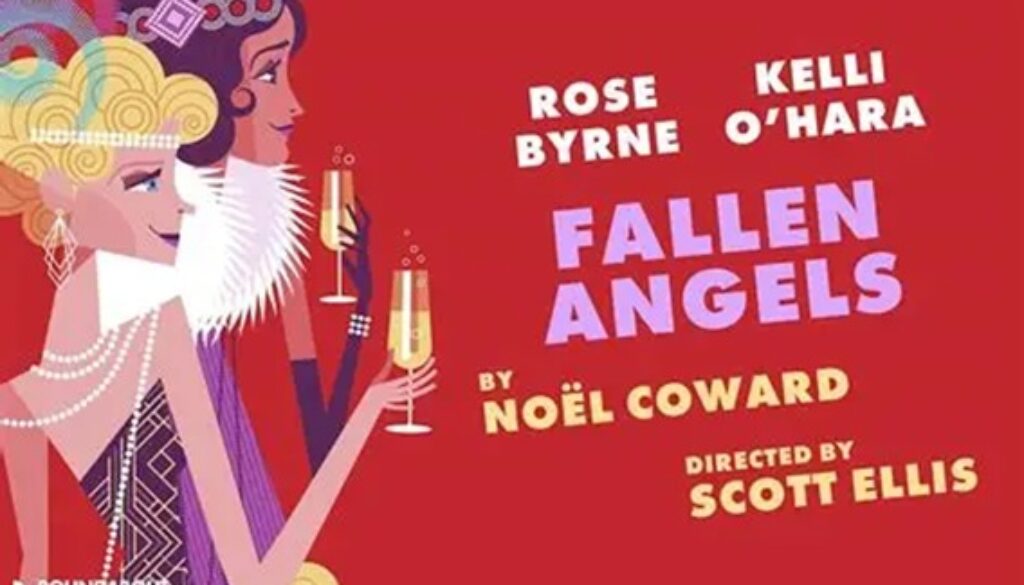
The production details of Fallen Angels are covered in the Rose Byrne profile earlier in this series, but Kelli O’Hara’s specific contribution to the production deserves its own extended treatment. As Julia Sterroll — the more elegant, slightly more composed of the two wives, whose composure is precisely what makes her eventual drunken dissolution so hilarious — O’Hara brings something to the role that is not available in the script but only in the performance: the full weight of a career spent playing queens, heroines, and grandes dames, now deployed in the service of shameless screwball comedy.
O’Hara is playing a character who considers herself a woman of perfect social breeding. The joke — which she commits to completely and mines with consistent precision — is that this breeding is, under sufficient quantities of champagne, no more durable than anyone else’s. The pratfalls, the sliding, the dishevelled wig, the moment-to-moment physical comedy of a woman losing her dignity one glass at a time: these are not things that come naturally to an actress who has spent twenty years being luminously composed on stage. They are the result of deliberate craft, comic timing developed over decades, and a willingness to look genuinely absurd in the service of the play’s central joke.
The SF Examiner’s critic summed it up with particular precision: O’Hara “isn’t simply delivering Noël Coward’s frothy text: She’s also writing her own wordless, parallel comedy about drunkenness via a truly stupendous physical performance. There ought to be a Tony just for the way she clings to a banister.” It is the kind of observation that captures what distinguishes a great comic performance from a merely funny one: the invention that goes beyond the script, the physical poetry that creates comedy out of nothing but timing and commitment.
The production is presented by Roundabout Theatre Company at the Todd Haimes Theatre, 227 West 42nd Street, directed by Scott Ellis — O’Hara’s director from The Light in the Piazza twenty years earlier, making this a reunion of considerable theatrical history. It runs through 7 June 2026. A live BroadwayHD stream takes place on 5 June 2026.
What the Critics Said: Review Roundup
Tony Nominated: Best Actress in a Leading Role in a Play — 9th Career Nomination
Kelli O’Hara’s ninth Tony nomination ties her with Rosemary Harris for third most by any female performer in Tony history, behind only Audra McDonald (11) and Julie Harris and Chita Rivera (10 each). Notably, this is O’Hara’s first nomination in the Best Actress in a Play category — her previous eight nominations were all in musical categories. She competes against her Fallen Angels co-star Rose Byrne.
Full Best Actress in a Play category nominees:
- Rose Byrne — Fallen Angels
- Carrie Coon — Bug
- Susannah Flood — Liberation
- Lesley Manville — Oedipus
- Kelli O’Hara — Fallen Angels
The Complete Tony Award Record: All Nine Nominations
| # | Year | Category | Production / Role | Result |
|---|---|---|---|---|
| 1 | 2005 | Best Featured Actress, Musical | The Light in the Piazza (Clara Johnson) | Nominated |
| 2 | 2006 | Best Actress, Musical | The Pajama Game (Babe Williams) | Nominated |
| 3 | 2008 | Best Actress, Musical | South Pacific (Nellie Forbush) | Nominated |
| 4 | 2012 | Best Actress, Musical | Nice Work If You Can Get It (Billie Bendix) | Nominated |
| 5 | 2014 | Best Actress, Musical | The Bridges of Madison County (Francesca) | Nominated |
| 6 | 2015 | Best Actress, Musical | The King and I (Anna Leonowens) | WON ★ |
| 7 | 2019 | Best Actress, Musical | Kiss Me, Kate (Lilli Vanessi/Katharina) | Nominated |
| 8 | 2024 | Best Actress, Musical | Days of Wine and Roses (Kirsten Arnesen) | Nominated |
| 9 ★ | 2026 | Best Actress in a Leading Role in a Play | Fallen Angels (Julia Sterroll) — FIRST PLAY NOM | Nominated (Pending) |
Beyond Broadway: Opera, Television, and the Range That Defines Her
Kelli O’Hara’s career has always extended well beyond the Broadway stage — a fact that distinguishes her from many of her peers and that reflects the depth of her classical training. Her Metropolitan Opera debut came in 2014 in The Merry Widow — an operetta that sits comfortably between the Broadway musical and the operatic repertoire, and that suited her particular combination of theatrical instinct and classical vocal technique. She returned to the Met in productions of Così fan tutte — Verdi’s comic masterpiece — and in Kevin Puts’ The Hours, based on Michael Cunningham’s Pulitzer Prize-winning novel. The cast recording of The Hours earned O’Hara a Grammy nomination for Best Opera Recording, a genuinely remarkable achievement for an actress primarily associated with the Broadway musical.
On television, she has made her most prominent screen appearances in HBO’s prestigious period drama The Gilded Age — Julian Fellowes’s exploration of New York’s Gilded Age class warfare — in which she plays as part of an ensemble that has also included Carrie Coon. She earned a Screen Actors Guild Award nomination for Outstanding Ensemble Performance for this work. She has also appeared in 13 Reasons Why and in The Accidental Wolf, for which she received a Primetime Emmy nomination for Outstanding Lead Actress in a Short Form Series.
Her concert career has taken her to Carnegie Hall, the Kennedy Center, and concert stages across the United States, Europe, and Japan — including performances at Suntory Hall in Tokyo that confirmed her international standing. She has been honoured with the Drama League Award for Distinguished Achievement in Musical Theatre in 2019 and was inducted into the Oklahoma Hall of Fame in 2016 — a recognition of her status as one of the state’s most distinguished cultural ambassadors.
She has also channelled her passion for music education into her home state, establishing the Kelli O’Hara Awards, which honour Oklahoma high school performers — a legacy programme that ensures the next generation of musical talent in her state has access to the recognition and inspiration that shaped her own early career.
A Career in Full: Selected Broadway and Stage Credits
Begins her professional career after graduating from Oklahoma City University. Regional and summer stock productions build her stage experience; the national tour of Jekyll & Hyde prepares her for her Broadway debut in the same production in 2000.
Broadway debut as a replacement in the long-running production. Her first experience of performing on the Main Stem, beginning the career that will produce nine Tony nominations over the following quarter century.
Plays Young Hattie Walker and Young Phyllis Rogers Stone in this ambitious Sondheim revival, working alongside Broadway veterans in an unusually experienced ensemble for a performer so early in her career.
Plays Susan Hunsecker alongside John Lithgow’s J.J. Hunsecker. Her first leading role in a high-profile new Broadway production — and her first exposure to working at the very top of the industry alongside a Tony-winning performer.
Stars as Lucy Westenra in this musical adaptation, building her leading role résumé before her career-defining breakthrough the following year.
Career breakthrough as Clara Johnson in Adam Guettel’s operatically ambitious musical. First Tony nomination (Best Featured Actress in a Musical). The performance that establishes her as one of Broadway’s most exciting new voices.
Stars as Babe Williams opposite Harry Connick Jr. Second Tony nomination. Demonstrates her ease in broadly comic, lighter material alongside the more serious dramatic weight of Piazza.
Plays Nellie Forbush in Bartlett Sher’s acclaimed Lincoln Center revival — one of the great Rodgers and Hammerstein leading roles. Third Tony nomination, Drama Desk nomination, Outer Critics Circle nomination. A performance critics and audiences describe as one of the finest of the decade.
Stars as Billie Bendix opposite Matthew Broderick in this Gershwin-based musical. Fourth Tony nomination, Grammy nomination for cast recording. The production marks her continued versatility across tonal registers.
World premiere of Jason Robert Brown’s musical as Francesca. Fifth Tony nomination in what many consider her most emotionally complex performance to date. The same year she makes her Metropolitan Opera debut in The Merry Widow.
Wins the Tony Award for Best Actress in a Musical for Anna Leonowens. After five nominations without a win, the prize arrives in the most acclaimed and widely seen production of her career. Reprises the role in the West End (London Palladium, 2018) — Olivier Award nomination.
Stars as Lilli Vanessi/Katharina in Cole Porter’s classic. Seventh Tony nomination. Her partnership with Roundabout Theatre Company continues, with Scott Ellis directing — the same director who helms Fallen Angels.
Stars as Kirsten Arnesen in Adam Guettel and Craig Lucas’s devastating musical about alcoholism. Drama Desk Award win and Outer Critics Circle Award win. Eighth Tony nomination. Immediately followed by Fallen Angels.
Stars as Julia Sterroll in the Roundabout Theatre Company revival of Noël Coward’s comedy. Ninth Tony nomination, tying Rosemary Harris for third most by any female performer in Tony history. First nomination in the Best Actress in a Play category. The show runs through 7 June 2026. A live BroadwayHD stream airs 5 June 2026.
Nine Nominations and Counting: What Kelli O’Hara Means to Broadway
To speak of Kelli O’Hara’s career in purely statistical terms — nine nominations, one win, three Grammy nominations, a Met debut, an Olivier nomination, an Emmy nomination — is to describe the outline of something without conveying its substance. The substance is what happens in the theatre when she performs: a combination of vocal perfection, physical ease, emotional intelligence, and comic or dramatic precision that is, by the universal testimony of critics and audiences across three decades, simply unsurpassed by any other leading lady currently working on the Broadway stage.
She came from Elk City, Oklahoma, with Irish blood and farming stock and a voice trained by Florence Birdwell in the same programme that produced Kristin Chenoweth. She won the Metropolitan Opera competition, studied at the Lee Strasberg Institute, and made her Broadway debut as a replacement in Jekyll & Hyde. She spent the next twenty-six years building a career of such consistent excellence that the Tony nominations — nine of them now, across two decades — are less a tribute to individual performances than to a sustained body of work that simply has no equal in the contemporary American musical theatre.
The ninth nomination, for Julia Sterroll in Fallen Angels, is unprecedented in one respect: it is her first in a play rather than a musical, confirming that her gifts — always suspected, never quite tested in the Broadway drama context — are fully transferable across genres. That the SF Examiner’s critic says there ought to be a Tony just for the way she clings to a banister is, in its own way, as complete a critical endorsement as any she has received for her work in Sondheim or Rodgers and Hammerstein. She is the complete article: the Broadway queen who can do it all.
It never gets old, because they’re all very different. I’m excited. Being nominated for a play gives me great pride. It’s always going to be my goal to get better and better and learn more as an actor.
Kelli O’Hara, reacting to her 9th Tony nomination, Playbill, May 2026