Fallen Angels by Noël Coward: Complete Guide, Broadway Revival & History
Fallen Angels by Noël Coward: The Definitive Guide to the Play, Broadway Revival & History
An exhaustive, detailed exploration of Noël Coward’s sparkling, scandal-inducing 1925 farce—from its controversial London West End debut to its major 2026 Broadway revival at the Todd Haimes Theatre starring Rose Byrne and Kelli O’Hara.
When Noël Coward’s Fallen Angels premiered on the London stage in April 1925, it exploded into a theatrical firestorm. Centered on two wealthy, upper-class British wives who get roaring drunk on champagne while anticipating the arrival of a handsome French lover with whom both had passionate pre-marital affairs, the play outraged moral guardians of the Jazz Age. Critics condemned it as “degenerate,” “disgusting,” and an insult to British womanhood. Lord Chamberlain’s censorship office was inundated with calls for its ban. Yet, beneath the initial moral panic lay a brilliant, pioneering comedy of bad manners that treated female sexual desire, domestic boredom, and rivalrous friendship with uninhibited wit and dazzling slapstick charm.
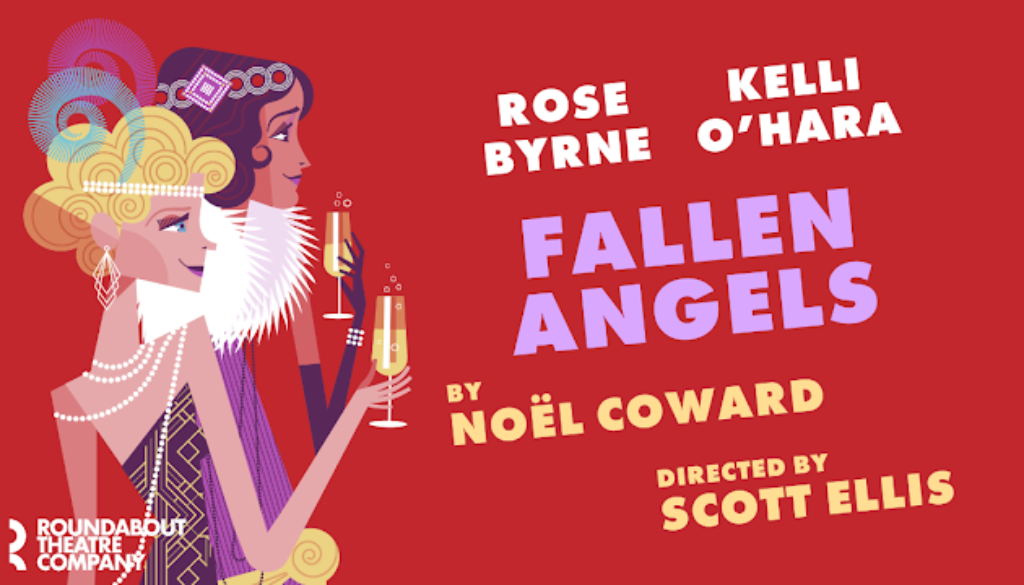
Written in just a few days in late 1924 while Coward was concurrently working on Hay Fever, Fallen Angels proved to be an irresistible star vehicle for comedic actresses. Across a century of performance, legendary stars from Edna Best and Tallulah Bankhead to Hermione Gingold, Joan Collins, and Felicity Kendal have taken on the iconic roles of Julia Sterroll and Jane Banbury. In spring 2026, Roundabout Theatre Company brought Coward’s champagne-soaked farce back to Broadway for its first major main-stem revival in seventy years. Staged at the Todd Haimes Theatre under the direction of Scott Ellis, the production starred Golden Globe winner Rose Byrne as Jane Banbury and Tony Award winner Kelli O’Hara as Julia Sterroll, alongside Mark Consuelos, Christopher Fitzgerald, Aasif Mandvi, and Tracee Chimo. The revival became one of the signature comedic hits of the 2025–2026 Broadway season, picking up Tony nominations for Best Revival of a Play and costume design honors. Below is the complete, definitive guide to the play’s plot, characters, production history, screen adaptations, awards, and Broadway metrics.
Fallen Angels at a Glance: Essential Historical Facts
- Playwright: Noël Coward
- World Premiere Venue: Globe Theatre (now the Gielgud Theatre), Shaftesbury Avenue, London
- World Premiere Date: April 21, 1925 (Ran for 158 Performances)
- Original London Stars: Edna Best (Julia Sterroll) and Tallulah Bankhead (Jane Banbury)
- Broadway Premiere Venue: 49th Street Theatre (Opening Date: December 1, 1927 | 36 Performances)
- 2026 Broadway Revival Venue: Todd Haimes Theatre (227 West 42nd Street, New York, NY)
- 2026 Broadway Run Dates: Previews began March 27, 2026 | Official Opening: April 19, 2026 | Closing Date: June 7, 2026
- 2026 Broadway Performance Count: 25 Previews and 57 Regular Performances (82 Total Performances)
- 2026 Broadway Lead Cast: Kelli O’Hara (Julia Sterroll), Rose Byrne (Jane Banbury), Mark Consuelos (Maurice Duclos), Aasif Mandvi (Fred Sterroll), Christopher Fitzgerald (Willy Banbury), Tracee Chimo (Saunders)
- 2026 Tony Award Honors: Winner – Best Costume Design of a Play (Jeff Mahshie); Nominee – Best Revival of a Play, Best Lead Actress (Kelli O’Hara, Rose Byrne)
Full Plot Synopsis: Act I, Act II & Act III
Fallen Angels takes place entirely within the stylishly appointed drawing room of Fred and Julia Sterroll’s London flat during the mid-1920s. The entire narrative unfolds over twenty-four hours, driven by romantic anticipation, heavy drinking, and escalating paranoia.
Act I: The Postcard and The Domestic Dilemma
The play opens on a quiet morning in the Sterroll household. Julia Sterroll and her close friend, Jane Banbury, are both five years into comfortable, respectable, yet utterly passionless upper-middle-class marriages to dutiful, golf-obsessed husbands (Fred Sterroll and Willy Banbury). Despite being fond of their husbands, both women privately lament that the romantic spark in their lives has completely fizzled out.
Domestic routine is disrupted when a postcard arrives from Italy. It is from Maurice Duclos—a suave, irresistibly handsome French lothario with whom both Julia and Jane had brief, intensely passionate romantic flings in Pisa before they were married. Neither woman knows that the other also had an affair with Maurice until they compare notes. Maurice’s postcard announces that he is arriving in London that very evening and intends to call on them. The revelation sends Julia and Jane into a panic of mixed emotions: they are terrified of endangering their social standing and marriages, yet desperately thrilled by the prospect of seeing Maurice again.
Conveniently for the women, Fred and Willy leave that afternoon for a weekend golfing trip in the country. Before leaving, Willy and Fred express complete confidence in their wives’ fidelity, blissfully unaware of Maurice’s existence. Meanwhile, the Sterrolls’ new maid, Saunders, makes her presence felt. Saunders is an extraordinarily accomplished woman who has held dozens of varied jobs—from golf caddy and piano tuner to ambulance driver and salon operator—and constantly offers unsolicited, expert advice on every domestic matter. Once their husbands depart, Julia and Jane decide to stay in together for dinner, promising each other that if Maurice calls, they will act with dignified restraint and present a united front.
Act II: Champagne, Confessions, and Catfight
Act II takes place that evening in Julia’s dining room. Dressed in elegant evening gowns, Julia and Jane sit down for dinner served by the ubiquitous Saunders. Nervous anxiety about Maurice’s pending arrival leads them to drink heavily. Beginning with subtle aperitifs, they quickly progress through bottle after bottle of vintage champagne.
As the alcohol takes hold, their pact of solidarity rapidly disintegrates. What began as fond reminiscing about their past romance turns into fierce, competitive jealousy. They bicker over whom Maurice loved more, who possessed better morals, and who is more likely to give in to temptation when he arrives. Their polite facade devolves into a hilarious, slurred shouting match, punctuated by physical comedy, spilled wine, and petty insults about each other’s dresses, age, and manners.
By the end of the meal, Jane accuses Julia of trying to monopolize Maurice for herself. Outraged, Jane storms out of the flat in a huff, declaring that she will intercept Maurice at his hotel. Julia, thoroughly drunk and emotionally exhausted, collapses on the sofa. Moments after Jane leaves, the doorbell rings. It is Maurice Duclos himself, looking dashing, charming, and utterly unbothered. Seeing Julia alone, Maurice sweeps into the apartment with effortless French sophistication, leaving the intoxicated Julia flustered as the act closes.
Act III: Morning After, Misunderstandings, and Reconciliations
Act III opens the following morning. Julia awakens with a roaring hangover and a overwhelming sense of dread. Jane arrives back at the flat early, equally hungover, repentant, and anxious to find out what happened after she left. Julia reveals that Maurice did indeed arrive, but insists that nothing untoward occurred between them because she fell asleep from the champagne. Jane remains skeptical, leading to renewed arguments between the two friends.
Complications double when Fred and Willy return unexpectedly early from their golfing weekend, having encountered terrible weather on the course. Noticing the dozens of empty champagne bottles, the disheveled state of their wives, and the general air of panic in the apartment, the husbands demand an explanation. Jane, attempting to cover her tracks, invents a flimsy story, but the truth comes spilling out when Saunders casually mentions the handsome French gentleman who spent the evening in the drawing room.
Fred and Willy are outraged to discover that their wives spent the evening pining over a former lover. As the husbands bluster and threaten duels, Maurice Duclos reappears at the front door to retrieve a pair of gloves he left behind the night before. Far from being intimidated by the furious husbands, Maurice turns his charming sophistication on Fred and Willy, casually mentioning that he has just rented the vacant luxury flat on the floor directly above them. Overwhelmed by Maurice’s suave charm and aristocratic manners, Fred and Willy find themselves unexpectedly mesmerized by him. In a classic Coward irony, Maurice invites both couples up to his new apartment for aperitifs. As the husbands eagerly accept and walk out with Maurice, Julia and Jane look at each other, fix their hair, share a triumphant smile, and follow the men upstairs, proving that the game of attraction remains entirely in their hands.
Original Casts & Major Broadway Revivals Breakdown
Across a century of theatrical history, Fallen Angels has served as a showcase for comedic stage stars. Below is a comparative cast breakdown across major London and Broadway productions:
| Role | Original London (1925) | Original Broadway (1927) | West End Revival (1967) | Broadway Revival (1956) | Broadway Revival (2026) |
|---|---|---|---|---|---|
| Julia Sterroll | Edna Best | Fay Compton | Joan Greenwood | Margaret Rutherford | Kelli O’Hara |
| Jane Banbury | Tallulah Bankhead | Estelle Winwood | Constance Cummings | Hermione Gingold | Rose Byrne |
| Maurice Duclos | Austin Trevor | Luis Alberni | Nicholas Pennell | John Merivale | Mark Consuelos |
| Fred Sterroll | Arthur Sonten | Gordon Ash | Bernard Braden | William A. Lee | Aasif Mandvi |
| Willy Banbury | Gerald Ames | Gerald Hamer | Hugh Latimer | Reginald Denny | Christopher Fitzgerald |
| Saunders (The Maid) | Mona Harrison | Eileen Beldon | Ann Way | Carmen Mathews | Tracee Chimo |
Comprehensive Production History: 1925 to 2026
London West End Premiere: Globe Theatre
Opening on April 21, 1925, at London’s Globe Theatre, Fallen Angels caused an immediate sensation. Originally, Margaret Bannerman was cast as Jane, but she suffered a nervous breakdown during dress rehearsals. American star Tallulah Bankhead stepped into the role with just a few days’ notice, learning the part overnight. Bankhead’s electric chemistry with Edna Best transformed the play into a box-office smash despite furious attacks from church leaders and theater critics who labeled it “immoral.” It ran for 158 performances, cementing Coward’s reputation as the bad boy of British theater.
The 49th Street Theatre Premiere
Two years after its London success, Fallen Angels opened on Broadway at the 49th Street Theatre on December 1, 1927. Featuring English star Fay Compton and Estelle Winwood, the production faced strict American censorship pressures and lukewarm reviews from New York critics who found its frank depiction of female desire jarring. It closed after a brief run of 36 performances.
The Playhouse Theatre Production
In 1956, Fallen Angels returned to Broadway in a heavily reworked, slapstick-infused production starring beloved British comedy legends Margaret Rutherford and Hermione Gingold. Broadening the comedy into high camp, Rutherford and Gingold’s physical antics delighted audiences, allowing the revival to run for 239 performances at the Playhouse Theatre—the longest Broadway run in the play’s history.
Todd Haimes Theatre (Roundabout Theatre Company)
In spring 2026, Roundabout Theatre Company presented a acclaimed revival of Fallen Angels at the Todd Haimes Theatre on Broadway. Directed by Tony nominee Scott Ellis, the production starred Golden Globe winner Rose Byrne as Jane Banbury and Tony Award winner Kelli O’Hara as Julia Sterroll, featuring television host Mark Consuelos making his Broadway debut as Maurice Duclos. Supported by scenic design from David Rockwell, 1920s period costumes by Jeff Mahshie, and lighting by Kenneth Posner, the revival was praised for restoring Coward’s sharp verbal wit while delivering champagne-soaked physical hilarity. The limited engagement played to 104% capacity in its final weeks, concluding on June 7, 2026, and receiving three Tony Award nominations, with Jeff Mahshie winning for Best Costume Design of a Play. The performance was also filmed and streamed globally on BroadwayHD.
Feature Film & Television Adaptations
Film & Television Screen History
Unlike Noël Coward’s Private Lives, Design for Living, or Blithe Spirit, Fallen Angels was never adapted into a major Hollywood feature film, primarily due to Hays Code censorship restrictions regarding pre-marital affairs and female intoxication throughout the mid-20th century. However, the play has been adapted several times for television. The BBC produced television film versions in 1963 and 1974 (the latter starring Susannah York and Joan Collins as part of the BBC Play of the Month series). In May 2026, the Roundabout Theatre Company Broadway revival starring Rose Byrne and Kelli O’Hara was captured live at the Todd Haimes Theatre and broadcast globally via BroadwayHD and cinema broadcasts, preserving the stage performance for international screen audiences.
Awards, Honors, and Critical Nominations
Throughout its history, Fallen Angels has garnered honors across its West End and Broadway engagements. Below is a summary of major accolades for the 2026 Broadway revival:
2026 Tony Awards Recognition
- Tony Awards: Winner – Best Costume Design of a Play (Jeff Mahshie)
- Tony Awards: Nominee – Best Revival of a Play
- Tony Awards: Nominee – Best Performance by a Lead Actress in a Play (Kelli O’Hara)
- Tony Awards: Nominee – Best Performance by a Lead Actress in a Play (Rose Byrne)
- Tony Awards: Nominee – Best Scenic Design of a Play (David Rockwell)
Outer Critics Circle & Drama Desk Accolades
- Outer Critics Circle: Winner – Outstanding Lead Performer in a Broadway Play (Rose Byrne)
- Outer Critics Circle: Winner – Outstanding Costume Design (Jeff Mahshie)
- Outer Critics Circle: Nominee – Outstanding Revival of a Play
- Drama Desk Awards: Winner – Outstanding Wig and Hair Design (David Brian Brown)
- Drama Desk Awards: Nominee – Outstanding Revival of a Play
- Drama Desk Awards: Nominee – Outstanding Lead Performance (Kelli O’Hara)
Themes and Critical Analysis: Why Fallen Angels Endures
A century after its controversial premiere, Fallen Angels remains a fascinating, highly theatrical piece of comedy due to several key thematic elements:
- Subversion of 1920s Female Respectability: Coward dared to depict married women who openly admitted to past sexual desire without suffering moral tragedy. By treating their desires with lighthearted comedy, Coward challenged the double standards of Jazz Age society.
- The Absurdity of Domestic Boredom: The play satirizes comfortable, predictable marriages. Fred and Willy represent boring domestic stability, while Maurice represents the romantic fantasy that exposes the boredom of middle-class respectability.
- The Dynamics of Female Friendship: Act II’s extended champagne scene is a masterclass in comedic writing. It demonstrates how affection and fierce rivalry coexist between close friends, as alcohol strips away polite social masks.
Reporting, cast data, performance counts, historical information, and awards listings compiled from Wikipedia, Playbill, The New York Times, Internet Broadway Database (IBDB), BroadwayWorld, Roundabout Theatre Company, and TheatreGold Archives.
Explore Authentic Broadway Memorabilia
Discover historic Playbills, vintage posters, and authentic theatrical souvenirs from Noël Coward classics at TheatreGold’s store: