Fiddler on the Roof: The Complete Guide — Broadway’s Record-Breaking Musical Masterpiece | Cast, Songs & History
Fiddler on the Roof - Podcast
Imperial Theatre, Broadway • 22 September 1964
Fiddler on the Roof
Directed & Choreographed by Jerome Robbins • Produced by Harold Prince
Set Design by Boris Aronson (in the style of Marc Chagall)
Based on Tevye the Dairyman stories by Sholem Aleichem
Tradition!
A Masterpiece
of the Stage
Fiddler on the Roof is a musical with music by Jerry Bock, lyrics by Sheldon Harnick, and book by Joseph Stein. Set in the Pale of Settlement of Imperial Russia in 1905, it is based on the Tevye the Dairyman short stories by Sholem Aleichem, written in Yiddish between 1894 and 1914. The story centres on Tevye, a poor Jewish milkman in the village of Anatevka, who attempts to maintain his Jewish traditions as outside forces encroach on his family’s lives — coping with the strong-willed actions of his three older daughters who wish to marry for love, and ultimately facing expulsion from his village by decree of the Tsar.
The original Broadway production, directed and choreographed by Jerome Robbins and produced by Harold Prince, opened at the Imperial Theatre on 22 September 1964. It became the first musical in theatre history to surpass 3,000 performances, running for a total of 3,242 performances. It held the record for the longest-running Broadway musical for almost ten years, until Grease surpassed it. The production won nine Tony Awards including Best Musical, Best Score, Best Book, Best Direction and Best Choreography — a sweep rarely equalled. The original cast recording was selected in 2020 by the Library of Congress for preservation in the National Recording Registry for being culturally, historically and aesthetically significant.
Its songs — “Tradition,” “Matchmaker Matchmaker,” “If I Were a Rich Man,” “Sabbath Prayer,” “To Life (L’Chaim!),” “Sunrise, Sunset,” “Now I Have Everything,” “Do You Love Me?,” “Far From the Home I Love” — are among the most beloved in the entire Broadway canon. More than 500 amateur productions are mounted in the United States alone every year. The musical has been staged in every metropolitan city in the world from Paris to Beijing.
Background
& Creation
Sholem Aleichem — The Source
The musical is based on a series of stories by Sholem Aleichem about his character Tevye the Dairyman, written in Yiddish between 1894 and 1914, depicting Jewish life in a village in the Pale of Settlement of Imperial Russia at the turn of the 20th century. The stories are based on Aleichem’s own upbringing near Kyiv. Aleichem wrote a dramatic adaptation of the stories that he left unfinished at his death — it was produced in Yiddish in 1919 by the Yiddish Art Theater and made into a film in the 1930s. In the late 1950s, a musical called Tevye and his Daughters was produced Off-Broadway by Arnold Perl. Both Rodgers and Hammerstein and Mike Todd briefly considered bringing it to Broadway but dropped the idea.
The “Too Jewish” Debate
Investors and some in the media worried that Fiddler on the Roof might be considered “too Jewish” to attract mainstream audiences. Others considered it too culturally sanitised — middlebrow and superficial. Philip Roth, writing in The New Yorker, called it “shtetl kitsch.” For example, it portrays the local Russian officer as sympathetic rather than brutal, as Sholem Aleichem had described him. And while Aleichem’s stories ended with Tevye alone, his wife dead and his daughters scattered, the musical ends with the family alive and most emigrating together to America. The show found the right balance for its time to become — as one historian put it — “one of the first popular post-Holocaust depictions of the vanished world of Eastern European Jewry.”
Marc Chagall — The Artistic Inspiration
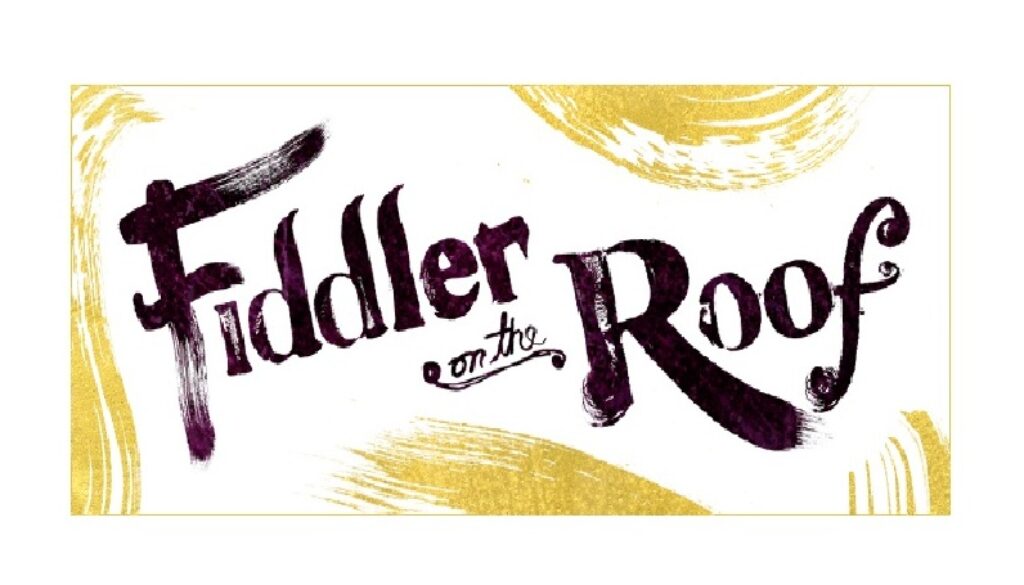
The title Fiddler on the Roof was inspired by various paintings by Marc Chagall — particularly Green Violinist (1924), Le Mort (1924), and The Fiddler (1912) — that also inspired the original set design by Boris Aronson. The writers and Robbins had considered naming the musical simply Tevye before landing on the evocative Chagall-inspired title. Contrary to popular belief, the title does not refer to any specific Chagall painting. Chagall himself reportedly did not like the musical. A colourful logo for the production, also inspired by Chagall’s work, was designed by Tom Morrow.
Jerome Robbins — The Director Who Defined the Show
Harold Prince replaced the original producer Fred Coe and brought in director/choreographer Jerome Robbins — for whom this would be his last original Broadway staging. Robbins’s direction and choreography — including the extraordinary bottle dance at the wedding and the iconic opening of “Tradition” — defined the show’s visual identity. However, his rehearsal process was famously brutal: one of the stars, Zero Mostel, feuded with Robbins, whom he held in contempt because Robbins had cooperated with the House Un-American Activities Committee and hidden his Jewish heritage from the public. Mostel, conversely, had been admired for his confrontational HUAC testimony that led to his blacklisting in the 1950s. Other cast members also had run-ins with Robbins, who reportedly “abused the cast, drove the designers crazy and strained the good nature of Hal Prince.”
The Story —
Anatevka, 1905
Act One — Tradition, Marriage and Change
Tevye, a poor milkman in the Jewish shtetl of Anatevka, explains the customs of his community through the great opening number “Tradition.” He and his wife Golde have five daughters. Village matchmaker Yente has arranged a match between the eldest, Tzeitel, and the wealthy widowed butcher Lazar Wolf — a match Tzeitel dreads. She loves her childhood friend, the poor tailor Motel Kamzoil. The girls wonder about their own prospects (“Matchmaker, Matchmaker”). Tevye, pulling his own milk cart because his horse is lame, asks God why life must be so hard (“If I Were a Rich Man”).
Tevye agrees to let Lazar marry Tzeitel — and they celebrate (“To Life / L’Chaim!”). But Motel finds the courage to ask Tevye for Tzeitel’s hand. Tevye is stunned, but impressed by the timid tailor’s backbone. To break the news to Golde, Tevye invents an elaborate dream sequence (“Tevye’s Dream”) in which dead relatives confirm that Tzeitel must marry Motel. The wedding of Tzeitel and Motel is a joyous occasion (“Sunrise, Sunset,” “The Wedding Dance”) — until Russian riders arrive to perform a “little unofficial demonstration,” wrecking the celebration. Meanwhile, Tevye’s second daughter Hodel has fallen in love with Perchik, a student revolutionary. They announce their engagement, and Tevye gives his blessing, however reluctantly, to a match made without any matchmaker (“Now I Have Everything”).
Act Two — Love, Loss and Departure
Tevye asks Golde, married to him for 25 years by arrangement, whether she loves him (“Do You Love Me?”) — she eventually admits that she does. Perchik is arrested and exiled to Siberia. Hodel refuses to abandon him and leaves Anatevka to be by his side (“Far From the Home I Love”). Tevye’s third daughter Chava has fallen in love with the young Christian Fyedka. When she elopes with him, Tevye faces his most agonising test: interfaith marriage is a line he will not cross. He tells his family to consider Chava dead. Then comes the news: a Tsarist edict orders all Jews to leave Anatevka. The villagers say farewell to their home (“Anatevka”). As the Jews depart, Chava and Fyedka stop to say goodbye — and Tevye, still unable to speak to Chava directly, prompts Tzeitel to add “God be with you” to her farewell. Tevye, Golde and their two youngest daughters leave for America. The fiddler begins to play. Tevye beckons with a nod — and the fiddler follows them out of the village.
The Songs —
The Broadway Canon
The score of Fiddler on the Roof by Jerry Bock and Sheldon Harnick is one of the most celebrated in Broadway history. Virtually every number from the show has entered the popular consciousness. “Sunrise, Sunset” is routinely played at weddings worldwide. “If I Were a Rich Man” has been covered, parodied and referenced countless times across six decades.
The Characters
of Anatevka
The show’s great central figure — a poor Jewish milkman and fierce defender of tradition, whose three older daughters successively test his beliefs with their choices of husbands. His direct addresses to God — alternating prayer, complaint and negotiation — are among the most beloved comic-dramatic devices in Broadway history.
Tevye’s sharp-tongued, practical wife of 25 years — wed to him by arrangement, as was the custom. Her admission in “Do You Love Me?” that she does love him is one of the show’s most touching moments. Maria Karnilova won the Tony Award for Best Featured Actress in the original production.
About nineteen, she loves her childhood friend Motel the tailor and refuses Lazar Wolf’s arranged match. Her defiance is the first crack in Tevye’s defence of tradition — but a crack he accepts, moved by Motel’s courage in asking for her hand.
Intelligent and spirited, she falls in love with the student revolutionary Perchik and later follows him into Siberian exile rather than remain without him. Her farewell song “Far From the Home I Love” is one of the score’s most moving numbers. Adrienne Barbeau later took the role in the original run.
Shy and bookish, she falls in love with the young Christian Fyedka — provoking Tevye’s most agonising crisis. Her elopement with a man outside the Jewish faith is the one act that Tevye cannot bring himself to accept, even as he softens toward her at the last moment of departure.
A Marxist student from Kyiv who arrives in Anatevka and falls in love with Hodel. He defies tradition by crossing the gender divide to dance with her at Tzeitel’s wedding. His arrest and exile to Siberia is the catalyst for Hodel’s departure — and for Tevye’s realisation that the world is truly changing.
The gossipy village matchmaker whose schemes drive the show’s opening plot. Beatrice Arthur created the role in the original production. The character’s name has entered common English usage as a synonym for a gossipy matchmaking woman. Florence Stanley took over the role nine months into the run.
A poor but hardworking tailor who loves Tzeitel and finds the courage to ask Tevye for her hand directly — bypassing the matchmaker entirely. Tevye is impressed by his backbone. His celebration on winning Tevye’s permission — “Miracle of Miracles” — is one of the score’s most joyful numbers.
Original Production —
Imperial Theatre, 1964
Opening Night — 22 September 1964
Following a tryout at Detroit’s Fisher Theatre in July–August 1964 and then Washington in August–September, the original Broadway production opened at the Imperial Theatre on 22 September 1964. It subsequently transferred to the Majestic Theatre in 1967 and to the Broadway Theatre in 1970, running for a record-setting total of 3,242 performances. The production earned $1,574 for every dollar invested in it — one of the most profitable returns in Broadway history.
Original Cast — Imperial Theatre, 1964
| Role | Original Actor | Notes |
|---|---|---|
| Tevye | Zero Mostel | Tony Award Best Actor; increasingly ad-libbed, “driving the authors up the wall” |
| Golde | Maria Karnilova | Tony Award Best Featured Actress |
| Yente | Beatrice Arthur | Florence Stanley took over nine months into run |
| Motel | Austin Pendleton | Later a celebrated stage and film director |
| Perchik | Bert Convy | Later a television host; Leonard Frey also appeared as Perchik |
| Hodel | Julia Migenes | Adrienne Barbeau later took the role |
| Tzeitel | Joanna Merlin | Later assumed by Bette Midler during original run |
| The Fiddler | Gino Conforti | The symbolic figure on the roof — a real violin virtuoso |
| Bielke (youngest daughter) | — | Later played by Pia Zadora in the original run |
Notable Later Tevyes in the Original Run
Following Zero Mostel, the role of Tevye was played by Luther Adler, Herschel Bernardi, Harry Goz and Paul Lipson (Mostel’s original understudy, who went on to appear as Tevye in more performances than any other actor until Topol — clocking over 2,000 in the original run and several revivals). Theodore Bikel and Leonard Nimoy also played the role.
Production History
& Revivals
Directed and choreographed by Jerome Robbins. Stars Zero Mostel (Tevye) and Maria Karnilova (Golde). Transfers to Majestic Theatre (1967) then Broadway Theatre (1970). Closes 2 July 1972. First musical in history to surpass 3,000 performances.
Stars Topol as Tevye (a role he had previously played in Tel Aviv) and Miriam Karlin as Golde. Runs for 2,030 performances. Topol would play the role across four decades internationally.
Stars Hayes Gordon (Tevye) and Brigid Lenihan (Golde). Runs for two years. First professional revival tour staged by Australian Opera in 1984 with Gordon again as Tevye; a young Anthony Warlow played Fyedka.
Stars Chaim Topol as Tevye. Directed by Norman Jewison. Becomes the highest-grossing film of 1971. Receives 8 Oscar nominations including Best Picture, Best Director, Best Actor (Topol) and Best Supporting Actor (Leonard Frey). Wins 3 Oscars including Best Score/Adaptation for John Williams.
Stars Zero Mostel in his final stage performance as Tevye. Directed and choreographed by Robbins. Runs 176 performances.
Stars Topol (Tevye) and Marcia Lewis (Golde). Reproduced by Ruth Mitchell. Wins the Tony Award for Best Revival. Topol is nominated Best Actor.
Directed by David Leveaux. Stars Alfred Molina (later Harvey Fierstein) as Tevye, Randy Graff (later Andrea Martin, Rosie O’Donnell) as Golde. Also features Laura Michelle Kelly (Hodel) and Lea Michele (Sprintze). 6 Tony nominations; wins none.
Directed by Bartlett Sher, choreography by Hofesh Shechter. Stars Danny Burstein (Tevye), Jessica Hecht / Judy Kuhn (Golde). Closes 31 December 2016. 3 Tony nominations; wins none.
Directed by Trevor Nunn. Stars Andy Nyman (Tevye) and Judy Kuhn (Golde). Later Maria Friedman (Golde) and Anita Dobson (Yente). 8 Olivier nominations; wins Best Musical Revival. Closes 2 November 2019.
Directed by Jordan Fein. Stars Adam Dannheisser (Tevye), Lara Pulver (Golde), Beverley Klein (Yente). Guardian: five stars. 13 Olivier nominations, winning 3 including Best Musical Revival. Transfers to Barbican Centre May–July 2025 then UK and Ireland tour.
The 1971 Film
& Cultural Legacy
The Film — Norman Jewison, 1971
A film version of Fiddler on the Roof, directed and produced by Norman Jewison with a screenplay by Joseph Stein adapting his own book, was released in 1971 by United Artists. Chaim Topol starred as Tevye. The film received mostly positive reviews and became the highest-grossing film of 1971. It received eight Oscar nominations including Best Picture, Best Director (Jewison), Best Actor (Topol) and Best Supporting Actor (Leonard Frey as Motel). It won three Academy Awards including Best Score/Adaptation for John Williams. A “Chagall colour palette” was exchanged for a grittier, more realistic depiction of village life.
Cultural Impact — 60 Years of Tradition
“If I Were a Rich Man” was covered by Gwen Stefani and Eve as “Rich Girl” — reaching No. 7 on the Billboard Hot 100 and nominated for a Grammy. Cannonball Adderley recorded a full jazz album of the score in 1964. The show has been parodied in Mrs. Doubtfire (Robin Williams), Family Guy, The Nanny, Community, Animaniacs and countless others. “Sunrise, Sunset” is routinely played at weddings worldwide. In 2015, a displaced persons camp near Kyiv was named Anatevka to house Jews fleeing the Russian invasion of Ukraine — life imitating art in the most poignant way imaginable. The documentary Fiddler: A Miracle of Miracles was released in 2019. The Yiddish-language production Fidler Afn Dakh, directed by Joel Grey, won the 2019 Drama Desk Award for Outstanding Revival of a Musical.
Awards &
Recognition
| Year | Award | Category | Nominee | Result |
|---|---|---|---|---|
| 1965 | Tony Award ✦ | Best Musical | Fiddler on the Roof | Won ✦ |
| 1965 | Tony Award ✦ | Best Score | Jerry Bock & Sheldon Harnick | Won ✦ |
| 1965 | Tony Award ✦ | Best Book | Joseph Stein | Won ✦ |
| 1965 | Tony Award ✦ | Best Direction of a Musical | Jerome Robbins | Won ✦ |
| 1965 | Tony Award ✦ | Best Choreography | Jerome Robbins | Won ✦ |
| 1965 | Tony Award ✦ | Best Actor in a Musical | Zero Mostel (Tevye) | Won ✦ |
| 1965 | Tony Award ✦ | Best Featured Actress | Maria Karnilova (Golde) | Won ✦ |
| 1965 | Tony Award ✦ | Best Scenic Design | Boris Aronson | Won ✦ |
| 1965 | Tony Award ✦ | Best Costume Design | Fiddler on the Roof | Won ✦ |
| 1965 | Tony Award | Best Featured Actor | Austin Pendleton (Motel) | Nominated |
| 1972 | Special Tony Award ✦ | Longest-Running Musical in Broadway History | Fiddler on the Roof | Won ✦ |
| 1972 | Academy Award ✦ | Best Adapted Score | John Williams (Film) | Won ✦ |
| 1972 | Academy Award ✦ | Best Cinematography | Oswald Morris (Film) | Won ✦ |
| 1972 | Academy Award ✦ | Best Sound | Gordon K. McCallum (Film) | Won ✦ |
| 1972 | Academy Award | Best Picture | Fiddler Film | Nominated |
| 1972 | Academy Award | Best Director | Norman Jewison (Film) | Nominated |
| 1972 | Academy Award | Best Actor | Chaim Topol (Film) | Nominated |
| 1991 | Tony Award ✦ | Best Revival of a Musical | 1990 Broadway Revival | Won ✦ |
| 2019 | Olivier Award ✦ | Best Musical Revival | Trevor Nunn West End production | Won ✦ |
| 2019 | Drama Desk Award ✦ | Outstanding Revival of a Musical | Yiddish Fidler Afn Dakh | Won ✦ |
| 2020 | Library of Congress ✦ | National Recording Registry | Original Broadway Cast Album | Inducted ✦ |
| 2025 | Olivier Award ✦ | Best Musical Revival | Regent’s Park Open Air Theatre 2024 | Won ✦ |