Jesus Christ Superstar on the West End: The Complete History, Cast & Musical Numbers
✨ Theatregold Musical Deep Dive · West End History, Songs & Every Major Production
Jesus Christ Superstar on the West End: The Complete History, Cast & Musical Numbers
Jesus Christ Superstar has one of the strangest origin stories in musical theatre history — a rock opera nobody would produce on stage until the songs became a hit record first — and one of the longest West End afterlives of any Andrew Lloyd Webber and Tim Rice title. Fifty-plus years after its original 1972 Palace Theatre run became, for a time, the longest-running musical in British history, the show is once again dominating London’s theatre conversation: Timothy Sheader’s Olivier Award-winning production, born at Regent’s Park Open Air Theatre, has arrived at the London Palladium starring Eurovision winner Sam Ryder in his West End debut, before transferring to Theatre Royal Drury Lane with a genuinely wild rotating cast of celebrity King Herods. Here’s the complete story: the original West End run, Sheader’s decade-long journey with the show, every musical number, and every notable cast along the way.
|
1972
Original West End Opening
|
8
Years of Original Run
|
2016
Sheader Production Premiere
|
1
Olivier Award, Best Musical Revival
|
2026
Palladium & Drury Lane Return
|
14
Celebrity Herods in 2026 Alone
|
🎤 Quick Facts
| Music | Andrew Lloyd Webber |
| Lyrics | Tim Rice |
| Origin | 1970 concept album, before any stage production existed |
| Original West End | Palace Theatre, 1972–1980 (directed by Jim Sharman) |
| Current Production Director | Timothy Sheader, originating at Regent’s Park Open Air Theatre (2016) |
| 2026 West End Run | London Palladium (20 Jun – 5 Sep), then Theatre Royal Drury Lane (16 Oct – 9 Jan) |
A Record Before It Was a Show
Jesus Christ Superstar has one of the more unusual creation stories in musical theatre: composer Andrew Lloyd Webber and lyricist Tim Rice couldn’t secure backing for a stage production of their rock opera about the final weeks of Christ’s life, so instead they released the score as a 1970 concept album — using the song “Superstar” itself as an early proof-of-concept single to test whether audiences would engage with a Bible-based rock opera at all. The gamble paid off spectacularly: the album became an immediate commercial success, paving the way for the show’s stage debut on Broadway in October 1971, more than a year before it reached the West End.
The Original West End Run: Palace Theatre, 1972–1980
The original London production opened at the Palace Theatre in August 1972, directed by Jim Sharman (who would go on to direct the film version of The Rocky Horror Show). It ran for eight consecutive years — an extraordinary achievement for the era that made it, for a time, the longest-running musical in British theatre history, comfortably outlasting the show’s own Broadway run. Composer Dmitri Shostakovich reportedly attended performances during the London run and admired the score’s orchestral textures. The production’s success helped cement Jesus Christ Superstar as a genuine global phenomenon: by 1980, the show had grossed more than $237 million worldwide across authorised productions in North America, Australia, Scandinavia, France, Latin America, and Asia — while producer Robert Stigwood simultaneously fought off more than 20 unauthorised, pirated productions springing up across the United States in the early 1970s, from Toronto touring troupes crossing the border to perform with the Detroit Symphony Orchestra to an unsanctioned staging at the Las Vegas Hilton.
From Broadway Revival to Reality TV: The Show Between Eras
Between its original run and Timothy Sheader’s now-definitive staging, Jesus Christ Superstar passed through several notable incarnations. A 1977 Broadway revival ran briefly at the Longacre Theatre. A major North American touring circuit operated continuously from 1976 to 1980. In 2011, director Des McAnuff mounted a new production at the Stratford Shakespeare Festival in Ontario starring Paul Nolan as Jesus and Josh Young as Judas, which transferred first to La Jolla Playhouse and then to Broadway’s Neil Simon Theatre in 2012 — earning two Tony nominations (Best Revival and Best Actor for Young, neither of which it won) before closing after 116 performances.
Perhaps the most unusual chapter came in 2012, when Andrew Lloyd Webber himself produced a UK reality television competition called Superstar, through which the British public voted to select an unknown performer, Ben Forster, to play Jesus in a new arena tour. That production — deliberately staged as a stripped-back rock concert rather than a conventional book musical, a format Lloyd Webber said was closer to the show’s original intent — starred Tim Minchin as Judas, Melanie C as Mary Magdalene, and radio DJ Chris Moyles as King Herod, and toured the UK and Australia through 2013. On Easter Sunday 2018, NBC aired a live television concert version featuring John Legend as Jesus, Sara Bareilles as Mary Magdalene, Brandon Victor Dixon as Judas, and Alice Cooper as King Herod, introducing the show to an entirely new streaming-era audience.
Timothy Sheader’s Production: Born at Regent’s Park
The production now playing the West End began life far more modestly: as the 2016 summer season centrepiece at Regent’s Park Open Air Theatre, where Sheader had served as Artistic Director since 2007. Staged to mark the 45th anniversary of the show’s original Broadway debut, Sheader’s production — choreographed by Olivier Award winner Drew McOnie and designed by Tony and Olivier Award winner Tom Scutt — reimagined the piece with a brutally industrial aesthetic: scaffolding, metalwork, and a giant cross-shaped playing space, contrasting the soft, loose costuming of Jesus’s followers against the hard black leather of Roman authority and the singular flamboyance of Herod’s one big scene.
The original 2016 cast starred singer-songwriter Declan Bennett as Jesus, with Tyrone Huntley — then a relative newcomer, previously seen in The Book of Mormon and Memphis — as Judas, and Anoushka Lucas as Mary Magdalene. The production was an immediate sensation: The Guardian called it “a gorgeous, thrilling, heavenly musical,” and the Daily Telegraph declared it “an almighty revelation,” with particular acclaim reserved for Huntley’s “soulful howl” as Judas. The production won Best Musical at the Evening Standard Theatre Awards in 2016 and, the following year, the Laurence Olivier Award for Best Musical Revival — with Huntley picking up his own Olivier nomination for the performance that would define his career.
A Decade of Transfers: From Regent’s Park to the World
Sheader’s production proved remarkably durable, returning to Regent’s Park for an extended second sell-out season in 2017 before beginning a genuinely global afterlife. It played a limited engagement at Chicago’s Lyric Opera in spring 2018, transferred to London’s Barbican Centre in 2019 (winning a Critics’ Circle Theatre Award along the way), and then embarked on a North American tour. In summer 2020, at the height of the COVID-19 pandemic, Regent’s Park reopened as the first UK theatre to stage a live production during lockdown, reconceiving the show as the socially distanced Jesus Christ Superstar: The Concert — an emotional landmark moment for British theatre, staged on the same tiered scaffolding steps left over from Jamie Lloyd’s Evita the previous year, with McOnie’s choreography ingeniously redesigned to keep performers safely distanced while looking entirely natural to the audience. The production returned to the Barbican a further time in the years that followed, and the show has since toured extensively across North America, the UK, Ireland, and Australia, including a headline concert engagement at the Hollywood Bowl in August 2025.
2026: Sam Ryder Makes His West End Debut
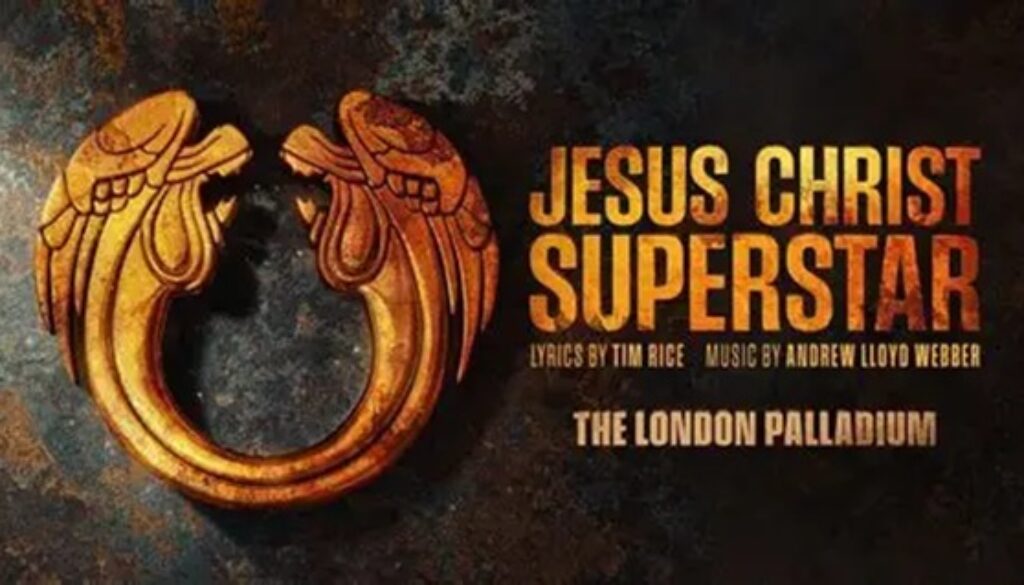
Ten years after its Regent’s Park premiere, Sheader’s production returned to the heart of the West End in summer 2026 — reuniting its full original creative team of Sheader, McOnie, and Scutt for a run at the London Palladium (20 June to 5 September), with a press night on 7 July, before extending to a further limited engagement at Theatre Royal Drury Lane (16 October 2026 to 9 January 2027).
The production’s biggest headline was its Jesus: Eurovision Song Contest winner and pop star Sam Ryder, making his professional stage debut in the title role — a genuinely unusual casting choice for a role that typically goes to trained musical theatre performers. Ryder previewed his interpretation of the show’s signature ballad “Gethsemane” on BBC’s Big Night of Musicals ahead of opening, filmed at Manchester’s AO Arena. Critical response to Ryder’s performance was notably mixed on his stage-acting chops even where his vocal ability wasn’t in question; Time Out’s review found him “all at sea” dramatically against Tyrone Huntley’s returning, considerably more seasoned Judas, contrasting his performance unfavourably with Declan Bennett’s original 2016 “brooding charisma.”
Alongside Ryder, the London Palladium company reunited Tyrone Huntley in his career-defining role as Judas — the only actor from the original 2016 Regent’s Park cast to appear in the 2026 West End transfer — with Desmonda Cathabel (Hadestown) as Mary Magdalene and Olivier winner David Thaxton (Sunset Boulevard) as Pontius Pilate, both of whom had also appeared in the Regent’s Park run. Bob Harms (Pretty Woman) played Caiaphas, Matty J (a Britain’s Got Talent alum) played Annas, Billy Nevers (Hamilton) played Simon Zealotes and served as alternate Judas, and Phil King (Jane Eyre) played Peter.
The Herod Carousel: A Genuinely Unprecedented Casting Stunt
The most talked-about element of the 2026 West End run has been its treatment of King Herod — a flashy, one-scene cameo role that Sheader’s production turned into a rotating showcase for a remarkable parade of celebrity guest stars. At the London Palladium, the role was shared across the run’s eleven weeks by Jesse Tyler Ferguson (Modern Family), Olivier and Tony winner Simon Russell Beale, Richard Armitage (The Hobbit trilogy), pop icon Boy George, Layton Williams, and comedian Julian Clary — each performer taking the role for roughly a two-week block. Time Out’s review, catching Jesse Tyler Ferguson’s turn, called the gimmick “a bit of a red herring” dramatically but conceded it made for “wonderful” theatrical spectacle in Scutt’s ceremonial robes.
The Herod carousel expanded even further for the Theatre Royal Drury Lane transfer, with nine additional performers announced to share the role across the autumn engagement: Matt Bomer, Rob Brydon, Reece Shearsmith, Bob The Drag Queen, Michael Ball, a returning Simon Russell Beale, Omid Djalili, and Layton Williams once again (returning after his Palladium stint), with one further Herod still to be announced at the time of the casting reveal. It’s a genuinely unusual commercial strategy — turning a single-scene supporting role into a recurring news hook capable of generating fresh press coverage roughly every two weeks across a combined six-month West End engagement, ensuring the production stays in the entertainment conversation well beyond its opening night.
Every Song in Jesus Christ Superstar: The Complete Musical Numbers
As a fully sung-through rock opera, Jesus Christ Superstar has no spoken dialogue — every line of the show is a musical number. The score, with music by Andrew Lloyd Webber and lyrics by Tim Rice, runs as follows:
Act One
| Overture | Instrumental introduction establishing the score’s rock idiom |
| Heaven on Their Minds | Judas voices his fear that Jesus’s movement is spiraling out of control |
| What’s the Buzz / Strange Thing Mystifying | The Apostles press Jesus for answers; Judas confronts him over Mary Magdalene |
| Everything’s Alright | Mary Magdalene soothes Jesus, to Judas’s continued disapproval |
| This Jesus Must Die | Caiaphas and the priests resolve that Jesus poses a fatal political threat |
| Hosanna | Jesus enters Jerusalem to adoring crowds, alarming Caiaphas further |
| Simon Zealotes / Poor Jerusalem | Simon urges Jesus toward political revolt; Jesus reflects on true power |
| Pilate’s Dream | Pontius Pilate recounts a premonition of his role in Jesus’s death |
| The Temple | Jesus violently drives merchants and profiteers from the Temple |
| Everything’s Alright (Reprise) | Mary Magdalene tends to an exhausted Jesus |
| I Don’t Know How to Love Him | Mary Magdalene’s iconic solo, confronting her feelings for Jesus |
| Damned for All Time / Blood Money | Judas wrestles with betrayal and accepts thirty pieces of silver |
Act Two
| The Last Supper | Jesus predicts Peter’s denial and Judas’s betrayal at the Passover meal |
| Gethsemane (I Only Want to Say) | Jesus’s tortured plea to God, questioning his fate — the score’s dramatic peak |
| The Arrest | Judas identifies Jesus to Roman soldiers with a kiss |
| Peter’s Denial | Peter denies knowing Jesus three times, as foretold |
| Pilate and Christ | Jesus is brought before Pilate for the first time |
| King Herod’s Song (Try It and See) | Herod mockingly demands Jesus perform a miracle — the show’s flamboyant showpiece |
| Could We Start Again Please? | Mary and Peter mourn how quickly events have spiraled out of control |
| Judas’s Death | Consumed by guilt, Judas takes his own life |
| Trial Before Pilate (Including the 39 Lashes) | Pilate condemns Jesus to death under pressure from the mob |
| Superstar | The spirit of Judas returns to interrogate Jesus in the show’s title number |
| The Crucifixion | Jesus’s death on the cross |
| John 19:41 | The orchestral finale, named for the Gospel verse describing Jesus’s tomb |
“I Don’t Know How to Love Him” became a genuine hit single well outside the context of the show itself, and “Gethsemane” remains the score’s most vocally demanding showcase — the number Sam Ryder chose to preview publicly ahead of his 2026 stage debut precisely because of its outsized reputation among the show’s most devoted fans.
Great Casts: The Performers Who Defined the Role
The only performer to appear in both the original 2016 Regent’s Park cast and the 2026 West End transfer, Huntley’s Judas won him an Olivier Award nomination, a Mousetrap Award, and an Evening Standard Theatre Award, and remains widely regarded as the definitive interpretation of the role in this production’s history. Critics reviewing the 2026 Palladium run consistently singled him out as the company’s strongest performer, a decade on from his breakthrough in the part.
Singer-songwriter Bennett, previously the lead in the West End revival of Once, originated the role of Jesus in Sheader’s 2016 production, bringing what critics described as an “unforced charisma” that later reviews of the 2026 revival would repeatedly invoke as the benchmark for the role.
The Eurovision 2022 runner-up made his professional stage debut in one of musical theatre’s most vocally demanding roles, a casting choice that generated significant advance publicity and a genuinely mixed critical reception on his acting, if not his singing. Ryder continues in the role through the Theatre Royal Drury Lane engagement into January 2027.
Comedian and composer Tim Minchin’s turn as Judas in the reality-TV-cast 2012 arena tour remains one of the most fondly remembered non-Sheader interpretations of the show, alongside Spice Girl Melanie C’s Mary Magdalene and radio presenter Chris Moyles’s memorably unconventional King Herod — proof that stunt casting around this title long predates its current celebrity-Herod era.
Both performers carried over from the Regent’s Park run into the 2026 West End transfer, with Thaxton — an Olivier winner for Sunset Boulevard — bringing seasoned West End authority to Pilate’s tortured moral reckoning, and Cathabel (fresh from Hadestown) delivering “I Don’t Know How to Love Him” as one of the production’s most consistently praised individual moments across its 2026 reviews.
Awards and Critical Legacy
Sheader’s production remains, by a wide margin, the most awarded and most widely toured version of Jesus Christ Superstar in the show’s history. Beyond its Evening Standard and Olivier Awards wins, it has picked up a Critics’ Circle Theatre Award, the BBC Radio 2 Audience Award, and consistent five-star reviews across nearly every major transfer, from Regent’s Park through Chicago, the Barbican, and its North American touring life. Reviews of the 2026 West End return have been more mixed specifically where Ryder’s acting is concerned, but largely consistent in praising Huntley, the design work, and McOnie’s choreography as unchanged strengths a full decade into the production’s life — a rare case of a musical theatre staging proving durable enough to survive a complete cast turnover and multiple continents of touring while retaining its core artistic identity.
A Rock Opera That Courted Controversy From Day One
No account of Jesus Christ Superstar‘s history is complete without acknowledging the religious controversy that has trailed the show since its earliest days. Its depiction of Jesus as a doubting, exhausted, deeply human figure — rather than a purely divine one — and its decision to tell the story through the eyes of a sympathetic, morally conflicted Judas drew criticism from religious groups on multiple continents throughout the 1970s, with some communities boycotting productions or picketing performances outright. The show’s willingness to sit inside genuine theological ambiguity, rather than resolve it, is part of what has made it a recurring flashpoint for religious commentary with every major revival since — even as it has simultaneously become a fixture of school, community, and church-affiliated theatre programming precisely because of the emotional directness with which it tells its story. Sheader’s own staging leaned into rather than away from that tension, framing the show explicitly as being about the danger of turning any spiritual movement into a “celebrity machine,” a lens that read as pointedly contemporary to audiences in 2016 and remains just as legible a decade later.
The Design and Sound of Sheader’s Superstar
Much of what has allowed this particular production to travel so successfully across such wildly different venues — an open-air park theatre, an arena-scale Chicago opera house, the cavernous Barbican, and now two grand West End houses — comes down to the elemental simplicity of Tom Scutt’s design. Rather than attempting period-accurate biblical spectacle, Scutt built the show around scaffolding, exposed metalwork, and a stark, oversized cross that doubles as both setting and central visual metaphor, deliberately evoking industrial decay and modern protest movements rather than ancient Judea. That flexibility of design language is precisely why the production has been able to scale up or down — from an intimate outdoor stage to a 2,000-plus-seat West End house — without needing to be substantially reconceived each time. Musical supervisor Tom Deering’s arrangements, meanwhile, have consistently been praised for restoring genuine rock-band grit to a score that later, more polished orchestral revivals had sometimes smoothed over, giving Lloyd Webber’s guitar-and-organ-driven 1970 songwriting room to sound properly abrasive again.
What Comes Next: A UK Tour on the Horizon
Beyond its current Palladium and Drury Lane engagements, Sheader’s production is already confirmed to embark on a further UK tour once its Theatre Royal Drury Lane run concludes in January 2027 — continuing a now well-established pattern for this particular staging, which has rarely sat still for long since its 2016 premiere. Given the production’s track record of picking up fresh casting hooks at every stage of its life — new Jesuses, new Marys, and an ever-expanding roster of guest Herods — expect the touring iteration to generate its own wave of regional casting news well into 2027 and beyond, extending a life cycle that has already made this the most travelled and most honoured version of Jesus Christ Superstar ever staged.
Legacy: A Rock Opera That Refuses to Age Out
Few musicals have demonstrated the sheer structural flexibility of Jesus Christ Superstar — a show that has thrived as a concept album, a conventional book musical, a stripped-back arena rock concert, a socially distanced pandemic staging, and now a starry, celebrity-cameo-driven West End spectacle, without ever fundamentally rewriting its 1970 score. That flexibility is precisely what has allowed Timothy Sheader’s production to travel so far, for so long, from a single London park to stages across four continents and back again to two of the West End’s grandest addresses. Whatever verdict history renders on Sam Ryder’s stage debut, the production’s decade-long journey — and the sheer scale of its 2026 celebrity Herod carousel — confirms that, more than fifty years on, London audiences still can’t get enough of asking Jesus Christ, who are you, what have you sacrificed.
Sources: Andrew Lloyd Webber official site, LW Theatres, West End Theatre, London Theatre, Playbill, Wikipedia, Regent’s Park Open Air Theatre, Time Out, WhatsOnStage, The Arts Shelf, ALW Show Licensing.
Tags: Jesus Christ Superstar West End Jesus Christ Superstar London Palladium Sam Ryder Jesus Christ Superstar Timothy Sheader Jesus Christ Superstar Jesus Christ Superstar Drury Lane Jesus Christ Superstar songs Jesus Christ Superstar musical numbers Tyrone Huntley Judas Jesus Christ Superstar Herod cast Andrew Lloyd Webber Tim Rice
Links
Jesus Christ Superstar – Memorabilia
Phantom of the Opera – Memorabilia
Phantom of the Opera – Musical
Sunset Boulevard – Memorabilia
La Cage Aux Follies – Memorabilia
Chess the Musical – Memorabilia
Little Shop of Horrors – Memorabilia
Starlight Express – Memorabilia
Dear Evan Hansen – Memorabilia
How to Succeed in Business Without Really Trying – Memorabilia
Terrence McNally – Memorabilia