War Horse Play: The Definitive Guide to Synopsis, Puppetry & History
WAR HORSE
The Soul of the National Theatre: A Story of Loyalty and Survival
Memorabilia Available Here
The Phenomenon of War Horse
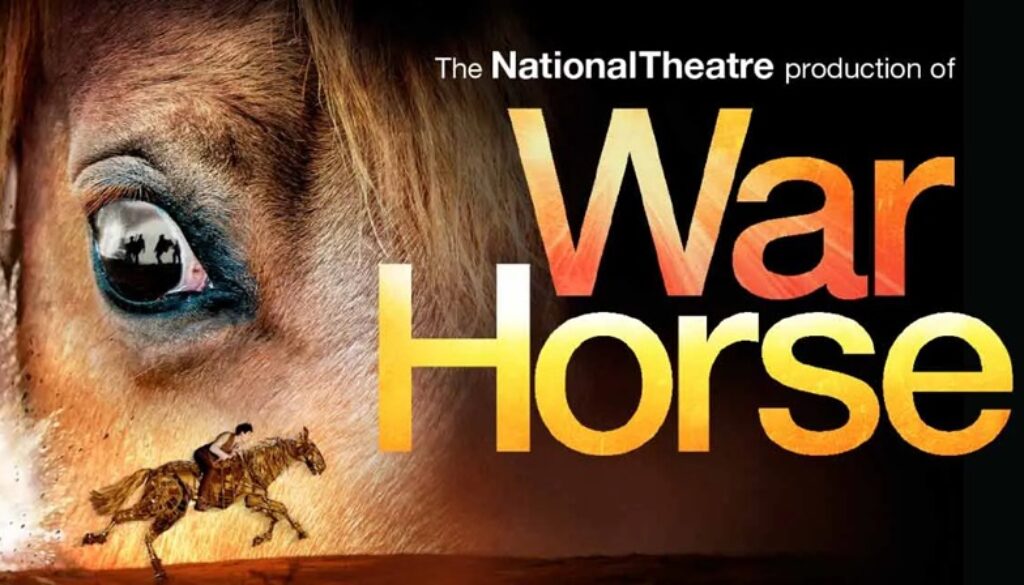
Since its premiere in 2007, the stage adaptation of Michael Morpurgo’s 1982 novel War Horse has become a global cultural touchstone. Originally, Morpurgo himself was skeptical, famously remarking that the creators “must be mad” to attempt a live-action version of a story told through the eyes of a horse. However, the collaboration between Nick Stafford and the Handspring Puppet Company proved to be a masterclass in theatrical innovation.
This post explores the intricate details of the production, from its humble beginnings at the Royal National Theatre to its sweep of the Tony Awards on Broadway, and the visceral emotional impact that continues to draw audiences worldwide.
A Journey Through the Trenches: Synopsis
Act I: Devon and the Bond
The story opens in Devon, England, where a spirited foal is sold at auction. To the dismay of his wife Rose, Ted Narracott outbids his brother Arthur with mortgage money he doesn’t have. Their son, Albert, takes on the responsibility of training the horse, whom he names Joey. The bond between the boy and the beast becomes the heartbeat of the play.
As World War I breaks out, the financial strain on the Narracott farm becomes unbearable. Ted secretly sells Joey to Captain James Nicholls of the British Cavalry. Albert is devastated, and though too young to enlist, he makes a silent vow to find Joey and bring him home. Joey is shipped to France, where he meets Topthorn, a majestic black horse who becomes his closest companion amidst the horrors of the front lines.
Act II: The Shadows of War
The play transitions into a gritty, visceral depiction of the battlefield. Joey and Topthorn are captured by the Germans and used to pull ambulances for wounded soldiers. They are cared for by a German officer, Friedrich Müller, who shares a quiet bond with a young French girl named Emilie. As the war intensifies, the horses are forced into heavy labor, pulling massive artillery guns through the mud of the Somme.
In a climactic sequence involving a terrifying, life-sized tank, Topthorn dies of exhaustion, and Friedrich is killed. Joey, panicked and alone, runs into “No Man’s Land,” where he becomes entangled in barbed wire. In a rare moment of shared humanity, a British and German soldier meet under a white flag to free the horse. Joey is taken to a British veterinary hospital, where a temporarily blinded Albert—who has finally joined the war—is recuperating. Through a familiar whistle, the two are reunited in one of the most emotional finales in modern theater.
The Art of Breathing Life: Handspring Puppetry
The defining feature of War Horse is the use of life-size puppets designed by the Handspring Puppet Company of South Africa. These puppets are not merely objects; they are living characters. Each horse is operated by three puppeteers:
- The Head: Controls the ears and gaze, dictating the horse’s focus.
- The Heart: Controls the front legs and the “breath,” a mechanical rising and falling of the ribs.
- The Hind: Controls the powerful back legs and the tail.
The choreography, led by Toby Sedgwick, ensures that the horses exhibit genuine equine behavior—the twitch of an ear at a sudden sound, the shifting of weight when nervous, and the terrifying power of a gallop.
Global Productions and Legacy
| Production | Venue | Years |
|---|---|---|
| West End Transfer | Gillian Lynne Theatre | 2009–2016 |
| Broadway Debut | Vivian Beaumont Theater | 2011–2013 |
| Berlin (Gefährten) | Theater des Westens | 2013–2014 |
The Sound of the Devon Hills: Song List
The music, composed by Adrian Sutton with songs by John Tams, is steeped in English folk tradition, grounding the play’s epic scale in intimate, human sounds.
- Only Remembered – The iconic anthem of the play.
- The Year of ’83 – A traditional Devon folk song.
- Snow Falls – Establishing the winter landscape.
- The Scarlet and the Blue – Military recruitment song.
Critical Response: “The Theatrical Event of the Decade”
Critics were nearly unanimous in their praise. The Times dubbed it “the theatrical event of the decade.” The New York Times highlighted the “spine-tingling” puppetry, noting that after ten minutes, the audience forgets they are watching puppets and begins to see a soul. While some critics, like Terry Teachout of the Wall Street Journal, found the plot somewhat sentimental, the consensus remains that the production’s technical achievement is unmatched in 21st-century theater.
Awards and Accolades
Tony Awards (2011): Winner of 5 Tonys including Best Play, Best Direction, and Best Scenic Design.
Olivier Awards (2008): Winner of Best Set Design and Best Theatre Choreographer.
Special Recognition: A Special Tony Award was presented to the Handspring Puppet Company for their extraordinary contribution to the Broadway production.
In Popular Culture
Saturday Night Live spoofed War Horse on an episode aired 17 December 2011. The sketch features a British couple (played by Bill Hader and Kristen Wiig) attending a regional production of War Horse. Instead of a life-size horse puppet, the role of Joey is played by host Jimmy Fallon, who cavorts around the stage, slapping his legs in an imitation of hoofbeats, neighing, and eventually robot dancing.Handspring Puppet Company artistic directors Basil Jones and Adrian Kohler appeared at the Long Beach TED Talk series in March 2011 to speak about their puppetry. In a highly popular segment, Jones and Kohler introduce the Handspring philosophy towards the ‘life’ of a puppet, before demonstrating their points with the help of the puppet Joey (performed by original National Theatre cast members Craig Leo and Tommy Luther and original West End cast member Mikey Brett). As Malone and Jackman observe: As Joey tentatively enters the stage space, he is met with a spontaneous ovation sparked by the immediacy of the live moment, in turn aided by the fact that Kohler and Jones never stray from the game that dictates they treat him as a live horse. This playful notion helps Joey’s creators invite the audience to believe in his aliveness, and the audience succumbs, not only for his lifelike movement, but also for the way he is activated by those around him. As both creators and performers, Jones and Kohler soothe Joey’s “nervousness”, and a planned moment when Joey “notices” the audience elicits a generous laugh. Joey shies, nervously clops his hooves, and nickers gently to demonstrate alarm. He sniffs Kohler’s jacket pocket, as he “knows” there is a snack in there. Later, when Jones crosses the stage to demonstrate a feature, he is careful not to walk behind Joey, lest he is kicked. The audience must believe he will not be kicked – only a spiteful puppeteer could activate such a trick – but Jones’s conviction that he should respect the animal’s space foregrounds the moment’s liveness and heightens the audience’s engagement. Finally, a jockey is introduced, and Joey patiently holds still while he is mounted. Joey accepts the rider’s weight without complaint, comfortably parades around the stage, and swiftly exits before the effect is mundane. For the entire time that Joey inhabits the stage, the audience is noticeably spellbound. In October 2021, the Handspring puppet Little Amal was met on the South Bank in London by Joey the War Horse, and they continued the walk together.
Critical Reception
The Guardian’s Michael Billington wrote in his review: Elliott and Morris recreate the kaleidoscopic horror of war through bold imagery, including the remorseless advance of a manually operated tank, and through the line-drawings of Rae Smith projected on to a suspended screen. Admittedly the performers are somewhat eclipsed by the action … The joy of the evening, however, lies in the skilled recreation of equine life and in its unshaken belief that mankind is ennobled by its love of the horse.Charles Spencer in The Daily Telegraph had written that, generally, “puppets are often an embarrassment, involving a lot of effort and fuss for negligible returns”; in this case, he praised the puppetry as “truly magnificent creations by the Handspring Puppet Company.” The Times’ 10-year-old guest reviewer called the show “movingly and realistically brought to life” and “an emotional and compelling adaptation of the book.”
In reviewing the Broadway production, Ben Brantley wrote in The New York Times, “…it is how Joey is summoned into being, along with an assortment of other animals, that gives this production its ineffably theatrical magic…Beautifully designed by Rae Smith … and Paule Constable, this production is also steeped in boilerplate sentimentality. Beneath its exquisite visual surface, it keeps pushing buttons like a salesclerk in a notions shop.” Brantley suggests, “The implicit plea not to be forgotten applies not just to the villagers, soldiers and horses portrayed here, but also to theater, as an evanescent art that lives on only in audiences’ memories. Judged by that standard, much of War Horse evaporates not long after it ends. But I would wager that for a good while, you’ll continue to see Joey in your dreams.”
Entertainment Weekly gave a positive review, calling the show an “Imaginative, moving new Broadway drama … The play’s equine stars are the remarkable creation of Adrian Kohler and Basil Jones’ Handspring Puppet Company. As manipulated by three handlers dressed in period costumes, the life-size creatures seem to breathe, snort, feed, walk, gallop, and rear up just as naturally as the genuine articles. In no time at all, they become characters as rounded and complex as any of the humans on stage.” Time magazine ranked the play as its top choice among all theatre productions in 2011.
The Wall Street Journal’s Terry Teachout praised the puppetry, but gave mixed reactions to the play: “The fundamental flaw of ‘War Horse’ is that Nick Stafford, who wrote the script ‘in association’ (that’s how the credit reads) with South Africa’s Handspring Puppet Company, has taken a book that was written for children and tried to give it the expressive weight of a play for adults. Not surprisingly, Mr. Morpurgo’s plot can’t stand the strain. Dramatic situations that work perfectly well in the context of the book play like Hollywood clichés onstage. In the first act, the craftsmanship is so exquisite that this doesn’t matter—much—but things go downhill fast after intermission. The really big problem is the last scene, about which, once again, the drama critics’ code commands silence. This much must be said, though: A play that is so forthright about the horrors of war owes its audience a more honest ending.”
Theatre review aggregator Curtain Critic gave the production a score of 88 out of 100 based on the opinions of 21 critics.