Who’s Afraid of Virginia Woolf? – Complete Guide to Edward Albee’s Masterpiece: | Plot, Cast, Themes & Awards
Who's Afraid of Virginia Woolf? - Podcast
Most Praised · Most Talked-About
Most Exciting Play of the Year
of Virginia Woolf?
Uta Hagen · Arthur Hill · Ben Piazza
Background & Overview
Who’s Afraid of Virginia Woolf? is a three-act play by Edward Albee, first staged in October 1962. It examines, with unflinching intensity, the complexities of a middle-aged academic marriage as it unravels across a single, alcohol-drenched late evening. Late one night, after a faculty party at an unnamed New England university, middle-aged couple Martha and George receive — without warning — a younger couple, Nick and Honey, as unexpected guests. What follows over the course of three acts is one of the most searing and celebrated confrontations in twentieth-century drama.
The play is notable for its brutal wit, its fearless engagement with the psychology of marriage and self-deception, and its dissection of the gap between the America its characters perform and the one they actually inhabit. It runs just under three hours in performance, with two ten-minute intermissions.
The title is a pun on the Walt Disney song “Who’s Afraid of the Big Bad Wolf?” from the 1933 animated film Three Little Pigs, substituting the name of the celebrated English author Virginia Woolf. Martha and George repeatedly sing this altered version throughout the play. Albee has explained the title’s meaning directly: it signifies “who’s afraid of living life without false illusions.”
Creation & Inspirations
The Title: A Graffito in a Greenwich Village Bar
Albee has described discovering the phrase that would become his title written in soap on a mirror in a Greenwich Village saloon in New York. He was struck by the phrase’s wit and its double meaning — the pun on the Disney song, and the deeper suggestion of someone afraid to face reality without the comfort of illusions. When he began writing the play, the phrase resurfaced in his mind and became its title.
The phrase had, intriguingly, appeared in print even earlier: in a 1957 issue of The New Yorker, which reported the same graffito on a Greenwich Village café wall. In 2013, The New Yorker speculated that the graffito Albee saw and the one reported in 1957 may well have been the same piece of writing.
Virginia Woolf: The Name Behind the Pun
The title alludes to the English novelist Virginia Woolf, who died by suicide in 1941. Twenty years later, before the play’s premiere, Albee wrote to her widower, Leonard Woolf, asking permission to use his late wife’s name in the title of his new play, according to the literary critic Leon Edel, an acquaintance of Leonard Woolf. Leonard Woolf granted that permission. He later attended a performance of the play in London and, according to Edel, enjoyed it.
Because using the actual Disney song would require costly licensing, most stage productions and the 1966 film use the melody of “Here We Go Round the Mulberry Bush” — a public domain nursery rhyme whose meter fits the words equally well — in place of the original tune.
The Real-Life Models: Willard Maas and Marie Menken
In interviews, Albee identified the characters of Martha and George as being based on two friends of his: Willard Maas, a professor of literature at Wagner College, and his wife Marie Menken, an experimental filmmaker and painter. Maas and Menken were celebrated in New York social circles for their tumultuous salons, where, according to those who attended — including Andy Warhol associate Gerard Malanga — drinking would begin on Friday afternoon and continue into the early hours of Monday morning. The combative, volatile nature of the Maas–Menken relationship provided the primary dramatic conflict between George and Martha.
The Play in Print
The print edition of the play was published in 1962 as one of the early releases of Atheneum Books. It sold over 70,000 copies in hardcover and paperback editions, an extraordinary figure for a play text, demonstrating the extraordinary hold the work had on the public imagination almost immediately upon its premiere. In 1963, Columbia Masterworks released a four-LP boxed recording of the original Broadway cast performing the entire play, with notes by Harold Clurman and Walter Kerr. It was reissued in 2014 by Masterworks Broadway.
The Plot — Act by Act
The play takes place entirely over one long, alcohol-fuelled night in the home of Martha and George, a middle-aged couple living on the campus of a small New England university. Martha is the daughter of the university’s president; George is an associate professor of history who has never fulfilled the ambitions she and her father once held for him. As the night progresses through increasingly vicious “games,” four lives are permanently altered.
George and Martha return home late from a faculty party at the president’s house. Martha reveals she has invited a young couple she met there — Nick, a biology professor new to the faculty, and his wife Honey — for an after-hours drink. Before they arrive, George issues a vague but loaded warning to Martha about “the bit with the kid.”
As drinks flow and the four interact, Martha and George engage in a sustained pattern of scathing verbal cruelty toward each other in front of their embarrassed guests. Martha tells a humiliating story about having once knocked George to the ground in front of her father. George retaliates by producing what appears to be a rifle and firing it at Martha — to everyone’s relief (and surprise), a Chinese parasol pops from the barrel. Tension nevertheless continues to escalate. When Honey lets slip that Martha had mentioned their son to her, George is visibly shaken. Martha’s taunts about George’s professional failure as the final straw leads him to shatter a bottle in fury, sending Honey fleeing to the bathroom in a drunken panic.
(The act’s title references the legendary annual witches’ gathering, deployed here satirically.) George and Nick are left alone. Nick reveals that Honey once had a hysterical pregnancy — a false pregnancy so convincing it led to their marriage. George, in turn, tells Nick an oblique, haunting story about a boarding school friend who accidentally killed his mother then, the following summer, swerved a car to avoid a porcupine and killed his father — after which the boy was institutionalised and became permanently mute.
Martha dances with Nick in a provocatively sensual way. George, seemingly indifferent, pretends to read a book. Enraged by his passivity, Martha announces she will go upstairs with Nick. George retaliates with a new game, “Get the Guests,” in which he recasts everything Nick confided about Honey — her hysterical pregnancy, her father’s money, the way she trapped Nick into marriage — as a thinly veiled story about a “mousie.” Honey, devastated, again retreats to vomit.
George, left alone, throws his book against the doorbell chimes and promises quietly to make Martha “regret this.”
George returns carrying snapdragons and making literary jokes that Martha, despite herself, seems genuinely to enjoy. The strange, tender interlude is interrupted by the revelation that Nick was too drunk to have sex with Martha upstairs. George calls the final game: “Bringing Up Baby.”
For the first time in the play, George speaks openly and in detail about the couple’s son. Martha joins in with her own “recitation,” describing their boy with beauty and love, while George simultaneously recites sections of the Libera me from the Latin Requiem Mass, and the Kyrie eleison. The competing voices — one tender, one liturgical — create an extraordinary theatrical duet.
George then announces that a Western Union telegram has arrived bearing news that their son has been killed in a car accident — swerving to avoid a porcupine, using the exact phrase he employed earlier in an apparently unconnected story. Martha is devastated. It slowly dawns on Nick that no son has ever existed: the boy is a shared fantasy, a game George and Martha have sustained throughout their marriage to compensate for their infertility. George has chosen this night to “kill” the child — because Martha broke the game’s only rule by mentioning him to someone else.
Nick and Honey depart, overcome with pity. Martha tentatively suggests creating a new imaginary child; George is clear: they cannot. The play ends with George singing the title song, quietly. Martha responds, “I am, George. I am.”
Themes & Ideas
Albee has described the play’s central question as who is brave enough to live without false illusions. The son that George and Martha have invented is the play’s most powerful symbol of the protective fictions people construct to survive. The line between what is real and what is fabricated is deliberately kept unstable — illusions are destroyed, but no stable truth is offered in their place. As George says: “All truth becomes relative.”
George and Martha’s marriage is a battlefield of mutual dependence and mutual destruction. Their cruelty is inseparable from their intimacy — they know each other with an almost unbearable precision, and they weaponise that knowledge. Yet the play ultimately suggests that this savagery is the expression of a love that cannot find any other form.
Scholar Christopher Bigsby argues that the play attacks “the false optimism and myopic confidence of modern society.” George and Martha are named for America’s first President and First Lady — a choice that is not accidental. Their marriage is a dark parody of the founding myth of the ideal American family. The societal norms of the 1950s demanded a breadwinner father, a homemaker mother, and well-behaved children; the play systematically demolishes every element of that picture.
George’s failure to rise to lead the university — the ambition that Martha’s father once entertained for him — is a wound that has never healed, for Martha or for George. The play examines how disappointed ambition corrodes a relationship and how people assign blame for their own unhappiness to those closest to them.
The imaginary son at the heart of the play represents both the literal impossibility of George and Martha having children and the broader impossibility of them creating anything together. Scholar Lawrence Kingsley argues that Albee’s characters create illusions to evade feelings of their own inadequacy — and the son is their most elaborate and most necessary illusion.
Albee has cited Nietzsche’s interpretation of the Apollonian/Dionysian dichotomy from The Birth of Tragedy as a framework for the play. Martha and Nick represent impulse, pleasure and disorder; George and the structure of the academic world represent the Apollonian ideal of reason and order. The night’s events pit these against each other, with the Dionysian winning decisively — at least until the final act.
Principal Characters
| Character | Description |
|---|---|
| Martha | The daughter of the university president, and George’s wife. Loud, combative, dangerously perceptive, and capable of devastating cruelty. She is also, beneath the aggression, deeply wounded. Her relationship with her father — and with the failure of her marriage — defines her. The more demanding of the two lead roles. |
| George | An associate professor of history, and Martha’s husband. Quieter but equally capable of surgical cruelty; more passive-aggressive than Martha but ultimately the one who drives the play’s resolution. His intelligence and resignation make him both sympathetic and complicit in the night’s events. |
| Nick | A young biology professor, newly arrived at the university. Handsome, ambitious and initially self-possessed, he gradually loses all control of the evening as the older couple turn their weapons on him and on each other. |
| Honey | Nick’s wife. Mousy, nervous and increasingly drunk as the night progresses, she is the most vulnerable of the four — and, in some ways, the most revealing. Her hysterical pregnancy and what it says about her marriage provides a crucial structural parallel with George and Martha’s imaginary son. |
Original Broadway Production (1962–1964)
Billy Rose Theatre, New York — Opening Night: 13 October 1962
The original production opened at the Billy Rose Theatre on 13 October 1962, directed by Alan Schneider. The original cast was:
| Role | Actor |
|---|---|
| Martha | Uta Hagen |
| George | Arthur Hill |
| Honey | Melinda Dillon |
| Nick | George Grizzard |
The Matinee Company
Because of the play’s unusual length — over three hours — the producers assembled a second, entirely separate cast to perform the twice-weekly matinees. The matinee company starred Kate Reid as Martha, Shepperd Strudwick as George, Avra Petrides as Honey, and Bill Berger as Nick. Both the evening and matinee performances sold out consistently throughout the run.
Notable Subsequent Cast Members (Evening Company)
During the original run, the evening company also included — at various points — Henderson Forsythe, Eileen Fulton, Nancy Kelly, Mercedes McCambridge, and Elaine Stritch.
Run
The original production closed on 16 May 1964 after 5 previews and 664 performances. In 1963, the production’s original cast recording — a four-LP boxed set — was released by Columbia Masterworks, directed by Alan Schneider. The recording was finally reissued in 2014 by Masterworks Broadway after decades out of print.
London Premiere (1965)
London — 1965
The play opened in London in 1965, starring Constance Cummings and Ray McAnally. Virginia Woolf’s widower, Leonard Woolf, attended a performance and, according to the literary critic Leon Edel, enjoyed the evening. This was a particularly meaningful moment given that Albee had sought Leonard Woolf’s permission to use his late wife’s name in the title.
Major Productions & Revivals
Colleen Dewhurst & Ben Gazzara — 1976
A Broadway revival starred Colleen Dewhurst as Martha and Ben Gazzara as George in 1976. Dewhurst’s commanding stage presence brought a particular rawness to the role of Martha.
Mike Nichols & Elaine May — 1980
A notable 1980 production in New Haven paired Mike Nichols and Elaine May — the legendary comedy duo — as George and Martha. Nichols had directed the celebrated 1966 film adaptation of the play, making this a striking reversal of his relationship to the material.
Diana Rigg & David Suchet — London 1996–97
A production starring Diana Rigg as Martha and David Suchet as George opened at the prestigious Almeida Theatre in 1996, before transferring to the Aldwych Theatre in London’s West End in 1997. The pairing of two of Britain’s most distinguished classical actors in the roles brought considerable critical attention.
Patrick Stewart & Mercedes Ruehl — 2000–2001
Patrick Stewart and Mercedes Ruehl starred together in a 2000–2001 production at The Guthrie Theater in Minneapolis. Stewart’s casting as George generated particular interest, given his profile at the time primarily as a screen actor.
Kathleen Turner & Bill Irwin — Longacre Theatre, 12 March 2005
The play was revived on Broadway at the Longacre Theatre, beginning previews on 12 March 2005 and running until 4 September 2005. Directed by Anthony Page, the production starred Kathleen Turner as Martha and Bill Irwin as George, with Mireille Enos as Honey and David Harbour as Nick. The production ran for 8 previews and 177 performances.
Bill Irwin won the 2005 Tony Award for Best Performance by a Leading Actor in a Play for his role as George.
The production also introduced a revised script — prepared by Albee — that has been used as the standard text ever since. Among the revisions: the removal of early references to George and Martha’s son, the removal of George’s reference to his failed novel and its connection to his parents’ deaths, and the complete cutting of an approximately seven-page scene between George and Honey at the end of Act Two.
West End Transfer — Apollo Theatre, 2006
The entire Broadway cast transferred to London’s Apollo Theatre in the West End, running from 31 January to 13 May 2006. The production subsequently toured the US, playing in Washington DC at the Kennedy Center in January 2007, and at the Ahmanson Theatre in Los Angeles from 6 February 2007, as well as at the Golden Gate Theatre in San Francisco from 11 April to 12 May 2007.
Amy Morton, Tracy Letts, Carrie Coon & Madison Dirks
On 12 December 2010, the Steppenwolf Theatre Company in Chicago began performances of the play featuring Amy Morton as Martha, Tracy Letts — the Pulitzer Prize-winning playwright of August: Osage County — as George, Carrie Coon as Honey, and Madison Dirks as Nick. The production was directed by Pam MacKinnon, who had previously directed premieres of Albee’s own later work.
This production transferred to Broadway at the Booth Theatre, beginning previews on 27 September 2012 and opening officially on 13 October 2012 — exactly fifty years after the original Broadway opening. The entire Steppenwolf cast reprised their roles. The production was praised in The New York Times by Charles Isherwood. Tracy Letts won the 2013 Tony Award for Best Performance by a Leading Actor in a Play.
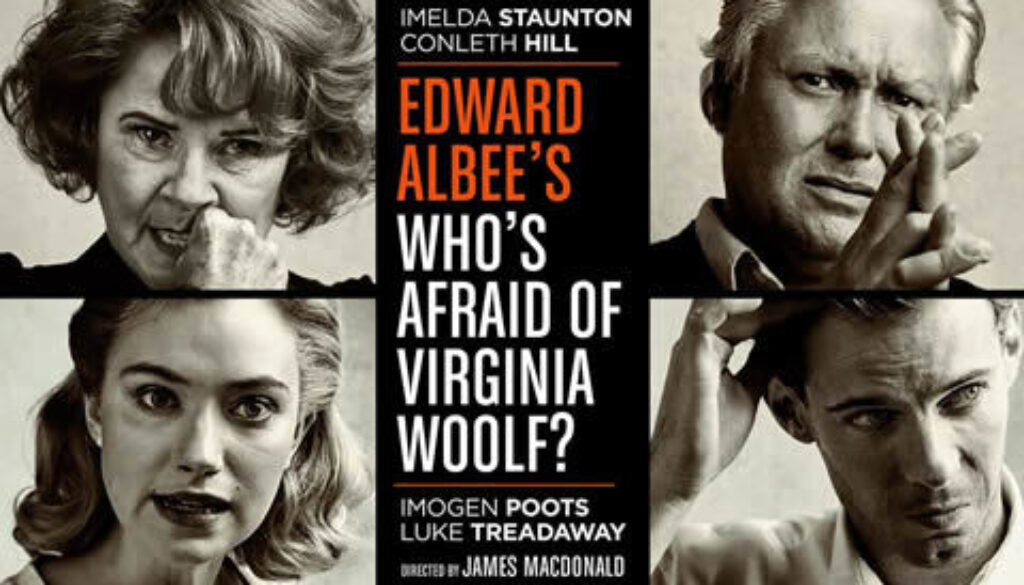
Imelda Staunton, Conleth Hill, Imogen Poots & Luke Treadaway
A highly praised London production directed by James Macdonald began at the Harold Pinter Theatre on 21 February 2017, running until 27 May 2017. The cast starred Imelda Staunton as Martha, Conleth Hill as George, Imogen Poots as Honey, and Luke Treadaway as Nick. Staunton’s performance was widely regarded as one of the finest interpretations of Martha in the play’s history.
Laurie Metcalf & Rupert Everett — Broadway Theatre, 2020
A Broadway revival was scheduled to open on 9 April 2020, directed by Joe Mantello and produced by Scott Rudin. It starred Laurie Metcalf as Martha, Rupert Everett as George (replacing Eddie Izzard, who had been originally announced but was replaced in September 2019), Russell Tovey as Nick, and Patsy Ferran as Honey. After nine preview performances, the production was cancelled due to the COVID-19 pandemic without ever officially opening.
Other Notable Productions
All African-American Cast
In 2001, Howard University staged a production with an all African-American cast and received Albee’s permission to adjust some of the dialogue to better reflect the experience of a Black academic family in the 1960s. Albee attended a performance and expressed his approval. A revival of this version was staged by the Portland Stage Company in Maine in 2025, featuring the same actor in the role of George as in the 2001 original.
Meg Tilly Returns to the Stage
In 2011, film actress Meg Tilly returned to acting to play Martha in a production by the Blue Bridge Repertory Theatre in Victoria, British Columbia. The production ran from 5 to 17 July 2011.
Kat Stewart & David Whiteley — Australia
A widely praised Australian production directed by Sarah Goodes starred Kat Stewart as Martha and David Whiteley — Stewart’s real-life husband — as George, with Harvey Zielinski as Nick and Emily Goddard as Honey. It played at the Red Stitch and Comedy Theatres in Melbourne in 2023–2024, before transferring to the Sydney Theatre Company in 2025.
Major Casting History
| Role | Broadway 1962 | London 1965 | Broadway 1976 | London 1996–97 | Broadway 2005 | Broadway 2012 | London 2017 | Broadway 2020* |
|---|---|---|---|---|---|---|---|---|
| Martha | Uta Hagen | Constance Cummings | Colleen Dewhurst | Diana Rigg | Kathleen Turner | Amy Morton | Imelda Staunton | Laurie Metcalf |
| George | Arthur Hill | Ray McAnally | Ben Gazzara | David Suchet | Bill Irwin | Tracy Letts | Conleth Hill | Rupert Everett |
| Honey | Melinda Dillon | — | — | — | Mireille Enos | Carrie Coon | Imogen Poots | Patsy Ferran |
| Nick | George Grizzard | — | — | — | David Harbour | Madison Dirks | Luke Treadaway | Russell Tovey |
| Director | Alan Schneider | — | — | — | Anthony Page | Pam MacKinnon | James Macdonald | Joe Mantello |
| Theatre | Billy Rose, Broadway | London | Broadway | Almeida / Aldwych, London | Longacre, Broadway | Booth, Broadway | Harold Pinter, London | Broadway* |
* COVID-19 pandemic prevented the 2020 production from officially opening.
Broadway Matinee Company (Original Production)
| Role | Actor |
|---|---|
| Martha | Kate Reid |
| George | Shepperd Strudwick |
| Honey | Avra Petrides |
| Nick | Bill Berger |
The 1966 Film Adaptation
A film adaptation was released in 1966, directed by Mike Nichols (making his feature film debut), with a screenplay by Ernest Lehman. It starred Elizabeth Taylor as Martha, Richard Burton as George, George Segal as Nick, and Sandy Dennis as Honey.
All four principal actors received Academy Award nominations: Taylor and Burton for Best Actress and Best Actor; Dennis and Segal for Supporting honours. Elizabeth Taylor won the Oscar for Best Actress. Sandy Dennis won Best Actress in a Supporting Role. Richard Burton was passed over in favour of Paul Scofield in A Man for All Seasons; George Segal lost to Walter Matthau in The Fortune Cookie.
The film attracted significant attention at the Motion Picture Association of America. Jack Valenti, newly installed as MPAA president, described it as the first controversial film he had to deal with in that role. After a three-hour meeting with Warner Bros. chief Jack Warner and his aide Ben Kalmenson, the word “screw” was deleted from the final cut, while “hump the hostess” was retained.
The film was historically significant in film industry terms: it was the first film to have its entire dialogue released on a commercial album — a two-LP “Deluxe Edition” released by Warner Bros. Records in 1967. At the time, the film’s adult content made network television broadcast impossible. The soundtrack album omits most pauses and silences, running approximately thirty minutes shorter than the film itself, but retains virtually every line of dialogue.
Reception & Cultural Legacy
The original Broadway production was met with an immediate and sustained outpouring of critical enthusiasm. The play was praised by the New York Herald Tribune as something that “must be seen,” described by the New York Times as “nothing short of tremendous,” and called something that “towers over the common run of contemporary plays” by the New York Post — phrases that featured on the original broadside poster. The production sold out both its evening and matinee performances throughout its two-year run.
The play’s reception was not without controversy. When it was submitted for the 1963 Pulitzer Prize for Drama, the drama jury selected it as the winner — but the advisory board (the trustees of Columbia University) overruled the jury’s decision, objecting to the play’s profanity and sexual themes. No Pulitzer Prize was awarded for drama in 1963. Two of the drama jury members resigned in protest.
The 2005 Broadway revival, the 2012 Steppenwolf/Broadway production, and the 2017 London production with Imelda Staunton each renewed critical and public enthusiasm for the play, consistently affirming its status as one of the central works of American drama. Charles Isherwood of The New York Times praised the 2012 revival — featuring Tracy Letts and Amy Morton — at length.
The play has entered the wider culture in numerous ways. Episodes of American Dad! and The Office have parodied its scenario. Steven Soderbergh’s 2025 spy thriller Black Bag was explicitly designed as an “espionage version” of the play. Canadian dance theatre company One Yellow Rabbit created a ballet homage, Permission, staged across North America and Mexico in 1995–96.
“Who’s afraid of Virginia Woolf? means who’s afraid of the big bad wolf — who’s afraid of living life without false illusions.”
— Edward Albee, interviewed in The Paris Review
Awards & Nominations
Original Production — Tony Awards 1963
| Category | Nominee | Result |
|---|---|---|
| Best Play | Who’s Afraid of Virginia Woolf? | Won |
| Best Performance by a Leading Actress in a Play | Uta Hagen | Won |
| Best Performance by a Leading Actor in a Play | Arthur Hill | Won |
| Best Direction of a Play | Alan Schneider | Nominated |
New York Drama Critics’ Circle Award 1962–63
| Category | Result |
|---|---|
| Best Play | Won |
Pulitzer Prize — 1963 (Contested)
| Category | Outcome |
|---|---|
| Pulitzer Prize for Drama | Selected by Drama Jury — Overruled by Advisory Board. No Pulitzer awarded in drama 1963. |
2005 Broadway Revival — Tony Awards 2005
| Category | Nominee | Result |
|---|---|---|
| Best Performance by a Leading Actor in a Play | Bill Irwin | Won |
2012 Broadway Revival — Tony Awards 2013
| Category | Nominee | Result |
|---|---|---|
| Best Revival of a Play | Who’s Afraid of Virginia Woolf? | Won |
| Best Performance by a Leading Actor in a Play | Tracy Letts | Won |
| Best Direction of a Play | Pam MacKinnon | Won |
1966 Film Adaptation — Academy Awards
| Category | Nominee | Result |
|---|---|---|
| Best Actress | Elizabeth Taylor | Won |
| Best Actress in a Supporting Role | Sandy Dennis | Won |
| Best Actor | Richard Burton | Nominated |
| Best Actor in a Supporting Role | George Segal | Nominated |
SEO Summary & Keywords
Links
Who’s Afraid of Virginia Woolf ? – Memorabilia
How I lerned to Drive – Memorabilia
Chess the Musical – Memorabilia
Little Shop of Horrors – Memorabilia
Starlight Express – Memorabilia
Dear Evan Hansen – Memorabilia
How to Succeed in Business Without Really Trying – Memorabilia
Terrence McNally – Memorabilia