Lesley Manville: Tony Nominated for Oedipus on Broadway 2026
Lesley Manville CBE: Five Decades of British Stage and Screen Excellence — and a Tony Nomination on Her Very First Night on Broadway
She trained at Italia Conti at fifteen, made her West End debut at sixteen, built one of the most distinguished theatre careers in Britain across fifty years, won an Olivier Award, earned an Oscar nomination, and played Princess Margaret for the world. Then, at sixty-nine, Lesley Manville made her Broadway debut as Jocasta in Oedipus — and walked straight into a Tony nomination.
Brighton, Hove and the Making of an Artist
Lesley Manville’s story begins in Brighton, on England’s southern coast — a city with a particular bohemian energy, caught between the respectable and the irreverent in ways that have produced an unusual share of creative talent. She was born Lesley Ann Manville on 12 March 1956 and grew up in nearby Hove, the daughter of a taxi driver father who was, by all accounts, a charismatic and natural performer in his own right — a crooner — and a mother who had trained as a ballet dancer at Sadler’s Wells. The performing arts were not a distant aspiration in the Manville household; they were woven into the fabric of family life.
From the age of eight, Manville trained as a soprano singer, winning two Sussex under-eighteen singing championships and performing in local cabaret clubs. She has described almost embarking on a career as an opera singer before discovering, at fifteen, that acting was her true vocation. The shift came when she moved to London and began training at the Italia Conti Academy of Theatre Arts — one of Britain’s oldest and most distinguished performing arts schools, whose alumni include Noël Coward, Leslie Hutchinson, and many others. She trained there from the age of fifteen, developing the technical foundations that would underpin a half-century of extraordinary professional performance.
At just sixteen, Manville made her West End debut in the musical I and Albert in 1972 — a spectacular entrance into professional performance for a teenager who would spend the next five decades making the London stage her primary home. It is a debut that, in retrospect, announces all the qualities that have defined her career: the willingness to take on challenging material, the technical readiness, and the absolute unselfconsciousness in front of an audience that remains one of her most distinctive attributes as a performer.
Her earliest professional television work came with a role in the ITV soap opera Emmerdale Farm in 1975–76, where she appeared in 80 episodes and — with characteristic Manville practicality — used the income to pay for her first flat in London. The soap gave her financial stability while she built the stage career that was always her primary artistic focus.
The Stage: RSC, Royal Court, and a Meeting That Changed Everything
From 1978, Manville’s stage career began to take on the shape of something exceptional. She appeared in new plays at the Royal Shakespeare Company’s Warehouse — the intimate studio space that became one of the most important developmental venues in British theatre during the late 1970s and 1980s — and at the Royal Court Theatre, home to the most challenging and politically engaged new writing in Britain. The Royal Court in this period was producing work by Caryl Churchill, Howard Brenton, and Edward Bond — a theatrical landscape in which technical facility was never enough on its own, and where the demands on performers were simultaneously intellectual, emotional, and physical.
It was during this period at the RSC that a chance encounter changed the trajectory of Manville’s entire artistic life. In 1979, the filmmaker Mike Leigh was looking for RSC actors who could improvise — a quality he needed for his distinctive, improv-based approach to developing films from first principles. Manville auditioned and was cast in his 1980 television film Grown-Ups. It was the beginning of a creative partnership that would span more than forty years and eight productions, and that would become the defining artistic relationship of her career.
The Leigh methodology — in which actors spend months developing their characters through improvisation before a single word of dialogue is written — demands of its participants a particular quality of unsentimental psychological honesty. There is no script to hide behind in a Mike Leigh rehearsal room; the actor must generate the character from within, discovering who this person is by inhabiting them rather than studying them at a distance. For Manville, who has always described herself as a profoundly instinctive rather than intellectual performer, the approach was perfectly suited to her gifts. It also required of her, over the decades, the consistent willingness to look unglamorous, unsympathetic, and unguarded in ways that require considerable artistic courage.
Meanwhile, her stage career continued at the highest level. In the 1980s she was a central figure at the Royal Court, appearing in productions including Top Girls by Caryl Churchill — one of the landmark British plays of the twentieth century — and The Visit. She appeared in Christopher Hampton’s Les Liaisons Dangereuses at the RSC in its original 1985 production — memorably playing the ingénue Cécile. Decades later, she would return to the same play at the National Theatre in 2026, this time as the scheming, ruthless Marquise de Merteuil — a complete inversion of her original role that she has called a “coming full circle” moment in her artistic life.
Her stage career in the 1990s and 2000s included significant productions at the Old Vic, where she appeared in Six Degrees of Separation and All About My Mother. In the West End she appeared in productions of Some Girls and The Cherry Orchard. She took a ten-year break from the stage between 1995 and 2005, a period she devoted almost entirely to film and television — and specifically to her work with Mike Leigh. When she returned, the reunion with the live stage proved richly productive.
The Mike Leigh Partnership: Eight Films and a Shared Artistic Vision
The creative partnership between Lesley Manville and Mike Leigh is one of the great actor-director relationships in the history of British cinema and television. Across eight productions spanning more than three decades, Leigh and Manville developed a collaborative shorthand and a mutual trust that has produced some of the finest naturalistic performances in British screen history.
Their first collaboration — the 1980 television film Grown-Ups — established the template: Manville disappearing entirely into a character generated through sustained improvisation, with no distance between herself and the role she was playing. High Hopes (1988) followed, then Secrets & Lies (1996) — one of the most acclaimed British films of its decade, which won the Palme d’Or at Cannes. Topsy-Turvy (1999), about the creative partnership of Gilbert and Sullivan, gave Manville the opportunity to inhabit the Victorian theatrical world with total conviction. All or Nothing (2002) returned to the working-class domestic drama that both Leigh and Manville do most naturally. Vera Drake (2004) — Leigh’s devastating account of an illegal abortionist in 1950s England — is one of the great films of its kind; Manville played a supporting role opposite Imelda Staunton’s extraordinary central performance. Another Year (2010) gave Manville what many critics consider her finest film performance: the lonely, desperately needy Mary, whose annual visits to a cheerfully content couple expose the tragedy of a life without connection. The performance won her the National Board of Review’s Best Actress award and the London Film Critics’ Circle British Actress of the Year.
Their most recent collaboration, Mr. Turner (2014) — in which Manville appeared alongside Timothy Spall’s magnificently eccentric portrayal of the painter J.M.W. Turner — was their eighth film together. In a career marked by extraordinary consistency, the Leigh collaborations represent both its creative heart and its most enduring artistic achievement.
The Screen Breakthrough: Phantom Thread, The Crown, and International Stardom
If the Mike Leigh films established Manville as one of the most respected screen actresses in Britain, it was a single performance in a Paul Thomas Anderson film that introduced her to the global audience that had not yet caught up with what the British theatrical community had known for decades.
In Paul Thomas Anderson’s Phantom Thread (2017), Manville played Cyril Woodcock — the steely, precise, deeply observant sister of Reynolds Woodcock (Daniel Day-Lewis), the obsessive couturier at the film’s centre. Cyril is one of cinema’s great supporting characters: a woman who says almost nothing overtly emotional and yet conveys, through pure stillness and watchfulness, an entire interior universe. Manville’s performance earned her an Academy Award nomination for Best Supporting Actress — her first Oscar recognition, arriving when she was sixty-one years old. In the same year, her then-husband Gary Oldman was nominated and won Best Actor for Darkest Hour. Manville and Oldman, who were married from 1987 to 1990, appeared together in A Christmas Carol (2009); their simultaneous Oscar nominations in 2018 were noted as an extraordinary coincidence of theatrical history.
Her BAFTA nominations for Another Year and Phantom Thread confirmed the depth of British industry recognition. She followed the Oscar nomination with the title role in Mrs. Harris Goes to Paris (2022) — a charming adaptation of Paul Gallico’s novel in which she plays a determined London charwoman who falls in love with haute couture — earning a Golden Globe nomination for Best Actress in a Motion Picture Musical or Comedy. The role confirmed her ability to charm as well as unsettle, and reached a new demographic of cinema audiences who had not previously encountered her work.
On television, her most prominent recent role has been as Princess Margaret in the final two seasons of Netflix’s The Crown (2022–2023) — one of the most watched television series in the world. Her portrayal of the older Margaret — bored, brilliant, self-destructive, and desperately seeking love in a life that offered very little room for it — was nominated for a BAFTA TV Award and earned her an Emmy Award consideration. The role brought her to the attention of audiences across six continents. She has described playing Margaret as one of the most psychologically demanding roles of her career, requiring her to find humanity and pathos in a figure who could easily have become a caricature of royal dysfunction.
It’s an indescribable feeling of love and warmth, and remembering the kernel of this whole thing, which was a group of enormously talented people getting together to make the most theatrical, exciting and challenging piece of work we could. Broadway embraced it in the same way that London had. It’s very heartwarming. I could not be prouder of this piece of work. It’s been a real career highlight for me.
Lesley Manville, reacting to her Tony nomination, Playbill, May 2026Return to the Stage: Ibsen, Three Olivier Nominations, Two Wins, and Theatrical Supremacy
When Manville returned to the live stage in 2005 after her decade-long hiatus, she came back with a clarity of purpose and a depth of craft that made her subsequent stage work among the most celebrated in Britain. The productions she chose — ambitious, classical, often collaborative with directors of the first rank — demonstrated a performer who had never stopped developing, and who brought to the stage everything she had learned in the film work: the unsentimental truthfulness, the absolute physical presence, the capacity to listen as well as speak.
Her most important stage relationships of this period were formed at the Almeida Theatre in Islington — one of London’s most distinguished producing houses — where she appeared in productions that generated major critical discussion and multiple award nominations. Her portrayal of Mary Tyrone in Eugene O’Neill’s Long Day’s Journey Into Night earned her an Olivier Award nomination for Best Actress. Her work in Grief earned her a further Olivier nomination. And then came the role that would define her stage career’s most recent chapter.
In 2014, Manville starred in a new production of Henrik Ibsen’s Ghosts at the Almeida Theatre, playing Helene Alving — one of Ibsen’s greatest and most demanding roles, a woman whose entire life has been constructed on the suppression of truth and the observance of social form, and who must now face the catastrophic consequences of that suppression. The production transferred to the West End and then to the Brooklyn Academy of Music in New York City — Manville’s first significant New York stage work, bringing her to American audiences for the first time in a theatrical context. She won the Olivier Award for Best Actress for the performance, and the Critics’ Circle Award for Best Actress. The BAM engagement gave sophisticated New York theatregoers a preview of the quality they would eventually encounter when she arrived on Broadway proper a decade later.
She returned to Ibsen subsequently, and has built a particular reputation for the Norwegian master’s work — finding in his ferocious examination of social hypocrisy, sexual repression, and the catastrophic cost of truth the same qualities that drew her to Mike Leigh’s naturalistic cinema and to the Royal Court’s tradition of unflinching social drama.
Oedipus: From Wyndham’s to Studio 54 — and Her Broadway Debut
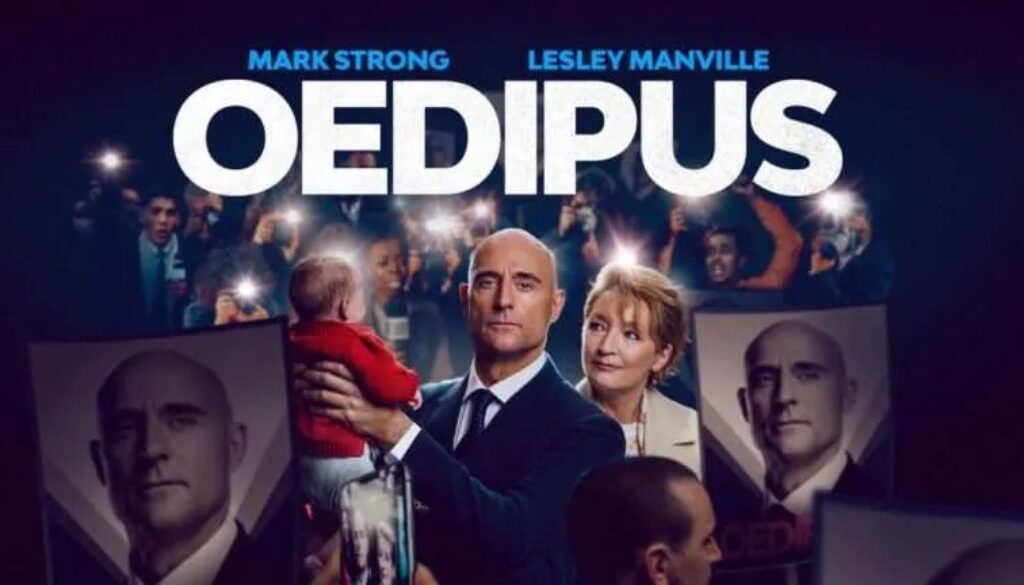
Robert Icke’s modernised adaptation of Sophocles’ Oedipus arrived at London’s Wyndham’s Theatre in 2024, and Manville’s portrayal of Jocasta — Oedipus’s wife and, as the play devastatingly reveals, his mother — was immediately recognised as a performance of the very highest order. Icke’s Jocasta is a modern political wife: polished, ambitious, passionately devoted to her husband, and, as the play unfolds, the bearer of a terrible buried knowledge that she has spent decades refusing to acknowledge. The role requires an actress of extraordinary technical control — the ability to convey, beneath every composed exterior, the faint but persistent tremor of a woman who knows what she knows and has chosen not to know it.
Manville won the Olivier Award for Best Actress for the performance in 2025 — her second Olivier win, following her win for Ghosts ten years earlier — and won the UK Critics’ Circle Award for Best Actress. The production won the Olivier for Best Revival of a Play. When it transferred to Broadway’s Studio 54 — opening 13 November 2025 and running through 8 February 2026 — it was Manville’s first Broadway appearance.
The production ran 100 performances and broke the all-time Studio 54 box office record in its final week. It received seven Tony Award nominations — the production’s achievement being the joint-highest for a play this season. Manville’s co-star Mark Strong received a Best Actor nomination alongside her Best Actress nomination, making Oedipus only the second production this season after Fallen Angels to receive double nominations in the same acting category.
Crucially, Manville received the Tony pin — the traditional symbol of nomination — not in New York but in London, where she had already moved on to her next project. A close friend, the director Marianne Elliott (Tony winner for Angels in America), presented the pin to Manville on the stage of the National Theatre during a rehearsal for Les Liaisons Dangereuses — a moment of theatrical affection and institutional solidarity that BroadwayWorld captured and circulated widely, and that speaks volumes about the esteem in which Manville is held throughout the English-speaking theatrical world.
Full Circle: Les Liaisons Dangereuses at the National Theatre, 2026
Even as the Tony nominations were being announced for her work in Oedipus, Manville had already moved on to her next stage project — and in doing so, completed one of the most resonant dramatic circles in her long career. She is currently starring as the Marquise de Merteuil in Marianne Elliott’s new production of Christopher Hampton’s Les Liaisons Dangereuses at the National Theatre’s Lyttelton in London, opposite Aidan Turner as the Vicomte de Valmont and American actress Monica Barbaro as Madame de Tourvel.
The significance of the casting is considerable. In 1985, the twenty-nine-year-old Lesley Manville appeared in the RSC world premiere of Hampton’s Les Liaisons Dangereuses — playing the sixteen-year-old ingénue Cécile, the naive, convent-educated young woman who becomes the Marquise’s instrument of revenge. Forty-one years later, she returns to the same play, the same Hampton text, and takes on the role of the Marquise herself — the scheming, brilliant, utterly ruthless puppet-master who “was born to dominate the opposite sex and avenge her own.” Critics and theatergoers have found in this casting not merely a tour de force but a kind of theatrical autobiography: Manville inhabiting, in the later stages of a magnificent career, the role that the younger self could not yet have possessed.
The National Theatre production runs through June 2026, with an NT Live cinema broadcast planned for 25 June 2026. The production reviews have been strong, with Time Out noting four stars and calling both Manville and Turner “superb,” and the BroadwayWorld review describing the performance as “riveting” — Manville claiming she was “born to dominate” the stage in precisely the way the Marquise claims to dominate the world.
What the Critics Said: Oedipus Reviews
The critical response to Oedipus and to Manville’s performance was uniformly admiring, with her portrayal of Jocasta serving as the emotional and moral centre of the production’s most devastating sequences.
Tony Nominated: Best Actress in a Leading Role in a Play
Lesley Manville’s first-ever Tony nomination arrives for her Broadway debut performance as Jocasta in Oedipus at Studio 54. She received the nomination pin from director Marianne Elliott on the stage of the National Theatre in London, where she is currently performing. A win would crown the most distinguished late-career surge of any British actress in recent memory.
Full category nominees:
- Rose Byrne — Fallen Angels
- Carrie Coon — Bug
- Susannah Flood — Liberation
- Lesley Manville — Oedipus
- Kelli O’Hara — Fallen Angels
The Honours and Awards Record
| Year | Award | Category / Production | Result |
|---|---|---|---|
| 1996 | Golden Globe | Best Supporting Actress — Secrets & Lies | Nominated |
| 2010 | BAFTA Film | Best Supporting Actress — Another Year | Nominated |
| 2010 | London Film Critics’ Circle | British Actress of the Year — Another Year | WON ★ |
| 2015 | Olivier Award | Best Actress — Ghosts (Almeida) | WON ★ |
| 2015 | Critics’ Circle | Best Actress — Ghosts | WON ★ |
| 2015 | OBE | Services to Drama (Queen’s Birthday Honours) | Awarded ★ |
| 2018 | Academy Award | Best Supporting Actress — Phantom Thread | Nominated |
| 2018 | BAFTA Film | Best Supporting Actress — Phantom Thread | Nominated |
| 2021 | CBE | Services to Drama & Charity (Queen’s New Year Honours) | Awarded ★ |
| 2022 | Golden Globe | Best Actress, Musical/Comedy — Mrs. Harris Goes to Paris | Nominated |
| 2022 | BAFTA TV | Best Supporting Actress — The Crown | Nominated |
| 2025 | Olivier Award | Best Actress — Oedipus (Wyndham’s) | WON ★ |
| 2025 | UK Critics’ Circle | Best Actress — Oedipus | WON ★ |
| 2026 | Tony Award | Best Actress in a Leading Role in a Play — Oedipus | Nominated ★ (Pending) |
A Career in Full: Selected Stage Credits
Makes her West End debut at sixteen in this musical, following her training at the Italia Conti Academy — a remarkable professional entrance for a teenager still in her formative years.
Builds her reputation as a distinctive theatre actress at two of Britain’s most important stages. RSC Warehouse work in new plays; Royal Court work including Churchill’s Top Girls. Meets Mike Leigh in 1979, beginning their transformative artistic partnership.
Appears in the world premiere of Christopher Hampton’s landmark adaptation, playing the ingénue Cécile. Forty-one years later she returns to the same play at the National Theatre — this time as the Marquise de Merteuil.
Eight productions across television and film with director Mike Leigh, forming one of the great actor-director partnerships in British cultural history. Key films: Grown-Ups (1980), High Hopes (1988), Secrets & Lies (1996), Topsy-Turvy (1999), All or Nothing (2002), Vera Drake (2004), Another Year (2010), Mr. Turner (2014).
Appears in two productions at the Old Vic, extending her stage range beyond the RSC and Royal Court into the classical mainstream of British theatre.
Wins the Olivier Award for Best Actress and the Critics’ Circle Award for her portrayal of Helene Alving in Ibsen’s Ghosts. The production transfers to the Brooklyn Academy of Music in New York — her first significant New York stage work, previewing her qualities for American audiences a decade before her Broadway debut.
Receives the Academy Award nomination for Best Supporting Actress for Paul Thomas Anderson’s film opposite Daniel Day-Lewis. International breakthrough to the global cinema audience. OBE already received in 2015; CBE follows in 2021.
Plays an older Princess Margaret in the final two seasons of Netflix’s global prestige drama. BAFTA TV nomination, Emmy consideration. Introduces her work to audiences worldwide who had not previously encountered her stage or art-house film career.
Plays Jocasta in Robert Icke’s modern adaptation alongside Mark Strong. Wins the Olivier Award for Best Actress and the UK Critics’ Circle Award. The production wins the Olivier for Best Revival. Prepares for the Broadway transfer.
Makes her Broadway debut as Jocasta at sixty-nine. The production runs 100 performances and breaks the all-time Studio 54 box office record in its final week. Earns her first Tony Award nomination for Best Actress in a Leading Role in a Play. The production receives nine Tony nominations in total.
Stars as the Marquise de Merteuil in Marianne Elliott’s production of Hampton’s Les Liaisons Dangereuses — a full-circle return to the play in which she first appeared as Cécile in 1985. Opposite Aidan Turner and Monica Barbaro. NT Live cinema broadcast 25 June 2026. Running through June 2026.
What Lesley Manville’s Tony Nomination Means for the Art of Acting
There is a peculiar quality to the story of Lesley Manville’s first Tony nomination. It arrived not at the beginning of a career or at its most commercially successful moment but at the point where fifty years of accumulated craft, artistic courage, and institutional respect have crystallised into something so clear and so complete that it simply cannot be ignored. She was sixty-nine years old when she made her Broadway debut. She will be seventy at the Tony ceremony. And the role she played — Jocasta, the wife-mother of a man whose truth she has spent her whole life refusing to know — is perhaps the role she was most perfectly equipped to play at exactly this point in her life and career.
It is a nomination that says something important about what the Tony Awards at their best are for: not merely recognising star power or commercial momentum, but honouring the art of acting at its highest level, wherever it finds expression. Lesley Manville has been doing this work for fifty years, across stages and screens of every kind, with a consistency and a depth that few performers anywhere have matched. Broadway, in welcoming her, was simply catching up with what London had known all along.
Lesley Manville and Mark Strong are stunning in Robert Icke’s compassionate political thriller spin on the horrifying Greek tragedy. Both performers find dramatic urgency in their relationship — and their body-wracking devastation in the final scenes is some of the finest ensemble acting available anywhere on Broadway this season.
Critical consensus across Time Out, NY Theatre Guide, and Gold Derby, 2025–2026