John Lithgow: Tony Nominated for Giant — Roald Dahl on Broadway
John Lithgow: The Titan of Broadway Who Became Roald Dahl — and Earned His Eighth Tony Nomination
At 80 years old, with 53 years and 25 Broadway shows behind him, John Lithgow is delivering what critics unanimously call the performance of his career — playing one of literature’s most beloved and morally complicated figures in Giant, the Tony-nominated sensation at Broadway’s Music Box Theatre.
Born Into Theatre: Rochester, Ohio and a Shakespearean Father
The story of John Lithgow begins, fittingly, backstage. Born on 19 October 1945 in Rochester, New York, he was the son of Arthur Washington Lithgow III, a pioneering theatre director and Shakespeare festival producer, and Sarah Jane Price, a former actress. His childhood was defined by constant movement — the family followed Arthur Lithgow’s theatrical ambitions across the American Midwest, living in Ohio and various other states as his father built and managed local theatre companies and Shakespeare festivals. In an industry notorious for the gap between the lives children lead and the lives their parents work in, Lithgow had no such gap: the theatre was home, and home was always, in some sense, a stage.
It was at one of his father’s Shakespeare festivals that the young John made his first childhood appearances as a performer. Yet despite this theatrical immersion, acting was not initially his calling — or so he believed. When the family settled in Princeton, New Jersey, after Arthur Lithgow became head of the McCarter Theater, John enrolled at Princeton High School with his artistic ambitions directed primarily at painting. He was, by his own account, certain he wanted to be a visual artist.
That certainty dissolved the moment he arrived at Harvard University, where he had won a scholarship and enrolled to study graphic arts. Almost immediately, he found himself drawn into campus theatre — acting, directing, stage designing, and generally doing whatever the university’s drama groups needed. A performance in a production of Gilbert and Sullivan’s Utopia, Limited proved decisive: the response from the audience was unlike anything he had experienced as a painter, and by the time he graduated in 1967, magna cum laude with a degree in history and literature, his vocation had been entirely transformed.
What followed Harvard was the education that would make him one of the most technically accomplished stage actors of his generation. Lithgow won a Fulbright scholarship to study at the London Academy of Music and Dramatic Art (LAMDA), spending two formative years in London absorbing British theatrical technique — a rigour and precision that would become the bedrock of everything he subsequently built as a performer. He returned to the United States in 1969 equipped with a classical training that few American actors of his generation could match.
The Long Apprenticeship: Regional Theatre and the Road to Broadway
The years between Lithgow’s return from London and his Broadway debut were years of active artistic formation. He directed and performed in plays across Connecticut, Pennsylvania, and New Jersey — including early work with his father’s theatrical companies — while developing the physical, vocal, and interpretive range that would make him one of Broadway’s most formidable assets. He also appeared in his first film during this period, the 1972 drug-themed comedy Dealing; or, The Berkeley-to-Boston Forty-Brick Lost-Bag Blues, though it was the stage rather than the screen that commanded his primary attention and energy.
Then, in 1973, came the Broadway debut — and with it, almost immediately, the first Tony Award. Lithgow appeared in David Storey’s The Changing Room, playing a somewhat dim British rugby player. The feat he accomplished was remarkable: just three weeks after his Broadway debut, he won the Tony Award for Best Featured Actor in a Play, along with the Drama Desk Award for the same performance. It was one of the fastest debut-to-Tony trajectories in Broadway history, and it announced a performer of exceptional discipline and natural authority.
The years following The Changing Room saw Lithgow cementing his status as one of Broadway’s most sought-after actors while simultaneously building a parallel film career. He appeared alongside Lynn Redgrave in My Fat Friend (1974) and opposite Meryl Streep in Arthur Miller’s A Memory of Two Mondays (1976). He played in Alan Ayckbourn’s Bedroom Farce (1979) and Tom Stoppard’s The Real Thing — performances that demonstrated his comfort with the full spectrum of theatrical styles from naturalism to heightened comedy. He also worked with the Royal Shakespeare Company and the National Theatre in England, playing Malvolio with the RSC and the title role of The Magistrate with the National — further deepening his classical foundations.
His off-Broadway work during this period included acclaimed productions that burnished his New York reputation even further. By the early 1980s, Lithgow had established himself as a performer equally at home in the intimate confines of a small Off-Broadway house and on Broadway’s grandest stages — a versatility that would remain a defining quality of his career for the next five decades.
Hollywood and the Screen: Oscar Nominations, 3rd Rock, and The Crown
While Lithgow’s theatrical career continued to flourish, the 1980s brought him to global attention through a series of extraordinary screen performances. His breakthrough came with The World According to Garp (1982), in which he played Roberta Muldoon, a transgender former football star — a performance of such humanity and specificity that it earned him his first Academy Award nomination for Best Supporting Actor. The following year brought a second Oscar nomination for Terms of Endearment (1983), confirming his status as one of the finest screen actors of his generation.
The decade also produced memorable performances in All That Jazz (1979), Blow Out (1981), Footloose (1984), and a brilliantly menacing villain turn in Cliffhanger (1993). He voiced Lord Farquaad in the Oscar-winning animated film Shrek (2001), a role that introduced him to an entirely new generation of fans. He played the Trinity Killer in Dexter — one of television’s most chillingly effective villain performances — winning an Emmy for the work. He portrayed Winston Churchill in the first two seasons of Netflix’s The Crown, earning Emmy and Golden Globe recognition for a performance that required him to embody one of the twentieth century’s most recognisable public figures.
More recently, Lithgow has appeared in Edward Berger’s Conclave (2024) and in the title role of JIMPA (2025), alongside Olivia Colman, which debuted at the Sundance Film Festival. Most tantalisingly for the future, he has been announced as Albus Dumbledore in HBO’s forthcoming Harry Potter series, a casting that has generated enormous anticipation worldwide.
Throughout this prolific screen career, the stage never ceased to be his artistic home base. As he told WBUR’s Here & Now in May 2026: “The theatre centres me and gives me an ownership of the work more than anything else.” It is a commitment that has shaped both the depth and the longevity of his career in ways that purely screen-focused careers rarely achieve.
In my 53-year, 25-show career on Broadway, I’ve rarely experienced the kind of audience response that we feel night after night with Giant. Mark Rosenblatt has written a play of extraordinary intelligence and humanity, and with every performance I can sense the audience wrestling with its questions in real time. This is the unique power of theatre at its best.
John Lithgow, in a statement upon the production’s Broadway openingA 53-Year Broadway Career: From The Changing Room to Giant
John Lithgow’s Broadway record is, by any measure, extraordinary. Twenty-five productions over fifty-three years, spanning every genre from Shakespearean tragedy to musical comedy, from intimate psychological drama to epic historical narrative. He has been inducted into the Theatre Hall of Fame. He holds four Drama Desk Awards. He is the proud possessor of eight Tony nominations — a record that places him among the most consistently recognised stage performers of his era.
Won the Tony Award for Best Featured Actor in a Play and the Drama Desk Award just three weeks after his Broadway debut. A startling entry into the professional stage world that immediately established him as a performer of rare distinction.
Starred alongside Lynn Redgrave in a warm comic drama, broadening his Broadway range beyond the dramatic intensity of his debut.
Appeared opposite Meryl Streep in Arthur Miller’s one-act play, an early collaboration with one of American theatre’s most enduring voices.
Demonstrated his comedic range in Ayckbourn’s celebrated domestic comedy, adding another register to his growing Broadway repertoire.
Appeared in Durang’s sharp satirical comedy about therapy and relationships, a production that showcased his ability to find the absurd humanity within heightened comic material.
Second Tony nomination (Best Actor in a Play) for his carefully crafted portrayal of a washed-up prize fighter — a performance that demonstrated the full emotional depth beneath his considerable technical gifts.
Third Tony nomination (Best Actor in a Play) and Drama Desk Award for his role in Hwang’s landmark play about illusion, identity, and colonial desire. One of the defining Broadway performances of the 1980s.
Second Tony win (Best Actor in a Musical) for his portrayal of the ruthlessly powerful columnist J.J. Hunsecker in this Broadway musical adaptation of the classic film. Also earned the Drama Desk Award and Outer Critics Circle recognition.
Appeared in the classic newspaper comedy in a production that once again demonstrated his ease across tonal extremes — high comedy, human warmth, and the sharp edges of satirical truth.
Tony nomination (Best Actor in a Musical) for his gleefully comic portrayal of the suave con man Lawrence Jameson in this hit Broadway musical — confirming that his musical theatre credentials were every bit as formidable as his dramatic ones.
Returned to Arthur Miller in a Broadway revival that drew strong notices for the ensemble, with Lithgow once again demonstrating his particular affinity for the American dramatist’s moral complexity.
Tony nomination (Best Actor in a Play) for his performance as the brilliant but deeply flawed newspaper columnist Joseph Alsop — a role that anticipated his later work in Giant by once again asking him to make a brilliant, difficult man fully human on stage.
Played the title role of Lear in Daniel Sullivan’s production for The Public Theater’s Shakespeare in the Park — a performance on the open-air Delacorte stage that drew some of the most passionate critical notices of his career up to that point.
Brought his personal one-man show — originally devised in 2008 and performed in 35 cities across the United States — to Broadway’s Roundabout Theatre for a warmly received limited engagement. A rare and intimate glimpse of the man behind the roles.
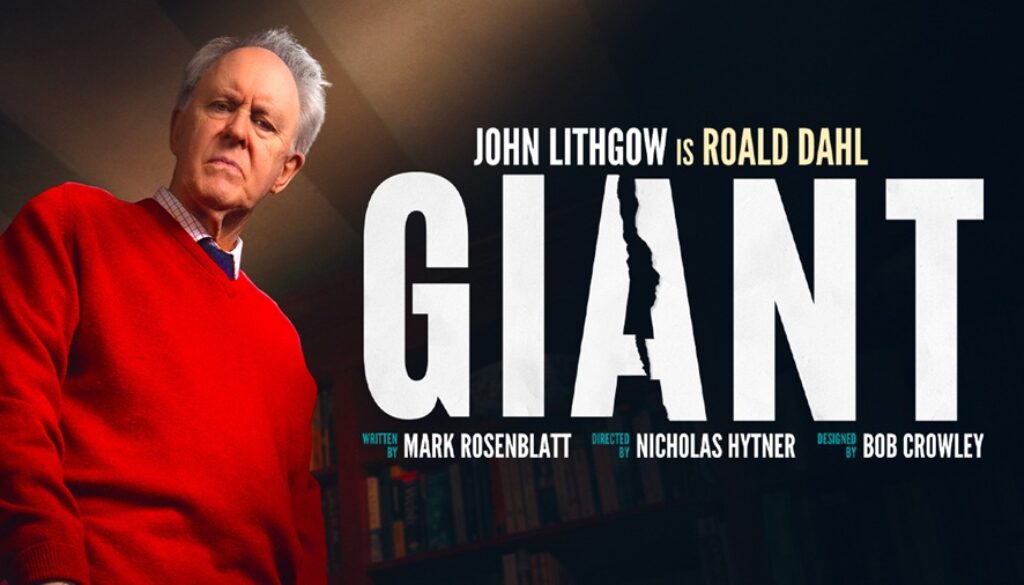
Tony nomination (Best Actor in a Leading Role in a Play) for his performance as Roald Dahl at the Music Box Theatre — described by critics across the board as the finest performance of his career. The production is a commercial as well as critical triumph, having recouped its entire $5.6 million capitalisation within ten weeks. Closing 28 June 2026.
The Tony Award Record: Eight Nominations, Two Wins
| Year | Category | Production | Result |
|---|---|---|---|
| 1973 | Best Featured Actor in a Play | The Changing Room | WON ★ |
| 1985 | Best Actor in a Play | Requiem for a Heavyweight | Nominated |
| 1988 | Best Actor in a Play | M. Butterfly | Nominated |
| 2001 | Best Actor in a Musical | Sweet Smell of Success | WON ★ |
| 2004 | Best Actor in a Musical | Dirty Rotten Scoundrels | Nominated |
| 2012 | Best Actor in a Play | The Columnist | Nominated |
| 2017 | Best Actor in a Play | The Front Page | Nominated |
| 2026 | Best Actor in a Leading Role in a Play | Giant | Nominated ★ (Pending) |
Giant on Broadway: The Play, the Story, and Why It Matters Now
Giant is a new play by first-time playwright Mark Rosenblatt, directed by two-time Tony winner Nicholas Hytner (The History Boys, War Horse). It received its world premiere at London’s Royal Court Theatre in 2024, transferring to the Harold Pinter Theatre in the West End in 2025, where it won three Olivier Awards: Best New Play, Best Actor (Lithgow), and Best Supporting Actor (Elliot Levey). It transferred to Broadway’s Music Box Theatre, beginning previews on 11 March 2026 and opening officially on 23 March, for a limited 16-week engagement closing 28 June 2026.
The play unfolds across a single afternoon in the summer of 1983, at Gipsy House, Roald Dahl’s country home in Buckinghamshire, England. The occasion is a crisis. Dahl — beloved author of Charlie and the Chocolate Factory, Matilda, James and the Giant Peach, and dozens of other works that have enchanted children worldwide — has just published a literary review of a photobook documenting the Israeli military’s 1982 siege of Beirut. The review has erupted into scandal: not merely for its political content, but for language that is unmistakably and virulently antisemitic. A Jewish bookseller representing a large network of shops has written to Dahl’s American publisher, Farrar, Straus and Giroux, to say he will no longer carry Dahl’s books.
Into Gipsy House descend two representatives of the publishing world: Tom Maschler (Elliot Levey), Dahl’s British publisher and a Jewish man, and Jessie Stone (Aya Cash), a young American sales director for FSG. Their mission: persuade Dahl to issue a public apology. Dahl’s fiancée, Felicity “Liccy” Crosland (Rachael Stirling), urges the same — partly from personal fear, as violent threats have necessitated police protection at their home. What follows across two hours and twenty minutes is a prolonged, ferocious battle of wills in which Dahl refuses to capitulate, weaponising his intellectual authority, his physical scale, his charm, and finally his unguarded hatred against his interlocutors.
The play draws on documented historical record — including Dahl’s actual 1983 book review and, in the play’s devastating finale, a verbatim interview he later gave to The New Statesman in which he doubled down on his antisemitism in terms so stark as to leave no ambiguity whatsoever about his views. Rosenblatt’s achievement is to have written a play in which we simultaneously comprehend the man’s brilliance, charm, and generosity — and cannot forgive him. Lithgow’s achievement is to have made that duality fully, unbearably human.
The production’s scenic and costume design by Bob Crowley — depicting Gipsy House mid-renovation, its walls stripped back to exposed brick, the sitting room a construction site — functions as a visible metaphor for Dahl’s own unravelling: the grand edifice dismantled to reveal something raw and ugly beneath. Lighting by Anna Watson, sound by Darron L West.
Lithgow as Dahl: A Performance for the Ages
The central challenge of Giant is one of the most demanding that an actor can face: to make a character genuinely monstrous and genuinely compelling, often simultaneously. Roald Dahl was brilliant, funny, generous, and a devoted father. He was also, the historical record makes inescapably clear, an antisemite. The audience of Giant must hold both truths at once — must feel the pull of the man’s charisma even as they are horrified by his convictions — and it is Lithgow who must make that cognitive and emotional dissonance not merely bearable but riveting.
He has spoken at length about what drew him to the role. In his interview with WBUR’s Here & Now in May 2026, Lithgow described Dahl as “a man of dizzying complexity” and said he found himself fascinated by “every variety of human experience” — especially the kind that demands the audience ask uncomfortable questions about themselves. He also noted a particular attraction to what he called Dahl’s “witting and unwitting cruelty”: the way the author deployed his formidable intelligence not merely to hold his views but to test and provoke the people around him, to see how far he could push before someone pushed back.
To play Dahl — who stood six feet six inches tall — Lithgow uses his own considerable physical stature (six feet three) to dominate the stage of the Music Box Theatre, the actor’s imposing frame filling the space with the presence of a man accustomed to commanding every room he entered. Lithgow bends and contracts to register Dahl’s physical infirmities; he expands and straightens to project his intellectual arrogance. The performance is, in the truest sense, full-bodied: you feel the weight of the man in every scene.
In his statement on the production, Lithgow declared that “being a part of Giant from its inception has been the most challenging and exciting stage experience of my career” — a claim that, given the extraordinary range of what his career encompasses, lands with the full weight of its implications. At 80, with 25 Broadway shows and a catalogue of screen performances that would constitute a distinguished career all on their own, Lithgow is saying clearly and deliberately that this is the best work of his life.
Being a part of Giant from its inception has been the most challenging and exciting stage experience of my career. Dahl is a man of dizzying complexity, and his story resonates powerfully with events of our present day.
John Lithgow, production statementWhat the Critics Said: Review Roundup
The critical response to Giant and to Lithgow’s performance was, by any standard, a triumph. Here is what the major outlets had to say.
Audience response on Broadway.com has been equally effusive. Verified ticket-buyers describe Lithgow’s performance as “riveting,” “pitch perfect,” “a masterclass in acting,” and “a 5-star titan.” Multiple audience members describe him as simply embodying Dahl — not performing the role but inhabiting it with total authenticity. One reviewer wrote: “At 80 years young, John Lithgow absolutely brings it in this stunning performance.”
Tony Nominated: Best Actor in a Leading Role in a Play
John Lithgow’s eighth Tony nomination arrives for his performance as Roald Dahl in Giant at the Music Box Theatre — by widespread critical consensus the finest dramatic performance currently on the Broadway stage. It is his first Tony nomination since 2017’s The Front Page.
Full category nominees:
- John Lithgow — Giant
- Will Harrison — Punch
- Nathan Lane — Arthur Miller’s Death of a Salesman
- Daniel Radcliffe — Every Brilliant Thing
- Mark Strong — Oedipus
A Rare Triumph: Giant‘s Commercial and Cultural Impact
Beyond the critical acclaim and the awards momentum, Giant has achieved something that far too few serious straight plays manage on Broadway: genuine commercial success. The production recouped its entire $5.6 million capitalisation in just ten weeks, according to a Playbill announcement — making it one of only four Broadway productions this season to have achieved that milestone. Its weekly gross routinely exceeds $1 million, with more than 90 percent of seats typically sold.
Producers Brian and Dayna Lee, Stephanie Kramer and Nicole Kramer, Josh Fiedler and Robyn Goodman, and the Royal Court Theatre — which co-produced the Broadway transfer — announced the recoupment with justifiable pride, noting that the show “has played to sold-out audiences at the Royal Court, in the West End, and now on Broadway at the Music Box Theatre.”
The production’s cultural impact has also extended beyond Broadway itself. A live capture of the West End production — filmed at London’s Harold Pinter Theatre by Trafalgar Releasing — will be screened in over 900 cinemas across 18 countries beginning 19 November 2026, giving audiences worldwide the opportunity to witness Lithgow’s performance in a medium suited to its intimacy and scale. Tickets go on sale 9 July 2026.
The timing of Giant‘s Broadway run — in the context of ongoing global debates about Israel, Palestine, antisemitism, and the relationship between an artist’s life and their work — has lent the production an urgency that purely historical drama rarely achieves. Post-show discussions, including a 92NY conversation with Lithgow, Aya Cash, and playwright Mark Rosenblatt, have drawn overflowing audiences eager to continue the conversations the play begins but deliberately refuses to resolve.
Beyond the Stage: Children’s Books, Political Satire, and Dumbledore
To describe John Lithgow solely through his stage and screen work would be to miss a significant part of who he is. He has written nine children’s picture books for Simon & Schuster, earned four Grammy nominations for his recordings for children, and appeared with a dozen major American orchestras in concerts featuring his own songs. He wrote the narration for the New York City Ballet’s Carnival of the Animals in 2003 and danced the role of The Elephant. His memoir, Drama: An Actor’s Education, published in 2011, was received as one of the finest theatrical autobiographies of its era.
During the Trump presidency, Lithgow authored the Dumpty Trilogy — three books of political satire from Chronicle Prism — achieving the extraordinary feat of landing on the New York Times non-fiction bestseller list for three consecutive years. He served as co-chair of the Commission on the Arts of the American Academy of Arts and Sciences, producing authoritative reports on America’s creative workforce. He delivered the commencement address at Harvard University in 2005 — the first actor in the university’s history to do so. He has a star on the Hollywood Walk of Fame. He is a member of the American Theatre Hall of Fame.
And now, Lithgow has been cast as Albus Dumbledore in HBO’s forthcoming Harry Potter series, bringing one of the world’s most beloved fictional characters to television in what promises to be one of the most-watched productions of the decade.
A Giant Indeed: What John Lithgow’s Career Teaches Us About Theatre
What makes John Lithgow’s career remarkable is not any single performance — not even the extraordinary work he is currently delivering in Giant — but the sustained quality and range of everything taken together. Eight Tony nominations spanning fifty-three years. Roles that encompass rugby players and transsexual football stars, washed-up boxers and suave con men, Winston Churchill and Roald Dahl. A Harvard education and a Fulbright scholarship put in service not of academia but of acting. A children’s book author and a political satirist and an orchestral narrator and an Emmy winner and an Olivier Award recipient. One career, one man, boundless range.
At 80, Lithgow is not winding down. He is going to the cinema worldwide as Roald Dahl in November. He is becoming Dumbledore on HBO. He is accepting a Tony nomination in the company of some of the finest dramatic actors currently working on the English-speaking stage. And every night until 28 June 2026, he is walking onto the stage of the Music Box Theatre and becoming — with complete, frightening conviction — one of the most complex and troubling figures in the history of English literature.
If you can get to the Music Box Theatre before the curtain comes down for the last time on 28 June, go. What John Lithgow is doing on that stage is exactly what great theatre has always been for: to make you feel, to make you think, and to make you leave the building uncertain about what you believe in a way you weren’t when you arrived.
Lithgow, who has long excelled at conveying erudition, shows us how, confronted with demands, Dahl conceals shivs within gossamer webs of words. It’s Lithgow’s ability to be quiet and sweet and seconds later booming and scary that makes us squirm in our seats over our own feelings toward the writer.
New York Post / Show-Score critics consensus, 2026