The Outsiders Complete Guide — Background, Plot, Full Cast, Everything You Need to Know
The Outsiders Musical Broadway Guide: Cast, Plot, and Production History
Few American stories have left as indelible a mark on the cultural consciousness as S.E. Hinton’s seminal 1967 novel, The Outsiders. Written when Hinton was just sixteen years old, the book captured the raw, unfiltered vulnerabilities of youth, socioeconomic warfare, and chosen family. Decades after Francis Ford Coppola brought the story to the silver screen, this timeless tale of the “Greasers” and the “Socs” has found its definitive modern form on the Great White Way. The Outsiders musical has solidified itself as a bona fide Broadway blockbuster, capturing the 2024 Tony Award for Best Musical and continuing its record-breaking run at the Bernard B. Jacobs Theatre.
This comprehensive guide dives deep into the spectacular world of the production. From its folk-rock Americana score to its breathtakingly kinetic choreography, we explore the background, full production history, scene-by-scene plot breakdown, the refreshed 2026 Broadway cast, and the sweeping critical acclaim that has turned this staging into a generation-defining theatrical milestone.
The Foundation: From Novel to Stage
The journey of The Outsiders to a Broadway musical stage required balancing deep reverence for the source material with a bold reimagining of its visual language. The musical draws its narrative beats directly from S.E. Hinton’s book and Francis Ford Coppola’s 1983 motion picture adaptation. The book, a staple of middle and high school curriculums for over half a century, handles heavy themes of urban poverty, toxic masculinity, parental abandonment, and cycles of violence.
To ground the narrative for a contemporary theater audience, the production team leaned heavily into an authentic, gritty 1960s Tulsa aesthetic. They stripped away traditional musical theater artifice, opting instead for a staging style that feels as visceral and dangerous as the asphalt the characters walk on. The book of the musical, co-written by acclaimed playwright Adam Rapp and creative multi-hyphenate Justin Levine, preserves Ponyboy Curtis’s iconic first-person narration. This structure transforms the stage into an expansive, memory-filled canvas where notebook sketches and lighting shifts stand in for the passage of time.
The Golden Rule of the Adaptation: “Stay Gold.” The musical emphasizes this central motif, adapted from Robert Frost’s poem, “Nothing Gold Can Stay.” It serves as an emotional compass for young Ponyboy and Johnny Cade as they navigate a harsh world designed to harden them prematurely.
Production History & Award Trajectory
Before capturing the hearts of Broadway audiences, The Outsiders underwent an extensive, highly deliberate developmental process. The musical had its official world premiere at La Jolla Playhouse in San Diego, California, in early 2023. This initial out-of-town tryout allowed the creative team—led by visionary director Danya Taymor and the sibling choreography duo Rick Kuperman and Jeff Kuperman—to experiment with the show’s hallmark physical staging elements, including its intense, rain-slicked fight sequences and complex set configurations.
The show officially opened on Broadway at the Bernard B. Jacobs Theatre in the spring of 2024. Facing a highly competitive theatrical season, it quickly set itself apart through unparalleled word-of-mouth momentum, exceptional box office receipts, and a sweeping critical consensus.
The 77th Tony Awards and Major Milestone Accolades
At the 2024 Tony Awards, the production converted its critical momentum into historic wins, securing its place at the top of modern American musical theater:
| Award Category | Recipient | Result | Significance |
|---|---|---|---|
| Best Musical | The Outsiders Production Team | Won | Cemented the show as the definitive production of the 2023-2024 Broadway season. |
| Best Direction of a Musical | Danya Taymor | Won | Honored Taymor’s staging, which fluidly links quiet human intimacy with explosive gang violence. |
| Best Lighting Design | Brian MacDevitt & Hana S. Kim | Won | Recognized the breathtaking use of shadows, headlights, and sunset hues illuminating the stage. |
| Best Sound Design | Cody Spencer | Won | Celebrated the hyper-realistic acoustic landscape, from falling rain to the roar of standard engines. |
In tandem with its Tony Award triumphs, the production received a prestigious Grammy Award nomination for Best Musical Theater Album. This recognized the mainstream appeal of its original Broadway cast recording, which has amassed millions of streams globally.
Act-by-Act Plot Synopsis
The narrative of The Outsiders unfolds across two high-octane acts, balancing the domestic struggles of the three orphan Curtis brothers with the larger, escalating gang warfare consuming their Tulsa community.
Act I: The Divide and the Fountain
The musical opens in Tulsa, Oklahoma, 1967. Fourteen-year-old Ponyboy Curtis sits quietly at a desk, writing frantically in his notebook. He introduces the audience to his world: a town strictly divided by class lines. On the North Side live the working-class, tough-as-nails Greasers; on the South Side live the affluent, privileged Socs, who cruise around in pristine Corvairs and wear expensive madras shirts. Ponyboy lives with his older brothers: Darrel (“Darry”), a former high school football standout who sacrificed his college dreams to work construction and keep the family together, and Sodapop, a charismatic, sensitive high school dropout working at a gas station.
Ponyboy’s best friend is Johnny Cade, a quiet, severely traumatized boy who was recently beaten half to death by a group of Socs. The tension reaches a boiling point when the fiery, freshly paroled Dallas “Dally” Winston takes Ponyboy and Johnny to a local drive-in movie theater. There, they meet Cherry Valance, a Soc cheerleader who refuses to conform to her peer group’s elitist expectations. Ponyboy and Cherry share a deep, quiet conversation about sunsets, books, and the realization that things are “rough all over,” sparking a dangerous resentment in Cherry’s boyfriend, Bob Sheldon.
Later that evening, after Darry strikes Ponyboy out of sheer, exhausted frustration over an missed curfew, Ponyboy and Johnny run away into the local park. They are swiftly ambushed by Bob and a ruthless contingent of intoxicated Socs. In an escalation of violence, the Socs attempt to drown Ponyboy in the park’s concrete water fountain. Terrified for his friend’s life, Johnny pulls a switchblade and stabs Bob Sheldon, killing him instantly. As the remaining Socs flee into the night, a panicked Ponyboy and Johnny turn to Dally. Dally provides them with cash, a gun, and instructions to catch a train to Windrixville, where they can hide out in an abandoned wooden church on Jay Mountain.
Act II: Fire, Rain, and Golden Skies
Act II begins in the quiet isolation of the Windrixville church. To alter their appearances, Ponyboy cuts and bleaches his signature hair. He and Johnny pass the long hours reading Margaret Mitchell’s Gone with the Wind and discussing the ephemeral nature of life, punctuated by Ponyboy reciting Robert Frost’s poetry. Dally arrives to check on them, revealing that the tension back in Tulsa has escalated into a city-wide war, with Cherry Valance acting as a secret spy for the Greasers.
Before they can leave the mountain, a fire breaks out at the church, trapping a group of young children who had been visiting for a picnic. Without a second thought, Ponyboy and Johnny rush inside the burning structure to rescue them. While Ponyboy escapes relatively unscathed, a collapsing roof beam strikes Johnny, breaking his back and leaving him with life-threatening third-degree burns. They are rushed back to Tulsa and hospitalized as heroes.
The narrative accelerates toward an ultimate showdown: a massive, sanctioned “rumble” between the Greasers and the Socs to determine turf control once and for all. Staged under a torrential downpour, the rumble is a masterclass in modern theatrical violence, with the Greasers emerging victorious. However, the victory rings hollow. Ponyboy and Dally rush to the hospital to deliver the news to Johnny, only to watch him pass away peacefully after uttering his final, immortal words to his friend: “Stay gold, Ponyboy. Stay gold.”
Blinded by grief and rage over losing the only person he truly loved, Dally intentionally provokes a confrontation with the police, resulting in his tragic death on the street. The musical closes where it began—with the Curtis brothers reaffirming their bond to one another, and Ponyboy opening his notebook to write down the story of his fallen friends, ensuring their memory stays gold forever.
The Broadway Cast Breakdown
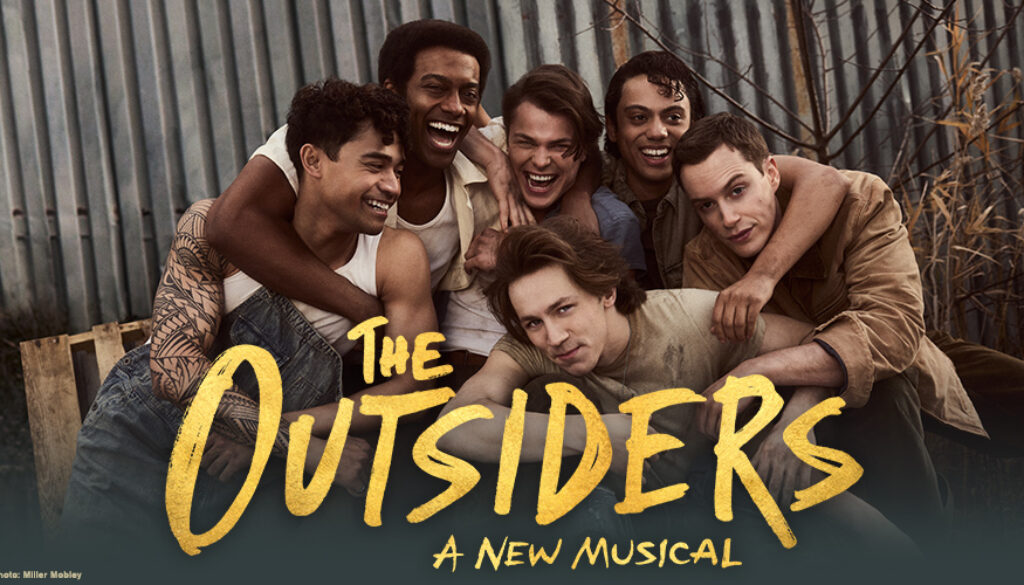
While the original Broadway cast—led by Brody Grant, Sky Lakota-Lynch, and Joshua Boone—set an incredibly high standard, the production entered an exciting new era with a major casting refresh at the Bernard B. Jacobs Theatre. These young actors bring fresh energy, exceptional vocal power, and a deep emotional resonance to these legendary literary characters.
The principal Broadway cast features the following performers:
- Noah Pacht (Ponyboy Curtis): Taking over the central narrative anchor, Pacht plays the十四-year-old dreamer with a mix of intellectual curiosity and raw, adolescent vulnerability. His vocal performance captures the acoustic folk styling of the character’s solo moments perfectly.
- Caleb Mathura (Johnny Cade): Making a stunning Broadway debut following his run on national tours, Mathura plays the fragile yet incredibly brave “pet” of the Greaser gang. His portrayal of Johnny’s final moments is a certified tear-jerker.
- SeQuoiia (Dallas Winston): Having previously understudied the role, SeQuoiia stepped permanently into the boots of the dangerous, magnetic, and fiercely loyal Dally, bringing an electric, commanding stage presence to every scene.
- Dan Berry (Darrel Curtis): Transitioning from his original role as Paul Holden, Berry portrays the eldest Curtis brother with the crushing weight of premature paternal responsibility, utilizing a booming baritone that highlights the character’s internal conflicts.
- Sutton James Kaylor (Sodapop Curtis): Making his Broadway debut, Kaylor imbues the middle Curtis brother with unmatched warmth, charm, and the heartbreak of a young man trying desperately to act as the glue holding his fragmented family together.
- Emma Pittman (Cherry Valance): Continuing her acclaimed run from the original Broadway company, Pittman plays the Soc cheerleader with sharp intellect and vocal precision, beautifully illustrating the bridge between two warring social classes.
- Daryl Tofa (Two-Bit Mathews): A continuing favorite from the original cast, Tofa provides essential comedic relief, physical agility, and fierce loyalty as the switchblade-loving veteran Greaser.
The Folk-Rock Americana Score
One of the most distinctive elements of The Outsiders is its musical identity. Moving completely away from standard, brassy Broadway showtunes, the production features music and lyrics by the acclaimed Texas folk-rock duo Jamestown Revival (Jonathan Clay & Zach Chance) alongside Justin Levine. The score is a rich tapestry of acoustic guitars, fiddles, harmonium, and soaring roots-rock harmonies that evoke the dusty, open-air feeling of 1960s Oklahoma.
Some of the show’s most impactful musical numbers include:
- “Tulsa ’67”: The explosive opening company number that establishes the socioeconomic divide, the danger of the streets, and the distinct musical motifs separating the two rival factions.
- “Runs in the Family”: Darry’s heartbreaking, introspective solo where he laments the sacrifices he has made, the fear of losing custody of his brothers, and the generational weight of his family name.
- “I Could Talk to You All Night”: A gentle, gorgeously harmonized duet between Ponyboy and Cherry at the drive-in, stripping away their gang affiliations to reveal two lonely souls finding solace in shared perspectives.
- “Far Away From Tulsa”: Johnny and Ponyboy’s sweeping, melancholy anthem sung in the shadow of their flight, expressing a deep, collective yearning for a utopia free from prejudice and violence.
- “Trouble”: The dark, pulsing ensemble track that acts as the musical prelude to the rumble, building a terrifying sonic momentum as both gangs prepare for war.
Critical Reception: What the Experts and Audiences Say
Critical reception for The Outsiders on Broadway has been nothing short of rapturous. Reviewers have consistently singled out Danya Taymor’s inventive direction and the Kuperman brothers’ choreography for praise. The physical staging utilizes unconventional elements—such as real gravel, scaffolding, a vintage car chassis, and an active water system—to construct a playground of high-stakes theatricality.
The New York Times heralded the production as an “unusually poetic and extraordinarily moving adaptation,” praising its ability to appeal simultaneously to adult theatergoers and the legions of young adults reading the novel for the first time. Critics also widely lauded the technical departments, pointing out that the lighting and sound design work in tandem to simulate the absolute terror of the sensory experiences tied to gang warfare.
Moreover, audience reception has turned the Bernard B. Jacobs Theatre into an emotional sanctuary. The production’s fan base has grown exponentially, drawing massive crowds to the stage door every night. It has successfully bridged the gap between classic literature preservation and modern cultural relevance, a feat few book-to-stage adaptations ever truly master.
Why The Outsiders Stays Gold on Broadway
At its absolute core, The Outsiders succeeds because it treats the emotions of young people with absolute seriousness. It does not look down on its characters or sanitize their struggles. By combining a timeless American narrative with an evocative folk score, groundbreaking physical theater, and a powerhouse new generation cast, the show stands tall as a triumphant monument to what contemporary Broadway can achieve.
Whether you have loved S.E. Hinton’s masterpiece for decades or are discovering the world of the Greasers for the very first time, this production offers a deeply cathartic, visually spectacular evening that will leave you breathless. Do not miss your chance to witness this American classic come to life on the New York stage.