Joshua Henry: Tony Nominated for Ragtime on Broadway 2026
Joshua Henry: The Baritenor of Broadway Who Finally Got His Dream Role — and Is Shaking the Rafters of the Vivian Beaumont
He wanted to be an accountant. A high school Music Man changed everything. Now, four Tony nominations, a Grammy Award, a Drama League win, and the most rapturously reviewed performance on the 2025-26 Broadway stage later, Joshua Henry has made Coalhouse Walker Jr. in Ragtime his undisputed masterwork.
From Winnipeg to Miami: A Budding Accountant Meets Harold Hill
The origin story of Joshua Henry’s theatrical career is one of theatre’s more satisfying accident narratives: the young man who planned to do something entirely different, who walked into an audition as a lark or a whim, and discovered in the moment of performance that he had found his irreversible vocation. It is a story he has told with considerable warmth in multiple interviews — and the specific details of it carry a pleasing sense of theatrical destiny.
Henry was born on 2 September 1984 in Winnipeg, Manitoba — Canada’s cultural heart of the prairies — to a father, Zadoc Henry, who taught at Calvary Christian Academy. The family subsequently relocated to Miami, Florida, where Joshua grew up in an environment that emphasised education and faith. His early academic ambitions were pointed firmly away from the performing arts: he has described wanting to be an accountant, like his mother, and approaching his schooling with that practical vocational goal in mind.
The transformation came through his high school, Florida Bible Christian School, when he was cast as Harold Hill in a production of Meredith Willson’s The Music Man. Harold Hill — the charming, silver-tongued con man who transforms a small Iowa town through the sheer force of his personality and his persuasion of its citizens that they can be a band — is, in a sense, the perfect first major role for a young performer of extraordinary natural charisma. The response of the audience, the experience of standing in front of people and commanding their attention and emotion, was transformative. The accountancy plans were shelved permanently.
He enrolled at the University of Miami, where he studied theatre and graduated with a BFA — a training programme that gave him the technical and conceptual foundations for the career that followed. At the University of Miami, his voice and his stage instincts were developed in the context of a strong theatre programme, and it was during these years that the vocal range and power that would later earn him the sobriquet “the Baritenor of Broadway” began to be formally cultivated and understood. He married his wife, Cathryn Stringer, in 2012; they have three children — son Samson Peter (born 2018) and twins Max and Leo (born March 2021).
The Early Career: Off-Broadway, In the Heights, and the Broadway Debut
Henry’s professional career began in the way that the most serious stage careers typically begin: with Off-Broadway work and regional productions that built his range and resilience before the Broadway spotlight found him. His Off-Broadway debut came in a production of Serenade in 2007, and he appeared in various early professional engagements that gave him the practical experience of sustained professional performance outside the star system. He also played Judas/John the Baptist in a New Jersey production of Godspell that was originally scheduled to transfer to Broadway — a transfer that was cancelled, leaving him to wait for the next opportunity.
That opportunity arrived with one of the most significant Broadway musicals of its era. Henry joined the original Broadway company of Lin-Manuel Miranda’s In the Heights in 2007, appearing in the ensemble and understudying several roles. The production — which opened on Broadway on 9 March 2008 at the Richard Rodgers Theatre, following its development at the 37 Arts Theatre — was a landmark: the first major Broadway musical with a predominantly Latino cast and creative team, featuring Miranda’s exuberant fusion of hip-hop, salsa, merengue, and traditional musical theatre forms.
Henry’s work in In the Heights earned him a Drama Desk Award for Outstanding Featured Actor in a Musical — a recognition that announced him immediately as a performer of genuine distinction rather than a promising newcomer. The show won the Tony for Best Musical in 2008, and Henry’s Drama Desk Award placed him in the company of some of the finest performers of the season. It was also the beginning of his association with Lin-Manuel Miranda — a creative relationship that would continue through Hamilton and beyond.
The years that followed saw Henry appear in a rich variety of productions that demonstrated the range he was building with such deliberate purpose. He played Judas in a production of American Idiot — the Green Day jukebox musical. He appeared in Porgy and Bess as Jake — both at the American Repertory Theater in Cambridge, Massachusetts, directed by the celebrated Diane Paulus, and in the Broadway production that transferred to the Richard Rodgers Theatre in January 2012. He played Noble Sissle in George C. Wolfe’s production of Shuffle Along — one of Broadway’s most ambitious and misunderstood productions of recent years, which closed early but whose critical appreciation has grown considerably since. And he appeared in the ensemble of Bring It On: The Musical, the Lin-Manuel Miranda–produced cheerleading musical that gave him further experience in large-scale physical and comedic theatrical work.
The Breakthrough: The Scottsboro Boys and a Tony Nomination at Twenty-Six
The production that first brought Joshua Henry to the sustained attention of the Broadway awards community was Kander and Ebb’s The Scottsboro Boys (2010) — the last musical on which the legendary songwriting team of John Kander and the late Fred Ebb collaborated, and one of the most formally daring and politically charged works in the canon of American musical theatre. The show tells the story of the nine young Black men who were unjustly accused of raping two white women in Alabama in 1931, and who were subjected to a series of deeply unjust trials that became a defining cause of the early civil rights era.
The production, directed by Susan Stroman, employed the format of a minstrel show — with all its associations of white exploitation of Black performance — as the structural frame through which the story is told. The effect is unsettling and deliberately so: the audience is placed in the position of witnessing authentic suffering through an entertainment format designed to dehumanise its subjects. Henry played Haywood Patterson — one of the nine Scottsboro Boys, and the figure who emerges as the production’s most defiant and articulate voice. The New York Times praised his “performance of blazing intensity,” and the Tony Award committee agreed: Henry received his first Tony nomination for Best Actor in a Leading Role in a Musical.
The show had a troubled journey to Broadway — it opened and closed with mixed commercial results despite its extraordinary critical reception — but its reputation has only grown in the years since, and Henry’s performance is remembered as one of the great Broadway acting achievements of the decade. He later reprised the role in a Los Angeles production in 2013, demonstrating his continued commitment to the material.
Having a dream, having kids, having a life that’s separate from the theater — a place where I go to get love and acceptance and belonging — has made a big difference in the way that I play Coalhouse. He goes to some incredibly joyous places and some incredibly dark places. I’ve always been a big dreamer, but fatherhood has intensified that.
Joshua Henry, Broadway.com, May 2026Violet, Carousel, Hamilton: The Nominations That Built a Legend
The years following The Scottsboro Boys saw Henry accumulate a body of work that places him, by any serious measure, among the finest musical theatre performers of his generation. Each major production added a new dimension to a performer whose gifts — the extraordinary vocal range, the emotional directness, the instinct for the moral core of complex characters — were becoming more apparent with every role.
In 2014, he appeared as Flick in the Broadway production of Violet — Jeanine Tesori and Brian Crawley’s moving musical about a young woman disfigured from childhood, travelling across 1960s America toward a promised healing. Flick is the Black Vietnam veteran whose love for Violet and his own experience of injustice and dignity form the production’s moral centre. Henry received a Tony nomination for Best Featured Actor in a Musical — his second career nomination — along with Drama Desk, Outer Critics Circle, and Drama League nominations. Working opposite Lauren Worsham (later replaced by Sutton Foster) and with co-star David Abeles, he delivered a performance that critics singled out for its warmth, dignity, and quietly devastating emotional intelligence.
Then came the role that confirmed his status as one of the essential performers in the contemporary musical theatre landscape. In 2016, Henry joined Lin-Manuel Miranda’s Hamilton — not in the original Broadway production but in a capacity that would prove equally formative. He helped create the roles of Hercules Mulligan and James Madison for workshop productions in 2013, giving him an intimate connection to the show’s development. He subsequently starred as Aaron Burr in the Chicago sit-down production of Hamilton from September 2016, and then took the role on the first national US tour — bringing the show to audiences across America who might not otherwise have access to its extraordinary cultural event. His Burr — the show’s moral and dramatic centre, the narrator-antihero whose ambition and caution ultimately destroy him — was described by critics across the tour as among the finest interpretations of the role.
After Hamilton, came what many critics consider the greatest performance of his pre-Ragtime career. In 2018, he played Billy Bigelow in the Lincoln Center Theater revival of Rodgers and Hammerstein’s Carousel, directed by Jack O’Brien and starring opposite Jessie Mueller as Julie Jordan. Billy Bigelow is one of the most demanding and morally complex roles in the American musical theatre canon — a volatile, charismatic man whose love is inseparable from his violence, and whose final “If I Loved You” and “Soliloquy” require a performer of extraordinary range to make fully human rather than merely sympathetic or merely monstrous. Henry made him both. He won the Drama League Award and the Drama Desk Award for Outstanding Actor in a Musical for the performance, and received his third Tony Award nomination for Best Actor in a Leading Role in a Musical — his third in seven years, confirming that his consistency at the highest level of Broadway performance was not occasional brilliance but sustained excellence.
The Road to Coalhouse: Into the Woods, The Wrong Man, and the Revelation of the Dream Role
Between Carousel and Ragtime, Henry continued to build the range and the personal depth that would make his eventual performance as Coalhouse Walker so complete. He appeared as Dr. Jim Pomatter in the national tour of Waitress (the charming, complicated doctor who becomes the protagonist’s lover). He starred in Into the Woods on Broadway at the Vivian Beaumont Theater — directed by Lear deBessonet, the same director who would later commission him for Ragtime — playing Rapunzel’s Prince with the combination of comic ease and genuine romantic intensity that few performers can sustain simultaneously. He appeared in The Wrong Man, earning further Outer Critics Circle recognition.
On screen, he gave a warmly praised performance as Roger Bart in Lin-Manuel Miranda’s feature film Tick, Tick… Boom! (2021) — the biographical drama about Jonathan Larson’s creative struggles. He starred as Gaston in Disney’s live television special Beauty and the Beast: A 30th Celebration (2022), broadcast on ABC and watched by millions. His debut album, Grow, was released on streaming platforms, followed by a second studio album in 2023 — both demonstrating the depth of his musical artistry beyond the theatre.
The revelation of the dream role came in 2023, when director Lear deBessonet — who had directed Henry in Into the Woods and with whom he had developed a deep working relationship and mutual trust — called him with a proposal. “She said, ‘Hey, I have this idea with you as Coalhouse, is that something that was ever on your radar?’ And I just laughed,” Henry told Montclair Local, “because I was like, ‘Are you kidding me? That’s the only dream role I’ve ever had to be perfectly honest.'” He played the role in the New York City Center Encores! production in October 2024 — a concert-style staging that confirmed the rightness of the casting and generated such a powerful response from audiences and critics that the Broadway transfer became not merely desirable but inevitable.
Ragtime on Broadway: The Musical and Its New Urgency
Ragtime has one of the most distinguished pedigrees in the history of the American musical theatre. Based on E.L. Doctorow’s 1975 novel — itself a Pulitzer Prize finalist — with a book by Terrence McNally, music by Stephen Flaherty, and lyrics by Lynn Ahrens, the musical had its world premiere in Toronto in 1996 and opened on Broadway at the Ford Center for the Performing Arts on 18 January 1998. It ran for 861 performances, won four Tony Awards including Best Book and Best Score, and launched the careers of several of its cast members. It has since been recognised as one of the great American musicals — a panoramic, operatically ambitious work that attempts nothing less than a portrait of America at the turn of the twentieth century, in all its beauty and brutality.
The story follows three families whose lives become intertwined in the years around 1910. The White Family — a prosperous, emotionally repressed Westchester household headed by a Father who represents the comfortable WASP establishment — is challenged and transformed by the events of the play. Tateh — a Latvian Jewish immigrant artist and his daughter — represents the immigrant experience of the era, the desperate hope and crushing disillusionment of those who came to America seeking a New World and found an old hierarchy. And at the centre of the musical’s most urgent moral argument is Coalhouse Walker Jr. — a proud, talented Black ragtime pianist whose love for Sarah and whose refusal to accept the casual racism that destroys his car and kills his beloved lead him from romantic idealism to revolutionary violence, ending in his death and in the haunting, magnificent final number “Make Them Hear You.”
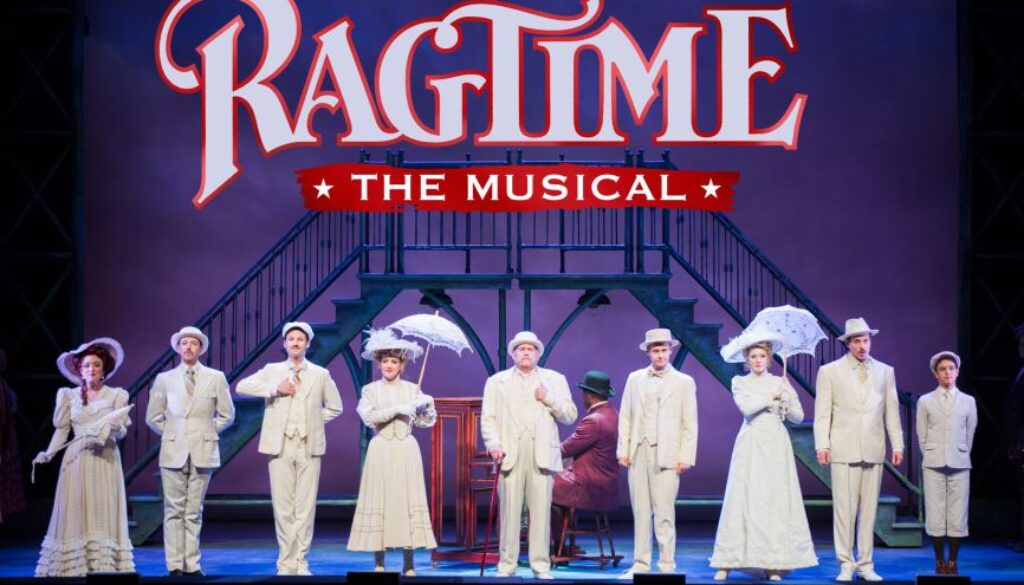
The 2025 Broadway revival is the second in the show’s history, and its timeliness — in the context of ongoing American debates about race, justice, and whose dreams the nation is prepared to protect — has been widely noted by critics and audiences. Director Lear deBessonet’s production, which transferred from the New York City Center to the Vivian Beaumont after its 2024 concert staging, features scenic design by David Korins, costume design by Linda Cho, lighting design by Adam Honoré, and sound design by Kai Harada. The cast alongside Henry includes Caissie Levy as Mother, Brandon Uranowitz as Tateh, Nichelle Lewis as Sarah, Ben Levi Ross as Mother’s Younger Brother, Shaina Taub as Emma Goldman, and Colin Donnell as Father. The production opened 16 October 2025 at the Vivian Beaumont Theater, after previews beginning 26 September 2025.
The show received eleven Tony Award nominations — the third highest total of any production this season — including Best Musical Revival, Best Actor (Henry), Best Actress (Levy and Lewis sharing the category attention), Best Featured Actor (Uranowitz), Best Score, and multiple design nominations.
Henry as Coalhouse: The Performance and What It Means
What Joshua Henry brings to Coalhouse Walker Jr. is, in the simplest terms, everything. His extraordinary baritenor voice — which spans from the warmth of a baritone’s lower register to the soaring power of a tenor’s upper notes — gives the role a musical authority that the score demands. His personal history of engaging seriously and courageously with roles that explore Black male dignity and the specific indignities that America has visited upon it — from Haywood Patterson to Billy Bigelow — gives him a depth of preparation and a quality of lived artistic knowledge that makes his Coalhouse feel not merely performed but inhabited.
In his Broadway.com interview, Henry spoke about how fatherhood had transformed his relationship to the role. Coalhouse Walker Jr. is, at his core, a man trying to create a life, a family, and a future — and his radicalization comes not from abstract political ideology but from the destruction of something specific and personal. “Having a dream, having kids, having a life that’s separate from the theater — a place where I go to get love and acceptance and belonging — has made a big difference in the way that I play Coalhouse,” Henry said. “He goes to some incredibly joyous places and some incredibly dark places.” The ability to inhabit both, simultaneously and in sequence, without sentimentalising either, is the achievement at the heart of the performance.
His “Make Them Hear You” — Coalhouse’s final song, sung as he surrenders to the authorities who will kill him — has become the emotional centrepiece of the production and the moment that has most consistently moved audiences to tears. The New York Theater review described him as “the Baritenor of Broadway” delivering “a shattering ‘Make them hear you'” — shattering being the precisely right word for what the performance does to an audience: it breaks through the distance that theatrical spectatorship creates and confronts the listener with something that cannot be looked away from or rationalised into comfort.
He earned standing ovations mid-show at multiple performances — a genuinely rare occurrence, reserved for moments of theatrical achievement so complete that the audience cannot contain its response. Man in Chair’s review described him as “a lock to win Best Actor at the 2026 Tony Awards before the season even opened,” noting that he “earned two mid-show standing ovations” and that “this is a performance that will be remembered for many years to come.”
What the Critics Said: Review Roundup
Tony Nominated: Best Actor in a Leading Role in a Musical — Fourth Career Nomination
Joshua Henry’s fourth Tony nomination — for his performance as Coalhouse Walker Jr. in Ragtime — arrives alongside the Drama League Award for Distinguished Performance and widespread critical consensus that this is the performance of his career and possibly the performance of the season. He is the pre-ceremony favourite in the category.
Full Best Actor in a Musical category nominees:
- Nicholas Christopher — Chess
- Luke Evans — Richard O’Brien’s The Rocky Horror Show
- Joshua Henry — Ragtime
- Sam Tutty — Two Strangers (Carry a Cake Across New York)
- Brandon Uranowitz — Ragtime
The Complete Tony Award Record: Four Nominations
| # | Year | Category | Production / Role | Result |
|---|---|---|---|---|
| 1 | 2011 | Best Actor in a Leading Role in a Musical | The Scottsboro Boys (Haywood Patterson) | Nominated |
| 2 | 2014 | Best Featured Actor in a Musical | Violet (Flick) | Nominated |
| 3 | 2018 | Best Actor in a Leading Role in a Musical | Carousel (Billy Bigelow) | Nominated |
| 4 ★ | 2026 | Best Actor in a Leading Role in a Musical | Ragtime (Coalhouse Walker Jr.) — DREAM ROLE | Nominated (Pre-Ceremony Favourite) |
A Career in Full: Selected Broadway Credits
The accidental revelation of his vocation. Cast as the con-man-with-a-heart Harold Hill, Henry discovers that performance is what he was born to do. The accountancy plans are abandoned permanently.
Graduates from the University of Miami with a theatre degree, having developed the vocal range and dramatic instincts that will characterise a career of extraordinary consistency.
Joins the ensemble of Lin-Manuel Miranda’s landmark musical as an ensemble member. Wins the Drama Desk Award for Outstanding Featured Actor. The show wins the Tony for Best Musical in 2008. His first encounter with the Broadway community’s full attention.
First Tony nomination (Best Actor in a Leading Role in a Musical) as Haywood Patterson in Kander and Ebb’s final musical, directed by Susan Stroman. The NYT praises his “performance of blazing intensity.” The show closes early but its reputation grows continuously.
Plays Jake in the American Repertory Theater production that transfers to Broadway. Works with director Diane Paulus in one of the season’s most discussed and debated productions.
Second Tony nomination (Best Featured Actor in a Musical) as Flick in Jeanine Tesori and Brian Crawley’s moving musical. Drama Desk, Outer Critics Circle, and Drama League nominations. One of the most praised performances of the season.
Plays Noble Sissle — one half of the partnership that created the original 1921 Shuffle Along — in George C. Wolfe’s ambitious revival. The show closes early despite enthusiastic notices, another case of exceptional work in a production whose commercial reception didn’t match its artistic ambition.
Stars as Aaron Burr in the Chicago production from September 2016, then takes the role on the first US national tour. Having helped create workshop roles for the show in 2013, his Burr represents a deep engagement with Miranda’s vision of the founding era’s morality and ambition.
Third Tony nomination (Best Actor in a Leading Role in a Musical) as Billy Bigelow in Jack O’Brien’s revival. Drama League Award win. Drama Desk Award win. Outer Critics Circle nomination. The most complex and morally demanding of his pre-Ragtime roles.
Plays Rapunzel’s Prince in Lear deBessonet’s Broadway revival of Into the Woods — the partnership that would lead directly to Ragtime. Plays Dr. Pomatter in the Waitress national tour. Stars in Tick Tick Boom! (Lin-Manuel Miranda’s film). Plays Gaston in Disney’s Beauty and the Beast 30th Anniversary special on ABC.
Plays Coalhouse Walker Jr. for the first time in Lear deBessonet’s New York City Center concert production. The response is so overwhelming that a full Broadway revival becomes immediately planned.
Stars as Coalhouse Walker Jr. in Lincoln Center Theater’s Broadway revival. Eleven Tony nominations for the production. Drama League Award for Distinguished Performance. Tony nomination (fourth career) for Best Actor in a Leading Role in a Musical. Production extended twice — now running through 2 August 2026.
Make Them Hear You: What Joshua Henry’s Career Teaches Broadway
The title of Coalhouse Walker Jr.’s final song is also, in a sense, the animating principle of Joshua Henry’s entire career. “Make Them Hear You” is a plea, a demand, and a promise: that the suffering and the dreams of people who have been marginalised, dismissed, and destroyed by a system built to exclude them must be carried forward — through art, through memory, through the voices that refuse to stop. Henry has spent fifteen years on Broadway, playing precisely the characters whose voices most needed carrying: Haywood Patterson, wrongly imprisoned and defiant; Flick, a Black veteran whose dignity is his only weapon; Billy Bigelow, whose violence and love are inseparable from his helplessness; and now Coalhouse Walker, the ragtime pianist whose refusal to accept injustice leads him toward a kind of heroism that the world of 2026 recognises with painful familiarity.
That he has done this with four Tony nominations, a Grammy Award, a Drama League win, a Drama Desk win, and a voice that the New York Theater calls “shattering” — all while raising three children in Harlem and remembering, as he told Broadway.com, to play up to the young person in the top seat who came from somewhere like where he came from — is one of the great stories of contemporary American musical theatre.
The Tony ceremony on 7 June 2026 will tell us whether the nominators’ preference matches the critical consensus. But whatever the result, this is the performance Joshua Henry was born to give. He just had to grow into it.
One can question whether “Ragtime” will be considered one of the great American musicals and still feel grateful to have been able to witness Joshua Henry, the Baritenor of Broadway, deliver a shattering “Make them hear you.”
New York Theater, review of Ragtime, October 2025
Links
La Cage Aux Follies – Memorabilia
Chess the Musical – Memorabilia
Little Shop of Horrors – Memorabilia
Starlight Express – Memorabilia
Dear Evan Hansen – Memorabilia
How to Succeed in Business Without Really Trying – Memorabilia
Terrence McNally – Memorabilia